
Marble-Sized Hail Hit Lake Mary on May 12 — What Homeowners in Heathrow, Timacuan, and The Crossings Need to Know
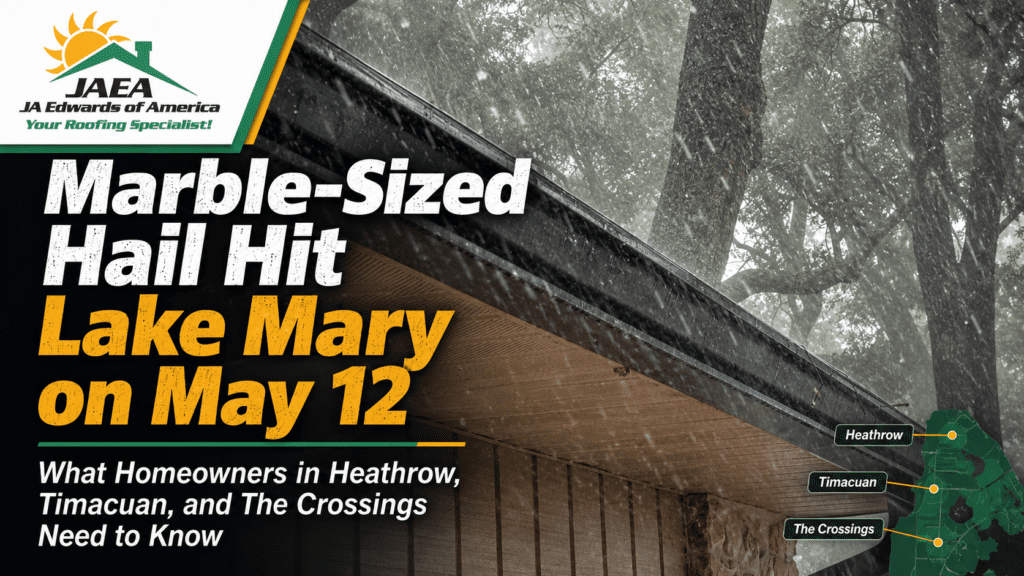
Lake Mary was not on the edge of the May 12 storm. It was directly in its path.
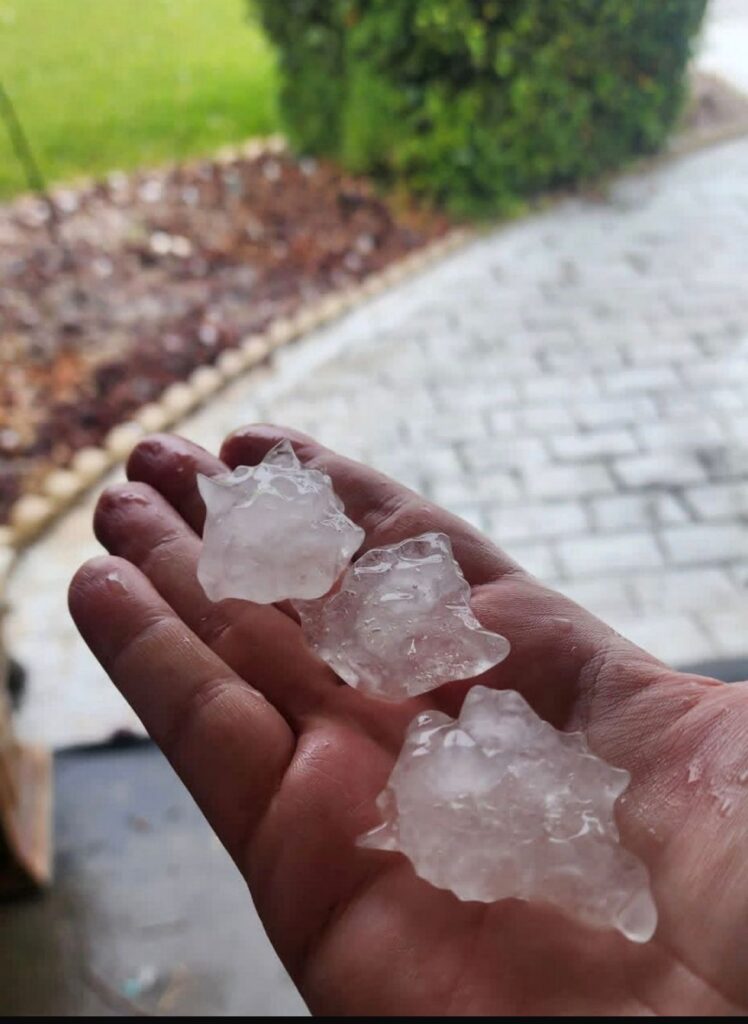
According to FOX 35 Orlando, the severe storm that moved through Seminole and Orange counties on May 12 hit Lake Mary and Oviedo especially hard, bringing heavy rain, marble-sized hail, and the potential for wind gusts between 40 and 50 MPH. This was a confirmed, documented event, not an isolated cell that passed through quickly. The storm tracked slowly at 10 MPH, meaning Lake Mary sat under it long enough to accumulate real impact on roofs across the area.
If you live in Heathrow, Timacuan, The Crossings, Alaqua Lakes, or anywhere in the Lake Mary area, the inspection window that matters most for your insurance claim is open right now. This post explains what marble-sized hail does to the roofs in this area specifically, what you should look for, and how to protect your home and your claim before that window starts to close.
Why Lake Mary Roofs Face a Specific Risk After This Storm
Lake Mary is not a typical Central Florida suburb in terms of housing stock. The communities along the Markham Woods corridor, Heathrow’s sub-neighborhoods, Timacuan’s golf-front homes, and the larger planned communities throughout the city represent a significantly higher average home value than most of the surrounding area. The average home price in Lake Mary runs around $600,000. In communities like Heathrow Woods, custom estates sit on one to two-acre lots with values well into seven figures.
That matters for two reasons when it comes to hail damage.
First, the roofs on these homes are more expensive to repair and replace correctly. A tile roof on a $700,000 custom home in Heathrow Woods requires a contractor with the right credentials, experience, and material access to do the job to manufacturer spec. Cutting corners on a repair of that magnitude creates liability for the homeowner, voids manufacturer warranties, and can affect the home’s insurability going forward.
Second, high-value homes face more aggressive scrutiny from insurance companies during the claims process. The larger the potential payout, the more carefully an adjuster reviews the documentation. A professional inspection report that accurately documents hail and wind damage from the May 12 event is the foundation of a claim that holds up.
Many homes in Lake Mary were also built during the late 1980s and 1990s, when most of the large planned communities in the area were developed. Heathrow, a master-planned gated community covering 1,800 acres and over 1,900 homes, was largely built during this era. Timacuan, a 400-acre golf community with 490 homes on Rinehart Road, began on farmland in the 1980s and is now completely built out. Roofs in this age range are at the point where they still have life remaining but are most vulnerable to hail impact and wind seal failure. A severe storm at this stage does not just create surface damage. It accelerates the end of the roof’s serviceable life in ways that do not show up for months.
What Marble-Sized Hail Does to Tile Roofs
A significant portion of homes in Lake Mary’s higher-end communities are covered in concrete or clay tile rather than asphalt shingles. Tile roofs are generally more durable than asphalt under normal conditions, but they respond to hail impact differently, and the damage pattern requires a different inspection approach.
When marble-sized hail hits a tile roof, the tile itself can crack without displacing. The crack is often hairline-thin, invisible from the ground, and invisible even from a few feet away without close inspection. Water does not leak through immediately. It takes a rainstorm at the right angle, a heavy downpour that overwhelms the underlayment beneath the cracked tile, or the slow accumulation of moisture cycling through the crack during Florida’s humidity swings.
By the time a tile roof leak becomes visible inside the home, the water has already been working through the underlayment for a while. The repair at that stage is more extensive, more expensive, and harder to tie cleanly to the May 12 storm event for insurance purposes.
The underlayment beneath the tile is the second layer of risk. Florida building codes have evolved significantly around underlayment requirements over the past two decades, and homes built in the 1990s may have underlayment that was code-compliant at the time but is now at or past the end of its expected service life. A hail event does not just damage the tile. It can accelerate degradation in underlayment that was already aging. An experienced inspector accounts for both.
Wind at 40 to 50 MPH introduces a separate concern for tile roofs: ridge caps. The capping tiles that run along the peaks and hips of the roof are the most exposed to wind uplift. If the mortar or adhesive holding them in place has aged, wind at those speeds can displace ridge cap tiles entirely or crack them at the base. A missing or compromised ridge cap is a direct water entry point at the highest and most exposed part of the roof.
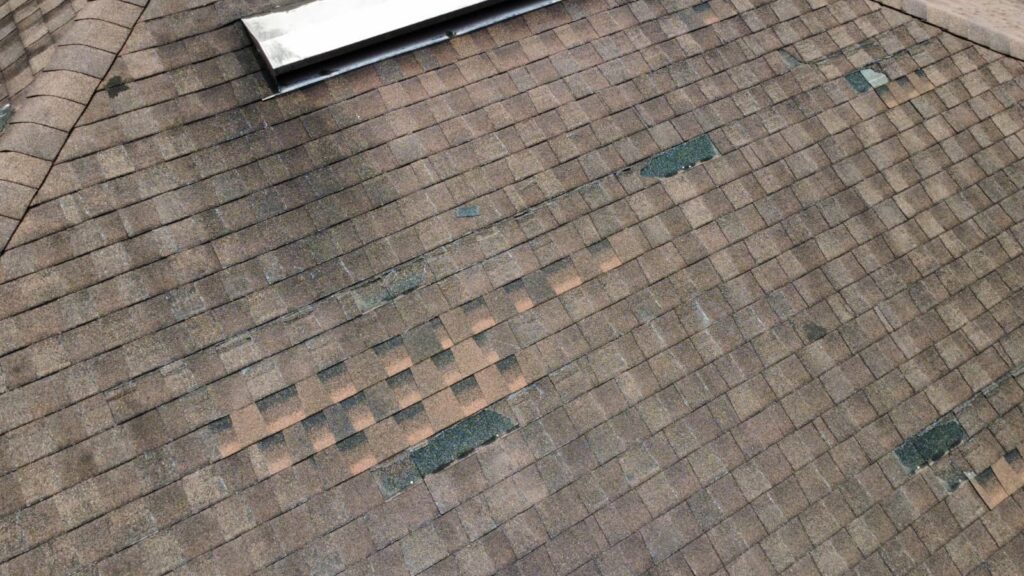
For homes with asphalt shingles, the dynamics are the same as described in the Oviedo and Daytona posts. Marble-sized hail is above the threshold where granule displacement is accompanied by fiberglass mat bruising. The shingles look intact. The internal structure has been compromised.
What to Look for Around Your Home Right Now
You do not need professional equipment to gather useful documentation before the inspector arrives. A ground-level walkthrough done in the next day or two captures evidence that is most valuable while it is clearly tied to the May 12 storm.
Walk the full perimeter of your home and check gutters and downspouts first. Dented gutters are among the most reliable ground-level indicators of significant hail impact. The aluminum is soft enough to show clear impact marks from marble-sized hail, and those marks are visible without getting near the roofline. If your gutters are dented, your roof took a direct hit. That is not a worst-case scenario to consider. It is the starting assumption.
Check around the base of your downspouts for granule accumulation. If you have asphalt shingles, the volume of granules washing off after a hail event is meaningfully higher than what accumulates under normal conditions. A visible dark gritty deposit that was not there before the storm is concrete documentation.
Look at any exposed soft metal surfaces around your home: vents, HVAC unit covers, aluminum fascia, pipe boots on the roof edge if visible from the ground. Impact marks on these surfaces confirm hail contact across your property and are typically photographed as part of a professional inspection report because they are objectively documentable.
If you have a tile roof and feel comfortable doing a visual scan with binoculars from the driveway or backyard, look at ridge cap tiles and hip caps. Any displaced, cracked, or missing cap tiles are visible with magnification and should be photographed immediately.
Take date-stamped photos and video of everything you observe. The documentation you create in the next 48 hours is something no one can recreate later.
How the HOA Factor Affects Your Claim
Many of Lake Mary’s communities are HOA-governed, and in some cases the HOA’s governing documents affect how roof repairs and replacements are handled. This is worth understanding before you open an insurance claim.
In most single-family home communities, the homeowner’s insurance policy covers the roof, and the homeowner manages the repair process independently of the HOA. The HOA may have architectural review requirements for materials and colors but is not a party to the insurance claim.
In townhome communities and some condominium-style developments, the HOA master policy may cover certain structural elements including the roof. Understanding which policy applies, yours or the master policy, before you begin the claims process saves you from filing under the wrong coverage and potentially affecting your future premiums unnecessarily.
If you are in a townhome community in Lake Mary and are not certain which insurance covers your roof, call your HOA management company and ask specifically: “Is the roof on my unit covered under the master policy or my individual policy?” Get the answer in writing before you proceed.
This is a question worth asking now, not after the adjuster has already been out.
The Inspection Process for High-Value Homes
When JAEA inspects a roof on a high-value home in Lake Mary, the process is more thorough than a standard post-storm check. The documentation requirements for a claim on a $600,000 to $1M+ property are higher, and the inspection reflects that.
For tile roofs, the inspector checks every plane systematically, including ridge caps and hip caps, all penetrations and transitions, the flashing at walls and dormers, and representative tile sections across each roof plane. Cracked tiles are documented individually with GPS-tagged photos. The underlayment condition at any accessible edge or penetration is noted. If evidence suggests underlayment damage beyond what is accessible, that observation is included in the report as requiring further investigation.
For asphalt shingle roofs, the test square method produces an objective impact count per area that is difficult for an adjuster to challenge. The report includes the number of impacts per measured section, the pattern of granule displacement across each plane, and the condition of all soft metal surfaces.
In both cases, you receive a written inspection report that is specifically tied to the May 12, 2026 storm event and is structured to hold up in the insurance claims process.
JAEA holds a GAF Master Elite + President’s Club 3-Star certification, one of fewer than three roofing contractors in the entire state of Florida to carry this designation. That credential matters when your claim involves a high-value roof, because the inspector’s credibility and the contractor’s qualifications are part of what the insurance company evaluates.
Communities in Lake Mary That Should Schedule Inspections
The May 12 storm’s direct path through Lake Mary and Oviedo means the following communities were in the impact zone:
Heathrow and Heathrow Woods sit in the northwest quadrant of Lake Mary and were directly exposed to the storm. Heathrow is a master-planned gated community covering 1,800 acres with over 1,900 homes in smaller sub-neighborhoods. Homeowners in any Heathrow sub-neighborhood, including Coventry at Heathrow, Barclay Place, Grande Oaks, and Savannah Park, should schedule inspections.
Timacuan on Rinehart Road is a 400-acre golf community with homes ranging from production-built to custom. The large lot sizes and tree canopy in Timacuan mean wind-driven debris is an additional factor beyond hail impact on roofs throughout the community.
Alaqua Lakes on Markham Woods Road is one of the area’s higher-value communities, with custom homes and significant landscape. Any home in the Markham Woods corridor was in the storm’s path.
The Crossings is a large planned community with over 1,250 homes, representing a wide range of roof ages and types. If your home in The Crossings was built in the 1990s, it is now in a critical age range for post-storm inspection.
Woodbridge Lakes, Tuscany at Lake Mary, Fountain Parke, and Griffin Park were all in the affected area and should have their roofs checked.
Longwood and Sanford, immediately adjacent to Lake Mary, were in the same storm system and are within JAEA’s service area from Orlando.
What to Do Before You Call Your Insurance Company
The single most valuable thing you can do before opening a claim is to get JAEA’s inspection report in hand. When the insurance company’s adjuster arrives, you want to already have independent documentation of the damage from the May 12 event. That documentation is what anchors your claim.
Open the claim promptly. Florida Statute 627.70132 governs notice requirements for storm damage claims. Delays in reporting give insurers room to argue the damage was not caused by the documented storm. Acting quickly after a confirmed weather event protects that connection.
If you receive a settlement offer that seems low, do not accept it without having your inspection report reviewed by someone who understands what the repair or replacement actually costs in the current Lake Mary market. Tile roof replacement on a high-value home in Seminole County has a specific cost structure, and adjuster estimates that are based on generic regional averages often do not reflect it.
If your claim is denied or disputed, the Florida Department of Financial Services provides consumer support for insurance disputes, and the Florida Office of Insurance Regulation has resources on your rights as a policyholder.
About JA Edwards of America

JA Edwards of America has been serving Central Florida homeowners since 2004. We hold a GAF Master Elite + President’s Club 3-Star certification, licensed under CGC1534283 and CCC1334804, and carry a BBB A+ rating. Our Orlando team covers all of Seminole County, including Lake Mary, and can schedule post-storm inspections within 24 to 48 hours.
If the May 12 storm affected your home in Lake Mary, Heathrow, Timacuan, or anywhere in Seminole County, call (407) 677-7663 or visit jaeofamerica.com to schedule your free inspection.
Frequently Asked Questions
What specific areas of Lake Mary were hit by the May 12 hail storm?
According to FOX 35 Orlando, Lake Mary was one of the areas most directly affected by the May 12 storm, with marble-sized hail confirmed in the Lake Mary area. The storm moved through Seminole and Orange counties at 10 MPH, meaning communities throughout Lake Mary, including Heathrow, Timacuan, Alaqua Lakes, The Crossings, and Woodbridge Lakes, were in the impact zone long enough to accumulate meaningful damage.
My home has a tile roof. Does hail damage it the same way it damages shingles?
No, but the damage can be just as significant. Hail on a tile roof tends to crack tiles without displacing them. The crack is often invisible from the ground and does not produce an immediate leak. Over time, water cycles through the crack during rain events and begins degrading the underlayment beneath the tile. By the time a leak appears inside the home, the underlying damage is already more extensive than the surface evidence suggests. A professional inspection shortly after the storm is the only reliable way to document tile cracks before they produce interior damage.
Is there a free inspection available for Lake Mary homeowners after the May 12 storm?
Yes. JA Edwards of America offers free post-storm roof inspections for homeowners throughout Seminole County, including Lake Mary, Heathrow, Timacuan, Sanford, and Longwood. There is no fee and no obligation to proceed with repairs or replacement after the inspection. Call (407) 677-7663 to schedule.
Does my HOA’s insurance cover my roof, or does my individual policy?
It depends on your community type and your HOA’s governing documents. In most single-family home communities in Lake Mary, your individual homeowners policy covers the roof. In townhome and some condominium communities, the HOA master policy may cover the roof structure. Contact your HOA management company directly and ask in writing which policy covers your roof before opening a claim.
How long do I have to file a storm damage claim after the May 12 event?
Florida Statute 627.70132 sets timelines for storm damage claim filings, but more important than the legal deadline is the practical reality: the sooner you act after a documented storm event, the stronger the connection between the damage and that specific event. Waiting weeks or months gives insurance companies room to argue pre-existing wear. Get the inspection done now and file promptly.
What makes JAEA qualified to inspect high-value homes in Lake Mary?
JA Edwards of America holds a GAF Master Elite + President’s Club 3-Star certification, which fewer than three roofing contractors in the entire state of Florida carry. The company has been operating in Central Florida since 2004, holds active licenses under CGC1534283 and CCC1334804, and has a BBB A+ rating. Our project managers are experienced with both tile and asphalt shingle inspections and with the Florida insurance claims process specifically.
What neighborhoods in Lake Mary does JA Edwards of America serve?
JAEA serves all of Lake Mary and Seminole County from its Orlando operations. This includes Heathrow, Heathrow Woods, Timacuan, Alaqua Lakes, The Crossings, Woodbridge Lakes, Fountain Parke, Tuscany at Lake Mary, Griffin Park, Markham Woods, and surrounding communities in Longwood and Sanford. Post-storm inspections can typically be scheduled within 24 to 48 hours of a call.
JA Edwards of America — Licensed Florida Roofing Contractor. CGC1534283 | CCC1334804. GAF Master Elite + President’s Club 3-Star. Serving Lake Mary, Seminole County, and all of Central Florida. Call (407) 677-7663.