Emergency Roof Repair in Jacksonville, FL: What to Do After a Storm
A storm just hit and your ceiling has a water stain that wasn’t there yesterday. Or there’s a shingle on your driveway that used to be on your roof. You’re not sure how bad it is, but you know something is wrong and you need to figure out what to do next without making it worse.
Jacksonville gets hit from multiple directions. The Atlantic coast brings nor’easters that can drive water sideways into flashing seams and ridge caps. Named storms track up from the south and stall over the St. Johns River basin for hours. Afternoon thunderstorms in June through September pack wind gusts that regularly top 50 mph. And a lot of the housing stock here, especially in neighborhoods like Ortega, Murray Hill, San Marco, and Arlington, was built in the 1960s through the 1980s with roofing systems that were never designed to handle 40 more years of Florida weather on top of what they’ve already seen.
When damage happens, the next few hours matter more than most homeowners realize.
The Window Between Storm and Water Damage
The single most expensive mistake Jacksonville homeowners make after roof damage is waiting too long to respond. A missing shingle or a cracked section of flashing doesn’t look like a crisis from the ground. But once water finds a path in, it follows the structure of the house wherever gravity takes it, and drywall, insulation, wood framing, and subfloor don’t recover the same way roofing materials do.
Mold can start growing in as little as 24 to 48 hours in Jacksonville’s humidity. According to the EPA’s guide on mold and moisture control, stopping moisture intrusion quickly is the most critical factor in prevention. A repair that costs $800 if you act the same day can turn into a $6,000 claim if interior damage is added to the scope two weeks later.
This isn’t meant to panic you. It’s just the reality of what water does inside a house in a humid subtropical climate, and knowing it upfront gives you a better frame for how fast to move.
Step 1: Don’t Go on the Roof Yourself
This sounds obvious, but every year Jacksonville homeowners injure themselves trying to assess storm damage on a wet, debris-covered roof surface. The inspection can wait until a professional arrives. What you can do safely from the ground:
Walk the perimeter of your house and look for missing shingles, displaced flashing, visible holes, or debris that’s clearly embedded in the roof surface. Take photos from ground level with your phone. Check your attic if it’s accessible from inside. Bring a flashlight and look for daylight coming through the decking, water stains on the insulation or joists, or wet spots that weren’t there before the storm.
That’s the full scope of your DIY assessment. The rest belongs to a trained inspector. Our Jacksonville storm damage repair team handles inspections after every type of weather event common to the area, from nor’easters to named storms.
Step 2: Protect the Interior Right Now
If you can see or hear water actively coming in, there are a few things you can do inside the house before anyone gets on the roof.
Move furniture and valuables out of any room where water is dripping or pooling. Put buckets under active drips. If you have a roll of plastic sheeting or a tarp in the garage, you can lay it over flooring or furniture that’s at risk of secondary damage.
From outside, if you have a large tarp and can safely secure it over an obvious breach without going above the first floor, that’s worth doing. Anything requiring a ladder or climbing onto the structure should wait for a professional crew with the right safety equipment.
Step 3: Call a Licensed Jacksonville Roofing Contractor
Not a handyman. Not a general contractor who does roofing on the side. A licensed roofing contractor who knows the Jacksonville market, understands Duval County permit requirements, and carries the insurance to work on your property.
Here’s why that distinction matters: after any significant storm in Jacksonville, you will see trucks in your neighborhood with out-of-state plates and no local office. These are storm chasers. They follow FEMA disaster declarations, collect deposits, and often disappear before the work is done or leave behind installation that fails within a year. They have no local license, no local address, and no accountability once they leave town.
A Jacksonville-based contractor has a physical office here, a local license number you can verify through the Florida Department of Business and Professional Regulation, and a reputation tied to this specific market. When you call them in six months because a repair isn’t holding, they answer.
When you’re evaluating who to call, ask three things: What’s your Florida license number? Do you have a local Jacksonville address? Can you send me a copy of your liability insurance? Any legitimate contractor answers all three without hesitation.
JA Edwards of America operates out of 4570 St. Johns Ave, Suite A, Jacksonville, FL 32210. Our license numbers are CGC1534283 and CCC1334804. We’re a GAF Master Elite certified contractor and have been in Florida since 2004 with a local Jacksonville crew.
Step 4: Document Everything Before Repairs Start
This is the step that most homeowners skip, and it can directly affect how much their insurance claim pays out.
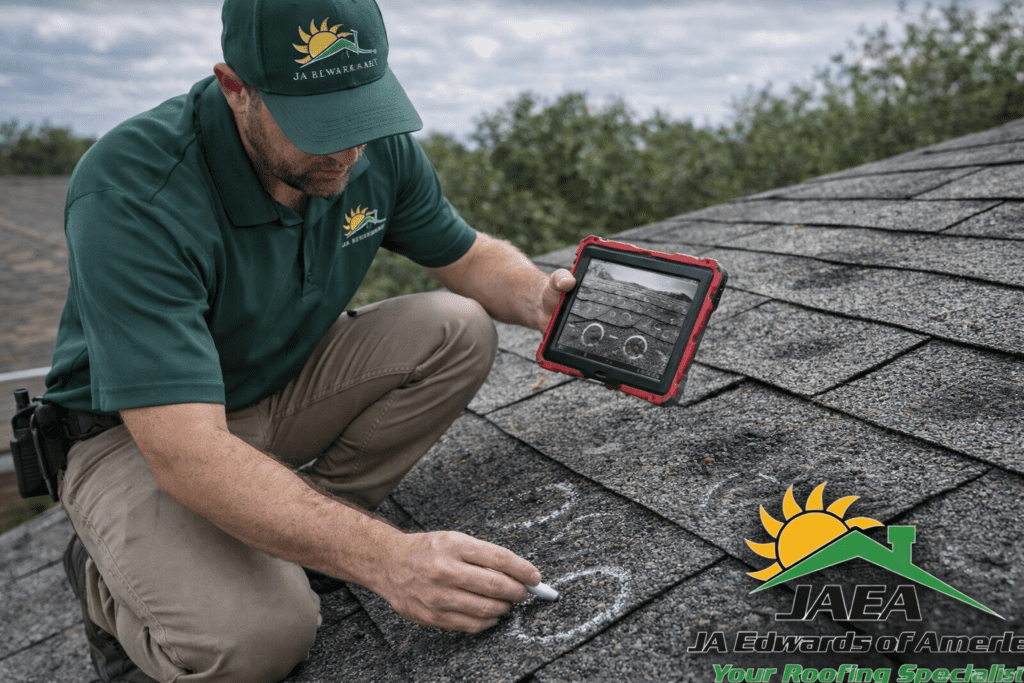
Before any contractor starts work, take photos and video of every piece of visible damage. Include wide shots that show the overall area and close-ups that show the specific points of failure. If shingles are missing, photograph the section and the exposed decking underneath. If there’s interior damage, photograph that too with time stamps on.
Save any shingles or roofing material you find in the yard. They can be used to match replacement materials and, in some cases, they can support your claim by showing physical evidence of wind damage.
Write down the date and time the storm occurred, what you observed during and after, and when you first noticed the damage. This timeline becomes part of your insurance documentation and it’s much easier to establish accurately in the first 24 hours than to reconstruct two weeks later.
If you want a more complete walkthrough of the documentation process, read our guide on how to document storm damage for insurance in Jacksonville-FL. The steps are the same regardless of city.
Emergency Tarping: What It Is and When You Need It
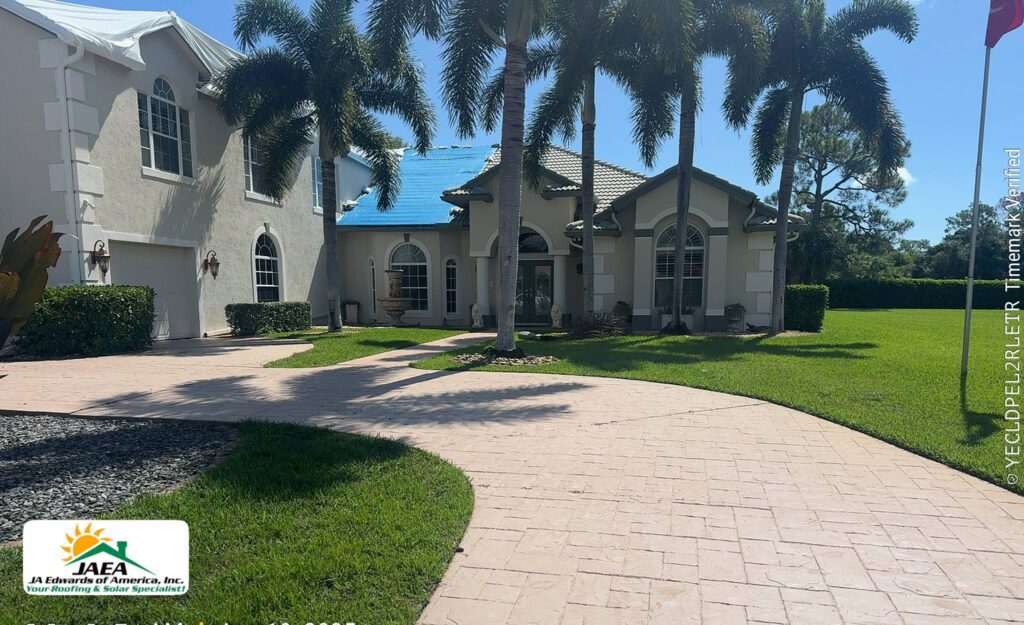
If your roof has a significant breach and rain is expected again before a full repair can be scheduled, a professional crew can install an emergency tarp that covers the exposed area and prevents additional water intrusion.
This is a temporary measure, not a repair. But it’s an important one. Emergency tarps are installed with anchor points that don’t further damage the roof and cover enough area to protect against typical Florida rain events.
Some insurance policies cover emergency tarping as a separate line item. Others treat it as part of the overall repair scope. The Florida Department of Financial Services has plain-language guidance on what standard homeowners policies cover that’s worth reviewing before you call your insurer.
JA Edwards of America provides emergency response in Jacksonville typically within 24 hours of a storm event. Call (904) 367-2913 if your roof has active exposure or you’re expecting more rain.
Understanding the Jacksonville Insurance Claim Process
Jacksonville is in Duval County, and Florida’s insurance market here has been through significant changes over the past several years. Several carriers have reduced their exposure in Northeast Florida following back-to-back storm seasons, which means some homeowners are now on Citizens Property Insurance or with smaller regional carriers whose claim processes differ from the major national insurers.
Regardless of who your carrier is, the core process is the same. You report the claim, they assign an adjuster, the adjuster schedules an inspection, and the adjuster’s report determines the initial claim amount. What most homeowners don’t know is that the adjuster’s initial offer is not a final number. If the scope of damage is more extensive than what the adjuster documented, or if material and labor costs have changed since the report was written, a licensed contractor can submit a supplemental claim with additional documentation.
This is one of the most concrete ways a good roofing contractor advocates for you beyond just installing the roof. Our Jacksonville PMs are trained to document damage using the same language and measurement standards adjusters use, which makes it significantly harder for claims to be underpaid. You can read more about how we handle the full process on our Jacksonville storm damage repair page.
Common Types of Emergency Roof Damage in Jacksonville
Wind damage from nor’easters. Jacksonville’s Atlantic exposure means nor’easters hit with sustained winds that can last 12 to 24 hours, long enough to work shingles loose even when individual gusts aren’t headline-worthy. This type of damage often shows up as lifted shingles with cracked seals rather than outright missing sections.
Falling trees and branches. The older tree canopy in neighborhoods like Avondale, Riverside, and Mandarin is part of what makes those areas beautiful and part of what makes them vulnerable. A single large live oak branch can puncture decking, damage flashing, and dislodge dozens of surrounding shingles.
Hurricane wind uplift. Named storms that track up the Florida peninsula bring the highest single-event risk. Wind uplift can strip entire sections of roofing, particularly on older homes where the adhesive strips on shingles have degraded over time. The National Hurricane Center tracks active storms and is worth bookmarking during hurricane season.
Flashing failure after heavy rain. Jacksonville’s tropical storms deliver rain horizontally in sustained bursts. Flashing around chimneys, skylights, and pipe penetrations is often the first thing to fail, and the resulting leak can look like it’s coming from somewhere completely different inside the house by the time you find it.
What Happens When You Call JA Edwards of America in Jacksonville
When you call us after a storm, here’s what actually happens: we schedule an inspection as quickly as crew capacity allows, typically same-day or next-day for active emergencies. The project manager comes out, assesses the roof thoroughly, documents everything in detail, and walks you through what they found before leaving. If emergency tarping is needed, the crew handles that on the same visit or the next morning.
If insurance is involved, we work directly with your adjuster and handle the documentation. If it’s a retail repair, we give you a clear scope of work with pricing before anything starts. No deposits collected before the work is scheduled. No vague estimates that balloon later.
The one thing we ask is that you don’t sign any assignment of benefits with any contractor before understanding what you’re signing. In Florida, an AOB transfers your insurance claim rights to the contractor. Florida law has significantly restricted AOB agreements since 2019, and JA Edwards of America does not use them.
After the Repair: What to Watch For
Once your emergency repair is complete, there are a few things worth monitoring in the weeks that follow.
Check your attic after the next significant rain. Any residual moisture in the insulation or on the joists should dry out within a few days in Jacksonville’s warm climate. If you’re still seeing wet spots after two rain events, call your contractor to re-inspect.
If interior drywall was affected by water intrusion, have it assessed before painting over it. Water-damaged drywall that isn’t fully dried can harbor mold inside the wall cavity even when the surface looks fine.
Keep a copy of all repair documentation, including the contractor’s scope of work, the invoice, and any insurance correspondence. If you sell the house in the next few years, a documented roof repair from a licensed contractor with warranty information is a real asset in the transaction.
Frequently Asked Questions
How fast can a roofing contractor respond to an emergency in Jacksonville, FL? A local roofing contractor with Jacksonville crews can typically respond within 24 hours for active emergencies. For major storm events when multiple properties are affected simultaneously, response time may extend to 48 to 72 hours. Emergency tarping is usually the fastest service to deploy.
Does homeowners insurance cover emergency roof repair in Jacksonville? Most standard homeowners insurance policies in Florida cover sudden and accidental damage from storms, including wind and hail. Emergency tarping is often covered as part of the loss mitigation clause. Water damage to the interior that results from the roof breach is typically covered as well. Gradual damage from wear and maintenance neglect is generally not covered.
What’s the difference between an emergency repair and a full roof replacement? An emergency repair addresses the specific breach or damaged area to stop water intrusion. It may or may not be a permanent solution depending on the age and overall condition of the roof. A full replacement is appropriate when the roof is at end of life, when damage covers a significant portion of the surface, or when an insurance claim covers the full scope. See our Jacksonville metal roofing page and tile roofing page if you’re considering a more durable material after storm damage.
Can I tarp my own roof after a storm in Jacksonville? You can place a tarp from the ground level or over low-slope sections you can safely access without climbing. Tarping that requires ladder work or walking on the roof surface should be handled by a professional crew with fall protection equipment. The risk of injury on a wet or debris-covered roof is significant.
What should I ask a Jacksonville roofing contractor before letting them start work? Ask for their Florida license number and verify it at myfloridalicense.com. Ask for a certificate of liability insurance naming your address. Ask for a written scope of work with itemized pricing before signing anything. Any contractor who can’t provide all three immediately isn’t someone you want on your roof.
How long does an emergency roof repair take in Jacksonville? A targeted emergency repair for a section of missing shingles or flashing damage typically takes a few hours. Larger repairs involving damaged decking, significant shingle area, or structural elements can take one to two days. Emergency tarping can often be done in under an hour.
What’s a storm chaser and how do I spot one in my Jacksonville neighborhood? Storm chasers are out-of-state roofing contractors who follow disaster declarations and work neighborhoods that just experienced weather events. Signs include out-of-state license plates, no local physical address, pressure to sign paperwork on the same day as the door knock, and requests for large upfront deposits. A legitimate Jacksonville contractor has a local office, local license, and no urgency around getting your signature before you’ve had time to verify their credentials.
JA Edwards of America serves Jacksonville, FL and surrounding areas including Orange Park, Fleming Island, Ponte Vedra, Mandarin, and Southside. Licensed General Contractor CGC1534283 | Certified Roofing Contractor CCC1334804 | GAF Master Elite | BBB A+. Call our Jacksonville office at (904) 367-2913 for emergency roof repair service.