
What Does a Professional Roof Inspection Cover in Jacksonville, FL?
A thorough roof inspection in Jacksonville should look at more than the shingles. It typically includes the roof covering, flashing, penetrations, valleys, roof edges, gutters and drainage, soffit and fascia, visible signs of deck damage, storm damage, ventilation, and the attic or interior where it can be accessed safely. The useful part is the documentation: you should leave with photos, findings, and a clear explanation of what needs attention now, what can be monitored, and whether repair or replacement is actually justified.
Most homeowners do not wake up on a Saturday excited to inspect flashing, pipe boots, and attic decking. Roof inspections usually enter the conversation because something changed: a storm came through, a ceiling stain appeared, a few shingles ended up in the yard, an insurance company requested documentation, or a home sale suddenly made the roof everyone's favorite topic.
The mistake is treating a roof inspection like a five-minute look from the driveway.
A good inspection is a condition assessment of the roofing system, not just the visible roof covering. On a Jacksonville home, that means looking at how shingles or tile, flashing, drainage, roof edges, attic ventilation, penetrations, and signs of moisture are working together.
Jacksonville also has a real weather reason to take that seriously. NOAA's 1991–2020 climate normals for Jacksonville show hot summers, with average July highs above 91°F, while the National Weather Service Jacksonville office regularly monitors severe thunderstorms, tropical weather, heavy rain, coastal hazards, and strong northeast wind events across Northeast Florida.

What a Professional Roof Inspection Actually Covers
The exact process can vary with roof type, height, access, weather, and the reason for the inspection. But a thorough Jacksonville roof inspection should cover the major exterior components and, when safely accessible, the attic or interior areas that can reveal moisture and ventilation problems.
Shingles, Tile, or Metal Roof Condition
For asphalt shingles, the inspector looks for missing shingles, lifted or creased tabs, exposed fasteners, cracking, unusual granule loss, blistering, deteriorated seal strips, and wear around high-stress areas.
For tile roofs, the focus shifts to cracked, slipped, loose, or displaced tiles, broken pieces, ridge and hip conditions, flashing, and signs that water may be reaching the underlayment below. Jacksonville homeowners with tile can also review our Jacksonville tile roofing services for repair and replacement considerations specific to clay and concrete tile.
Metal roofs require a different checklist again: seams, fasteners where applicable, panel movement, coatings, corrosion, flashing, and transition details. If you have a metal system, see our Jacksonville metal roofing page.
Flashing and Leak-Prone Transitions
Flashing is one of those roof components nobody notices until it fails.
An inspector should look closely at chimneys, skylights, vents, plumbing penetrations, wall-to-roof transitions, valleys, and other areas where water needs to be redirected around an interruption in the roof surface.
The problem is not always dramatic. A small separation, failed boot, deteriorated seal, or incorrect overlap can let water travel under the roof covering long before a homeowner sees a stain inside.
Gutters, Downspouts, and Drainage
Water has to leave the roof somewhere. Gutters and drainage paths can reveal problems that are easy to miss when everyone is staring at shingles.
A thorough inspection may note gutter separation, heavy granule accumulation, clogged sections, water marks, fascia deterioration, or obvious drainage problems. The goal is not to turn a roofing inspection into a landscape survey. It is to identify whether water leaving the roof is creating a roofing or edge-condition problem.
Soffit, Fascia, and Roof Edges
Soffit and fascia sit right where roof ventilation, drainage, gutters, and roof edges meet. That makes them useful indicators.
Inspectors look for staining, deterioration, rot, gaps, peeling finishes, pest entry points, damaged vents, and other signs that moisture or airflow is not behaving the way it should.
Roof Deck Condition
The roof deck is the plywood or OSB sheathing beneath the roofing system. An inspector cannot see every square foot of it without removing the roof, obviously. Civilization has not yet reached the point where every inspection includes free demolition.
But problems can leave clues. From the exterior, low or wavy areas may suggest deck or framing concerns. From the attic, dark staining, moisture marks, deterioration, visible fastener issues, or active leakage can reveal problems that are invisible from the street.
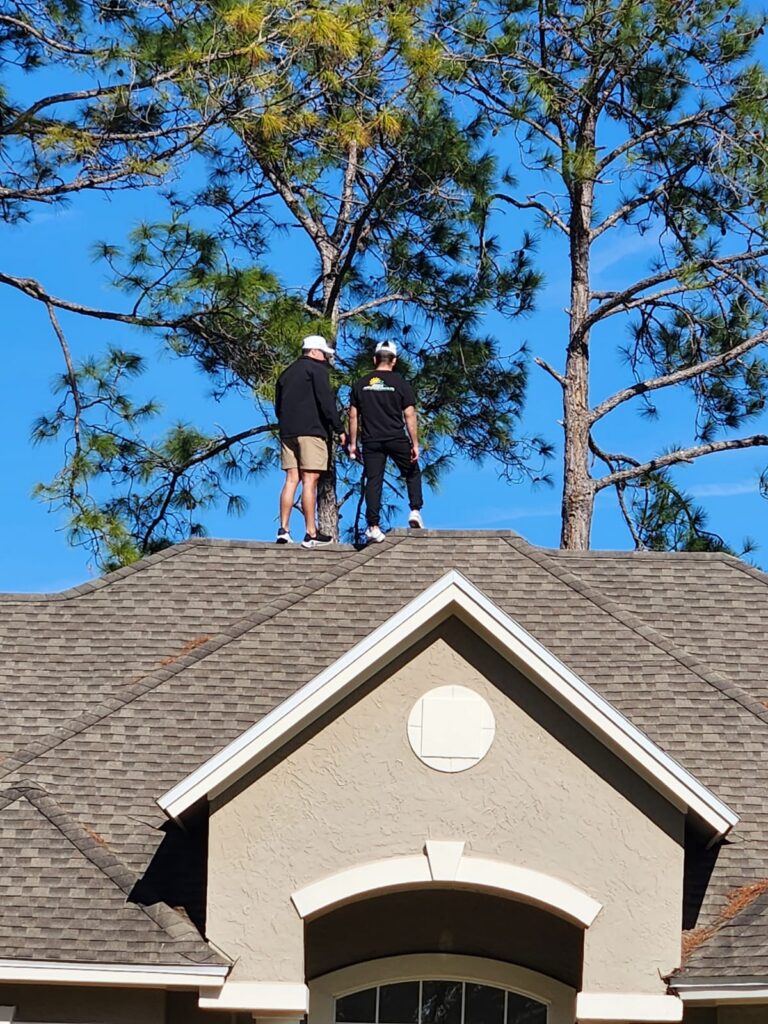
Attic, Ventilation, and Interior Evidence
When the attic is safely accessible, it can answer questions the exterior cannot.
An inspector may look for:
Water stains or active moisture on decking and framing
Signs of previous leaks around penetrations
Ventilation conditions and blocked intake areas
Condensation or unusual moisture patterns
Daylight where it should not be visible
Insulation conditions that may affect airflow
The Florida Building Code includes requirements that affect roof assemblies and ventilation. The inspection itself is not a code-compliance certificate unless that is the specific scope of the service, but visible installation or ventilation concerns can absolutely affect the recommendation.
Chimneys, Skylights, Vents, and Other Penetrations
Every hole through a roof is a place that deserves attention. Jacksonville homes can have plumbing vents, bath or kitchen exhausts, skylights, chimneys, satellite penetrations, HVAC-related components, and other accessories that interrupt the roof covering.
The inspector should check the roofing details around those penetrations for deterioration, separation, damaged flashing, failed boots, corrosion, and evidence of water entry.
Want to know what your roof actually looks like?
JA Edwards offers free Jacksonville roof inspections with photo documentation and a written report you keep. If the roof is fine, that is useful information too.
What Makes a Jacksonville Roof Inspection Different?
The inspection checklist does not magically change when you cross into Duval County. The context does.
Jacksonville combines a hot, humid climate with severe thunderstorms, tropical weather exposure, coastal conditions, heavy rain events, and occasional prolonged northeast wind events. The National Weather Service office in Jacksonville specifically tracks tropical, severe-weather, heavy-rain, coastal, and high-wind hazards for Northeast Florida.
Heat and Humidity
Jacksonville's climate normals show long, hot summers. Heat loads the roof surface while attic moisture and poor ventilation can create problems below it. That makes both exterior roof condition and attic conditions relevant during an inspection.
Wind, Thunderstorms, and Tropical Weather
Storm damage is not always a missing section of roof. Wind can lift, crease, or loosen roofing material while leaving the roof looking mostly normal from the ground. After a significant weather event, documentation matters before repairs change the original condition.
Our Jacksonville storm damage roofing page explains what happens when the inspection finds wind or hail damage and the homeowner needs repair or replacement options.
Coastal Exposure and Corrosion
Homes closer to Jacksonville's beaches and other salt-exposed areas deserve extra attention around metal components. Flashing, fasteners, vents, gutters, metal roofing components, and accessories can show corrosion earlier than similar components farther inland.
Older Roofs and Insurance Questions
This is where the original version of this article needed more precision.
Florida law does not simply say, “your roof is 15 years old, replace it.” Under Florida Statute 627.7011, an insurer may not refuse to issue or renew a homeowners policy solely because a roof is under 15 years old. For a roof that is at least 15 years old, the insurer must allow the homeowner to obtain an inspection by an authorized inspector before requiring replacement solely because of roof age. If that inspection indicates at least five years of useful life remaining, the insurer may not refuse coverage solely because of roof age.
Individual underwriting rules can still involve other conditions, and specific insurers can have their own inspection forms and eligibility requirements. Citizens Property Insurance, for example, publishes separate older-roof documentation rules. So if an insurance carrier sends you a roof letter, the correct move is to read the actual request rather than assuming every “roof inspection” means the same thing.
Roof Inspection vs. 4-Point vs. Wind Mitigation: They Are Not the Same
This matters in Florida because people use the phrase “roof inspection” to describe several different things. Then everyone discovers at closing or renewal that they ordered the wrong one. A charming little tradition.
| Inspection | Main Purpose | What It Covers |
|---|---|---|
| Roof condition inspection | Understand roof condition and next steps | Roof covering, flashing, penetrations, drainage, visible deck/attic indicators, damage, repair vs. replacement |
| 4-point inspection | Insurance underwriting on certain homes | Roof plus electrical, plumbing, and HVAC systems |
| Wind mitigation inspection | Document wind-resistant construction features | Roof shape, roof covering, deck attachment, roof-to-wall connections, opening protection, and other mitigation features |
| Insurer-specific roof form | Satisfy a carrier's underwriting request | Depends on the insurer and form; may require useful-life or condition documentation |
If you specifically need a wind mitigation inspection, start with our guide to Florida wind mitigation inspections. If an insurer gave you a form, send or show the form before the appointment so the inspection can be matched to the actual request.
When Should You Schedule a Roof Inspection in Jacksonville?
You do not need a calendar reminder every time the weather app shows a cloud. The useful triggers are more practical.
After a Significant Storm
Schedule an inspection when you have a reason to suspect damage: visible debris, missing material, a new leak, hail in your area, strong wind, tree impact, or other changes after a storm.
When You See a New Leak or Interior Stain
Water can travel along decking, framing, or penetrations before it appears on a ceiling. The place where you see the stain is not always directly below the source.
If a leak is already active, our Jacksonville roof repair team can inspect the roof and determine whether a targeted repair makes sense.
Before Buying a Home With an Older or Questionable Roof
A general home inspection is valuable, but a dedicated roof condition assessment can go deeper when the roof age, visible condition, prior leaks, or insurance eligibility could affect the transaction.
When an Insurance Carrier Requests Documentation
Read the request carefully and confirm whether the carrier wants a roof condition form, 4-point inspection, wind mitigation inspection, photographs, proof of replacement, or another document. Do that before booking the wrong inspection and discovering bureaucracy has once again defeated common sense.
Before Selling a Home
Knowing about a roof issue before the buyer's inspection gives you more options. You can repair it, document it, price around it, or understand whether replacement is likely to become part of the negotiation.
When an Aging Roof Starts Showing Changes
Do not rely only on age. An older roof with good installation and condition may be performing well, while a younger roof with storm damage or installation problems may need attention. Condition beats calendar math.
What Happens After a Professional Roof Inspection?
A useful inspection should leave you with more than “looks good” or “you need a roof.”
At minimum, the homeowner should understand:
What was inspected
What conditions were found
Which findings are urgent
Which findings can be monitored
Whether a repair is reasonable
Whether replacement is becoming the better financial decision
Whether another specialist or insurer-specific inspection is needed

If the Roof Needs a Repair
A repair recommendation should identify the problem area and explain what the repair is intended to solve. Common repair scopes include flashing failures, pipe boots, missing shingles, isolated wind damage, leaking penetrations, and limited damaged areas.
If you are budgeting, see our guide to roof repair cost in Jacksonville.
If Replacement Makes More Sense
Replacement becomes a more reasonable conversation when damage is widespread, repairs are repeating, the roof system has multiple failing areas, decking issues are extensive, or the roof has reached a condition where continued patching no longer makes financial sense.
Our Jacksonville roof replacement page explains the full replacement process. If price is the next question, use our Jacksonville roof replacement cost guide.
If the Inspection Finds Possible Storm Damage
The contractor can document visible conditions and provide a roofing scope. If you choose to file an insurance claim, coverage decisions belong to the carrier and the policy. For the process itself, see our Jacksonville roof insurance claim guide.
How to Tell a Thorough Inspection From a Sales Visit
A free inspection can be useful. “Free” does not automatically mean “fake,” and “paid” does not automatically mean “thorough.” The process matters more than the price tag.
Look for these signals:
Photo documentation: You can see the conditions being discussed.
Multiple outcomes are possible: The answer can be repair, replacement, monitoring, or no action.
The inspector checks more than the field shingles: Edges, flashing, penetrations, drainage, and accessible interior areas matter.
The recommendation connects to evidence: “You need a roof” is not evidence.
The contractor is verifiable: Florida DBPR provides an official license lookup for contractors.
No invented insurance promises: A roofing contractor should not promise that a carrier “will pay” a claim.
A good inspection should make the roof less mysterious, not make the sales pitch more dramatic.
JA Edwards of America: Free Roof Inspections in Jacksonville
JA Edwards of America operates from a Jacksonville office at 4570 St Johns Ave Suite A, Jacksonville, FL 32210 and serves homeowners across Jacksonville, Duval County, and surrounding Northeast Florida communities.
Our Jacksonville inspection process is built around a simple idea: document first, recommend second.
The inspection includes photos and a written report you keep. If the roof needs a targeted repair, we can explain that option. If the roof is approaching replacement, we can show you why. If it is in good condition, you still leave with useful documentation instead of a suspiciously convenient replacement quote.
JA Edwards holds Florida roofing and general contractor licenses CCC1334804 and CGC1534283 and is a GAF Master Elite contractor. You can verify contractor licensing through the official Florida DBPR license portal.
For the service page, visit Professional Roof Inspections in Jacksonville, FL. Homeowners comparing broader roofing options can also review our Jacksonville residential roofing services and Jacksonville shingle roofing pages.
Your roof has questions. Start with photos.
Book a free Jacksonville roof inspection. You keep the photo report and decide the next step with real information.
Jacksonville Roof Inspection FAQ
JA Edwards' Jacksonville inspection service is designed around roughly 30 minutes on site for a typical inspection, but larger, steeper, more complex, or damaged roofs can take longer. Access conditions and whether the attic can be inspected safely also affect the time.
It can be, if the inspection produces real documentation. Ask whether you receive photos, a written report, and a recommendation that can include repair, monitoring, replacement, or no work. A free inspection is much less useful when it exists only to produce a replacement quote.
A thorough roof condition inspection should include accessible interior or attic areas when it is safe and practical to do so. The attic can reveal moisture, staining, ventilation issues, and underside deck conditions that cannot be seen from the exterior. Some homes have limited or unsafe attic access, so the actual scope can vary.
There is no single interval that fits every roof. Schedule an inspection after significant weather when you see signs of damage, when a new leak appears, when an insurer requests documentation, before a real-estate transaction when roof condition is uncertain, or when an aging roof starts showing changes. Condition matters more than a rigid calendar rule.
JA Edwards offers free roof inspections in Jacksonville. If you need a separate insurance form, 4-point inspection, wind mitigation inspection, engineering report, or another specialized inspection, confirm the required service because that may be a different inspection performed under a different scope.
Yes. An inspection can document visible wind, hail, impact, leak, and roofing conditions before repairs change the original condition. A roofing contractor can document damage and provide repair or replacement recommendations; the insurance carrier determines whether a loss is covered under the policy.
Read the letter carefully and identify exactly what the carrier is requesting. It may be a roof condition report, useful-life documentation, 4-point inspection, wind mitigation inspection, proof of replacement, photos, or another form. Send the request to the inspector before scheduling so you do not order the wrong service.
A general home inspection covers many systems in the property. A dedicated roofing inspection focuses specifically on the roof system and can go deeper into roof covering, flashing, penetrations, drainage, storm damage, attic evidence, repairability, and replacement considerations. The exact scopes depend on the inspector and service ordered.
Florida Statute 627.7011 includes licensed roofing contractors among the types of authorized inspectors who may perform the roof inspection described in the statute, subject to insurer approval and the insurer's requirements. Always confirm the carrier's required form and inspector qualifications before scheduling.
Sources: Florida Statute 627.7011; Citizens Property Insurance inspection guidance; Florida Building Commission code resources; NWS Jacksonville weather resources; and Florida DBPR contractor license verification.
Stop guessing from the driveway
A Jacksonville roof inspection can show you whether the roof needs a repair, replacement, monitoring, or nothing at all. Get photos, a written report, and a straightforward recommendation.