
Tile vs. Shingle Roofs in Florida: Cost, Lifespan, Insurance, Hurricanes
The Short Answer
Shingle costs less upfront ($5.75-$8.75/sq ft vs. tile's $12-$22/sq ft) and is easier to repair. Tile lasts longer (30-50+ years vs. shingle's 25-30), handles Florida's heat and UV better over time, and often carries a stronger wind mitigation insurance credit. Neither is "better" universally: the right choice depends on your budget, your roof structure's ability to carry tile's added weight, and how long you plan to stay in the home.
In this guide
- Why this decision looks different in Florida
- Quick verdict: who should pick which
- Cost comparison
- Lifespan in Florida's climate
- Hurricane and wind performance
- Insurance and wind mitigation credits
- Maintenance and repair differences
- Curb appeal and resale considerations
- The structural question nobody asks upfront
- Which we recommend, and when
- Frequently asked questions
Tile and shingle are the two most common roofing materials in Florida, and homeowners choosing between them for a new build or a full replacement usually get pulled in different directions by different people: the contractor who mostly installs shingle recommends shingle, the one who specializes in tile recommends tile. This guide compares them directly, on the specific factors that actually matter in Florida, cost, lifespan, hurricane performance, and insurance, so you can make the call based on your situation rather than whichever material the person you called happens to install most.
Why this decision looks different in Florida
The tile-versus-shingle question gets asked in every state with a housing market, but it plays out differently here than almost anywhere else in the country. Florida combines three stresses most other states only deal with one or two of at a time: sustained UV intensity that degrades roofing materials faster than temperate climates, hurricane-force wind events that test installation quality directly rather than theoretically, and humidity that accelerates decking and underlayment problems regardless of what's on top. A material comparison written for a Midwest or Northeast market simply doesn't transfer, cost and lifespan numbers you'll find in national buying guides routinely assume conditions Florida doesn't have.
That's part of why tile has such deep roots here specifically, going back to the Mediterranean and Spanish Revival architectural waves that shaped Florida residential construction through the early-to-mid 1900s, while shingle became the volume-market default once production-home building accelerated in the postwar decades and needed a faster, cheaper material to keep pace. Both materials have had close to a century to prove themselves under Florida conditions specifically, which is more real-world data than most other states' roofing markets have generated.
Quick verdict: who should pick which
Choose Shingle If
- Upfront budget is the primary constraint
- You plan to sell within 10-15 years
- Your roof structure wasn't engineered for tile's weight
- You want the widest range of contractors able to service the roof
- Fast, straightforward repairs matter to you
Choose Tile If
- You're planning to stay long-term, 20+ years
- Your home is already engineered for tile, or you're building new
- Maximizing wind mitigation insurance credit matters
- HOA or architectural style requirements call for it
- You want to minimize the number of times you reroof in your lifetime
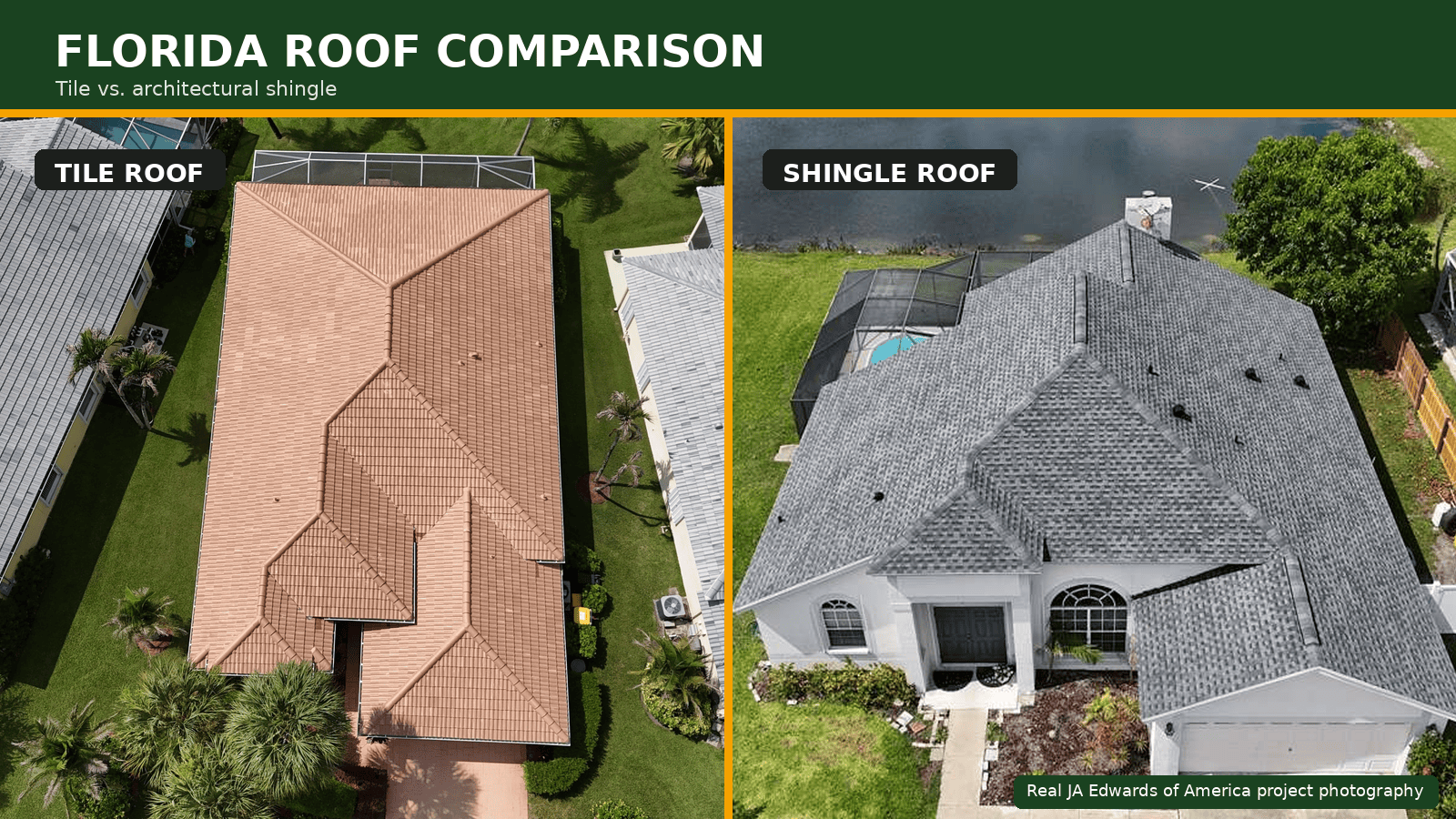
Cost comparison
| Factor | Architectural Shingle | Concrete/Clay Tile |
|---|---|---|
| Cost per sq ft installed | $5.75 - $8.75 | $12 - $22 |
| 2,500 sq ft home, typical total | $14,000 - $22,000 | $24,000 - $37,000+ |
| Repair cost (typical job) | $300 - $900 | $250 - $1,800 |
| Cost-per-year over lifespan | ~$0.25-$0.35/sq ft/yr (25-30 yr life) | ~$0.30-$0.45/sq ft/yr (30-50 yr life) |
Shingle wins on upfront cost by a wide margin, roughly half of tile's installed price. Priced over the full lifespan, the gap narrows but doesn't fully close; tile's cost-per-year is still somewhat higher than shingle's in most scenarios, which is different from the metal-vs-shingle math where the annualized costs land close to even. Tile's premium is a genuine premium, not just a timing difference, and the case for it rests more on lifespan, resilience, and insurance than on lifetime cost parity.
Lifespan in Florida's climate
Architectural shingle realistically lasts 25-30 years in Florida's heat and UV exposure, sometimes less on roofs with poor attic ventilation, which accelerates shingle aging from underneath. Tile, both concrete and clay, commonly lasts 30-50+ years for the tile itself, though this comes with an important asterisk covered in our tile roof replacement cost guide: the underlayment beneath tile typically needs replacement on its own cycle, often once or twice within the tile's lifetime, which means "50 year tile roof" doesn't always mean zero work for 50 years, it means the visible material lasts that long while the waterproofing layer underneath gets serviced along the way.
Hurricane and wind performance
Both materials can be installed to meet Florida's wind code requirements, but they fail differently under extreme wind. Shingle failure in high wind typically starts at the tabs and edges, individual shingles lifting and peeling progressively, which is a gradual failure mode. Tile, when properly installed with correct fastening for the home's wind zone, resists uplift well due to its weight, but if a tile does fail, it can become a wind-borne projectile that damages neighboring property, a risk profile shingle doesn't share. Neither failure mode is strictly "worse"; they're just different, and both are reasons proper installation (correct nailing pattern for shingle, correct fastening and adhesive for tile) matters more than the material choice itself.
Not sure which material fits your home?
Free inspection and a straight comparison for your specific roof, structure, and budget, no pressure either direction.
Get My Free ConsultationInsurance and wind mitigation credits
Both materials can earn wind mitigation credits under Florida's program, but tile often performs somewhat better due to its weight and resistance to uplift, provided the underlying attachment method meets current standards. Shingle earns strong credits too, especially newer architectural shingle installed with enhanced nailing patterns and secondary water resistance. The bigger insurance factor for either material is age and installation quality, not the material category alone; an aging, poorly-maintained tile roof won't out-credit a newer, well-installed shingle roof. Our guide on Florida wind mitigation inspections explains what actually gets verified.

Maintenance and repair differences
Shingle repair is generally faster and more straightforward: most licensed roofers can handle it, materials are widely stocked, and matching an existing roof's color and profile is usually simple unless the shingles are heavily faded. Tile repair requires more specialized handling, hand removal and reinstallation, careful breakage management, and profile matching that's occasionally complicated by discontinued styles. Tile also has a foot-traffic sensitivity shingle doesn't: any technician walking the roof for an unrelated reason (AC service, gutter work) needs to know proper technique to avoid cracking tiles, a maintenance consideration worth mentioning to any vendor who'll be on your roof.
Over a full ownership period, the maintenance economics diverge in a way that's easy to miss looking only at year-one cost. Shingle roofs typically need more frequent smaller interventions, algae treatment on north-facing slopes, occasional tab resealing after wind events, granule loss monitoring as the roof ages past the 15-year mark. Tile roofs need less frequent attention but the interventions that do come up, an underlayment inspection or a broader tile-lift-and-reseal, tend to be bigger single events rather than a steady trickle of small ones. Neither pattern is objectively easier to budget for; it depends whether you'd rather plan around predictable small costs or save for a less frequent bigger one. For Florida-specific installation standards on the tile side, the Florida Roofing and Sheet Metal Contractors Association co-develops the state's tile installation manual and publishes homeowner-facing resources worth reviewing alongside any contractor's pitch.
Curb appeal and resale considerations
Material choice affects resale in ways that vary more by neighborhood than by any universal rule. In communities where tile is the architectural norm, Tampa Palms-style developments, Mediterranean and Spanish Revival-influenced neighborhoods, and many HOA-governed communities across the Treasure Coast, a shingle roof can actually work against a home's marketability regardless of its condition, since it reads as inconsistent with the street. In shingle-dominant neighborhoods, the reverse rarely holds true; a tile roof is generally seen as a premium feature rather than a mismatch. If resale within a specific community is part of your decision, it's worth walking the street before walking away from either material on cost alone.
The structural question nobody asks upfront
This is the factor that eliminates tile as an option for some homes before cost ever enters the conversation. Concrete and clay tile are significantly heavier than architectural shingle, and a roof structure has to be engineered to carry that load. Homes originally built with tile are already engineered for it. Homes built with shingle that are considering switching to tile need a structural verification first, in some cases the framing can handle it, in others it can't without reinforcement that adds real cost. This is one of the first things we check during a tile consultation, and it's worth confirming before you fall in love with a tile aesthetic your roof structure may not support.
Which we recommend, and when
If we're being direct rather than diplomatic: for most Florida homeowners planning a standard ownership timeline, 10-15 years, architectural shingle remains the better financial decision, lower upfront cost, simpler maintenance, and a lifespan that roughly matches typical ownership length anyway. For homeowners planning to stay long-term, already have tile-engineered structures, or are building new in a community where tile is the architectural standard, tile's longevity and insurance profile make the premium worth considering seriously rather than defaulting away from it on cost alone. The wrong approach is picking based on what looks best in a photo without running your specific numbers, which is exactly what a real inspection and consultation is for.
Frequently asked questions
Is tile or shingle better for hurricanes in Florida?
Both can meet Florida's wind code when properly installed. They fail differently under extreme wind rather than one being categorically stronger, shingle tends to lift progressively at the edges, while tile resists uplift well but can become a projectile risk if it does fail. Correct installation matters more than the material choice alone.
Does tile really last twice as long as shingle in Florida?
The tile material itself often does, 30-50+ years versus shingle's 25-30. But the underlayment beneath tile typically needs its own replacement cycle within that timeframe, so "50 year roof" describes the visible tile more than a zero-maintenance guarantee.
Can any home be converted from shingle to tile?
Not without a structural check first. Tile is significantly heavier than shingle, and the roof framing needs to be engineered to carry that load. Some homes can be reinforced to support tile; others can't without cost that changes the economics of the decision.
Which material gives a better insurance discount in Florida?
Both can earn strong wind mitigation credits. Tile's weight often helps, but installation quality and roof age matter more than material category alone. A well-installed newer shingle roof can out-credit an aging, poorly-maintained tile roof.
Which material requires less maintenance over time?
Tile requires less frequent attention, but the interventions that do come up tend to be larger single events, like underlayment work, rather than the smaller, more frequent upkeep shingle roofs typically need as they age past 15 years.
Does switching from shingle to a mismatched material hurt resale value?
It can, depending on the neighborhood. In tile-dominant communities, a shingle roof can read as inconsistent with the street even in good condition. In shingle-dominant neighborhoods, tile is generally viewed as a premium upgrade rather than a mismatch.