
How to Document Roof Storm Damage for a Florida Insurance Claim
If wind, hail, a hurricane or another storm damages your roof, good documentation helps create a clear record of what happened. It does not guarantee coverage or a particular payment, but photos, dates, receipts, weather records and a professional roof inspection can make the physical condition of the property much easier to understand.

The first hours after a storm are useful for documentation because the condition is fresh, debris has not been cleaned up and temporary repairs may not have changed what is visible. But there is no Florida rule saying a homeowner loses a legitimate claim because photos were not taken within 24 or 72 hours. The practical goal is simpler: document safely, prevent additional damage and notify your insurer promptly if you intend to make a claim.
Florida's Department of Financial Services advises policyholders to contact the insurance company directly, take photos, make necessary emergency or temporary repairs, keep receipts and avoid discarding damaged property before the insurer has had an opportunity to inspect it.
Step 1: Start With Safety, Not the Roof
Do not climb onto a wet, steep or visibly damaged roof to get better pictures. Storm-damaged roofing can be slippery, loose or structurally compromised. If a tree is on the home, power lines are down or part of the structure appears unstable, keep people away from the area and deal with the safety hazard first.
From the ground, look for obvious changes: missing roofing material, displaced flashing, broken tile, damaged ridge material, branches, exposed decking, gutter damage or debris that came off the roof. From inside the home, check for active water entry, ceiling stains and, if safely accessible, attic moisture or wet insulation.
For more detail, see our guide on whether you need a roof inspection after a Florida storm.
Step 2: Photograph the Property Before Cleanup Changes It
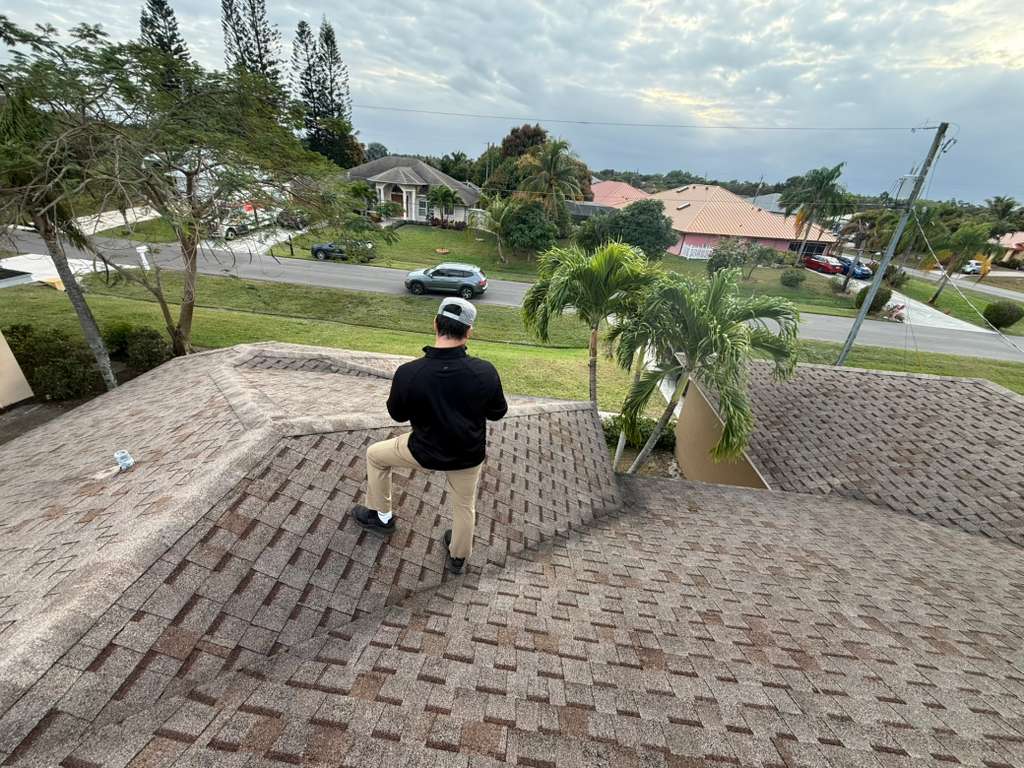
Your phone is enough to create a useful visual record. The goal is not to prove an insurance claim yourself. It is to preserve what the property looked like before debris is removed, water dries, tarps are installed or repairs begin.
Do not over-interpret the photos. Visible granule loss on asphalt shingles can have several causes and is not, by itself, proof of hail damage. A professional inspection should evaluate the pattern, location and surrounding roof condition.
Step 3: Write Down What Happened
A short factual timeline is useful because storms are chaotic and details become harder to remember later. Keep it boring. Boring is excellent documentation.
- Date and approximate time of the storm.
- When you first noticed roof or interior damage.
- What you actually observed, such as hail, wind-driven debris, a tree impact or water entering the home.
- Rooms or roof areas where damage appeared.
- Any known pre-existing roof condition in the same area.
- Emergency steps taken to prevent additional damage.
- Names, dates and claim numbers from insurer communications once the claim is reported.
Step 4: Save Official Weather Information
Weather records can provide context for the date of loss, especially when the storm involved a named tropical system, severe thunderstorm, hail or reported damaging wind. They should support the record, not be treated as a magic coverage certificate.
The National Hurricane Center publishes advisories and post-storm reports for tropical cyclones. The National Weather Service publishes warnings and local storm information, and NOAA's Storm Events Database provides searchable NWS storm-event records.
Step 5: Contact Your Insurer Directly and Promptly
You do not need to wait for a roofing contractor's report before notifying your insurer. Florida DFS advises homeowners to contact the insurance company directly to report damage and arrange for the insurer's adjuster to inspect the property.
When reporting the loss, have your policy information, date of loss and a simple factual description available. Ask for the claim number and save it with your documentation.
Step 6: Get a Professional Roof Inspection

A roofing contractor's inspection can run in parallel with the insurance claim. The contractor can document the physical condition of the roof, identify areas that require repair or replacement and prepare an itemized roofing estimate.
That report can include roof-wide photos, close-ups, measurements and written findings. It can be useful when comparing the contractor's proposed roofing scope with the insurer's estimate. But the contractor's report does not decide insurance coverage and does not guarantee that the insurer will classify every observed condition as storm-related or covered.
JA Edwards of America offers free standard roof inspections with photo documentation.
What a Florida Roofing Contractor Can and Cannot Do
A Roofing Contractor Can
- Inspect the roof and document physical conditions.
- Photograph visible storm damage and deterioration.
- Prepare an itemized repair or replacement estimate.
- Explain the contractor's construction scope and pricing.
- Discuss or explain its own repair bid with the homeowner or insurer.
- Be present during a site inspection when appropriate.
A Roofing Contractor Cannot
- Interpret the homeowner's insurance policy.
- Tell the homeowner whether the policy covers the loss.
- Adjust or negotiate the insurance claim on the homeowner's behalf unless separately licensed as a public adjuster.
- Waive, rebate or absorb a required insurance deductible.
- File false, incomplete or misleading claim information.
Florida Statute 489.147 prohibits contractors from interpreting policy provisions, advising insureds about coverage or policy duties, or adjusting the claim on the homeowner's behalf unless the contractor is also properly licensed as a public adjuster.
Step 7: Prevent Additional Damage and Preserve Evidence
Florida DFS advises homeowners to make emergency or temporary repairs needed to prevent further damage. That can include measures such as tarping an exposed roof area or protecting an opening from additional rain, when the work can be performed safely.
Take photos before and after emergency work when possible and save all receipts. Do not discard damaged items before the insurer has completed its inspection unless safety, sanitation or another practical reason requires removal.
Understand the Claim Timeline in Florida
| Current Florida Rule | General Requirement |
|---|---|
| Acknowledge claim communication | Generally within 7 calendar days after the insurer receives a claim communication. |
| Begin investigation after proof of loss | Generally within 7 days after receiving proof-of-loss statements. |
| Physical inspection after proof of loss | If the investigation requires one, generally within 30 days after receipt of proof-of-loss statements. |
| Copy of insurer's detailed estimate | If the insurer's adjuster generates a detailed estimate, the insurer generally must provide a copy within 7 days. |
| Pay or deny claim | Generally within 60 days after receiving notice of an initial, reopened or supplemental claim, subject to statutory exceptions and tolling. |
These timelines come from Florida Statute 627.70131.
Review Your Deductible and Loss Settlement Terms
Two policy details can materially affect what a roof claim looks like: the deductible and whether the damaged property is settled on a replacement-cost or actual-cash-value basis.
Hurricane deductible
Florida policies can contain a separate hurricane deductible. The hurricane deductible applies only during the statutory hurricane period, not automatically to every wind or rain event.
Roof deductible
Some Florida policies may also contain a separate roof deductible for certain non-hurricane roof losses. Check the declarations page and endorsements rather than assuming which deductible applies.
ACV vs. replacement cost
Florida DFS explains that Actual Cash Value generally reflects replacement cost minus depreciation, while Replacement Cost generally reflects the cost to replace the damaged property without deducting depreciation. Policy language controls the actual settlement.
What Citizens Policyholders Should Know
If your home is insured by Citizens Property Insurance, do not rely on old "15-year roof" rules circulating online. Citizens' current published eligibility guidance is different.
Citizens states that shingle and similar roofs older than 25 years, and tile, slate, clay, concrete or metal roofs older than 50 years, require documentation showing at least five years of remaining useful life, subject to its underwriting rules and exceptions.
When Might a Public Adjuster Be Relevant?
A public adjuster represents the policyholder in adjusting and presenting a property insurance claim. That is different from what a roofing contractor does.
Florida DFS requires public adjusters to be licensed. Verify the license, understand the contract and fee, and decide whether you actually need someone to represent you in the claim process.
The Role of JA Edwards After Storm Damage

JA Edwards of America serves Orlando, Tampa, Jacksonville and Port St. Lucie. We can inspect the roof, document the physical condition, identify the roofing work that appears necessary and prepare an itemized estimate.
We are a Florida Certified Roofing Contractor (CCC1334804), Certified General Contractor (CGC1534283), GAF Master Elite contractor and GAF President's Club 3-Star contractor.
If the damage is concentrated in one area, repair may be reasonable. If the roof has widespread damage or deterioration, replacement may be the better roofing scope. See our guide to roof repair vs. roof replacement.
You can also visit our Florida storm damage repair page.
Quick Checklist: Documenting Storm Damage
- Stay off a wet or visibly damaged roof.
- Photograph the property and visible roof damage from safe locations.
- Photograph interior water intrusion and accessible attic evidence.
- Save original image files and back them up.
- Write down the storm date and what you actually observed.
- Save official NWS, NHC or NOAA event information when relevant.
- Contact your insurer directly and get a claim number.
- Make reasonable emergency repairs to prevent additional damage.
- Photograph temporary repairs before and after and keep receipts.
- Preserve damaged materials until the insurer has had an opportunity to inspect, when practical.
- Schedule a professional roof inspection and obtain a written roofing scope.
- Keep insurer letters, estimates, emails and call notes together.
- Review the deductible and loss-settlement provisions in your own policy.
- Remember the Florida notice limits: generally 1 year for initial/reopened claims and 18 months for supplemental claims.
Need the Roof Documented After a Storm?
JA Edwards of America offers free standard roof inspections with photo documentation across Orlando, Tampa, Jacksonville and Port St. Lucie.
Schedule a Free Roof InspectionFrequently Asked Questions About Florida Roof Claims
How soon should I document roof damage after a storm?
As soon as it is safe and practical. Early photos and notes preserve the condition before cleanup or temporary repairs change what is visible. Florida law does not require photos within a specific 24- or 72-hour window.
Should I wait for a roofer before reporting the claim?
No. Florida DFS advises homeowners to contact the insurance company directly and promptly. A roofing contractor can inspect the roof and prepare documentation while the insurer's claim process is underway.
How long do I have to report a property insurance claim in Florida?
Florida Statute 627.70132 generally requires notice of an initial or reopened property insurance claim within one year after the date of loss. A supplemental claim generally must be noticed within 18 months after the date of loss.
How long does a Florida insurer have to pay or deny a property claim?
Florida Statute 627.70131 generally requires an insurer to pay or deny an initial, reopened or supplemental residential property claim within 60 days after receiving notice, subject to statutory exceptions and tolling provisions.
Can a roofer negotiate my insurance claim?
Not unless the roofer is separately licensed and compliant as a public adjuster. A roofing contractor can inspect, document physical conditions, prepare a roofing estimate and explain its own bid, but Florida law restricts contractors from interpreting policy coverage or adjusting the claim on the homeowner's behalf.
Can I make emergency repairs before the insurer inspects?
Yes. Florida DFS advises policyholders to make emergency or temporary repairs needed to prevent additional damage, take photos when possible and keep receipts.
Does weather data prove my roof claim is covered?
No. Weather data can help establish what occurred in the area, but coverage depends on the policy, physical damage, cause of loss and insurer investigation.
What is the difference between ACV and replacement cost?
Florida DFS describes Actual Cash Value as replacement cost minus depreciation, while Replacement Cost generally pays the current cost to replace damaged property without deducting depreciation. Your own policy and endorsements control the actual settlement.
Is JA Edwards a public adjuster?
No. JA Edwards of America is a licensed Florida roofing and general contractor. We inspect roofs, document conditions and prepare roofing scopes and estimates. We do not determine insurance coverage or adjust a claim on the homeowner's behalf.
Official & Technical Sources
Florida Statute 627.70132 — Notice of Property Insurance Claim
Florida Statute 627.70131 — Claim Acknowledgment, Investigation and Payment
Florida Statute 489.147 — Contractor Property Insurance Practices
Florida DFS — General Disaster Insurance FAQs
Florida DFS — Hurricane Deductible Guide
Florida DFS — Public Adjusters
Citizens Property Insurance — Current Inspection Requirements
National Hurricane Center
NOAA NCEI — Storm Events Database