
How Many Bundles Are in a Pallet of Shingles?
Weight, coverage, delivery planning, and what Florida homeowners should know before a pallet of shingles shows up in the driveway.
A standard pallet of asphalt shingles usually contains 21 to 42 bundles, weighs roughly 2,100 to 3,360 pounds, and covers about 7 to 14 squares, or 700 to 1,400 square feet. Ordering should start with your measured roof area, not a guess based on the size of the house.
That distinction matters on a Florida reroof. A delivery truck may arrive before the crew starts tearing off, and the wrapped pallet sitting in your driveway can immediately raise practical questions. Will the driveway support it? Can the crew move it without damaging pavers, concrete, landscaping, or a garage door? Should all the materials arrive at once, or should the supplier split the delivery?
A pallet of shingles is more than a stack of roofing material. It affects tear-off timing, staging, roof access, traffic around the property, and the sequence of installation. The right plan limits delays and protects your home before the first new shingle is installed.
Table of Contents
- The Moment a Pallet of Shingles Shows Up at Your House
- What a Pallet of Shingles Actually Includes
- Why Pallet Sizes Vary by Shingle Type
- How to Calculate How Many Pallets Your Roof Needs
- Delivery and Storage Planning for Florida Jobs
- What Drives the Cost of a Pallet of Shingles
- How Pallet Choices Connect to Florida Code and Insurance
- Ordering Tips and When to Get a Professional Inspection
The Moment a Pallet of Shingles Shows Up at Your House
The delivery truck backs into the driveway on the morning of your reroof. You expect bundles, but instead you see a tall, wrapped pallet that looks closer to a small freight shipment. The crew explains that one loaded pallet can weigh between 2,100 and 3,360 pounds, depending on the product and bundle configuration, as documented in industry guidance on shingle bundle and pallet weight.
That weight changes the conversation. A narrow driveway, sloped concrete, pavers, soft soil, or a lawn beside the drive can make placement difficult. The forklift operator may need to approach from a particular angle, while the roofing crew must decide whether to leave the pallet at ground level, break it into bundles, or move some material closer to the roof edge later.

Why staging affects the workday
The delivery location can determine how quickly the crew begins tear-off. If the pallet blocks the only vehicle route, sits where debris must be loaded, or occupies the space needed for a trailer, the project may require a different sequence. On larger homes, commercial buildings, or phased reroofs, the crew may prefer separate deliveries instead of filling the property with materials before the roof is ready.
Practical rule: The best pallet location is not simply the closest point to the house. It's the location that supports safe unloading, crew movement, debris removal, and access for the rest of the project.
Florida conditions add another concern. Afternoon rain, high heat, humidity, tropical storms, and hurricane-season scheduling can make exposed materials harder to protect. Before delivery, your contractor should confirm the surface, access route, unloading equipment, staging area, and installation sequence.
What a Pallet of Shingles Actually Includes
A pallet of shingles is a factory-wrapped group of shingle bundles delivered together. The count isn't universal. Industry examples place common pallet configurations between 21 and 42 bundles, with the product line and manufacturer determining the final count, as explained in this breakdown of shingle pallet sizes.
A common coverage assumption is about 33.3 square feet per bundle. That puts a pallet's approximate coverage between 7 and 14 roofing squares, or about 700 to 1,400 square feet, depending on how many bundles are included. Roofing contractors measure roof area in squares, and one roofing square equals 100 square feet.
| Specification | Typical Range |
|---|---|
| Bundles per pallet | 21 to 42 bundles |
| Coverage per bundle | About 33.3 square feet |
| Pallet coverage | About 7 to 14 squares |
| Pallet coverage in square feet | About 700 to 1,400 square feet |
| Total pallet weight | About 2,100 to 3,360 pounds |
The field shingles aren't always the only materials considered during planning. Starter strips, ridge caps, hip shingles, and other accessory products may arrive in separate bundles or as part of a broader material order. They shouldn't automatically be treated as interchangeable with field shingle bundles.
For a homeowner, the useful process is straightforward:
- Measure the true roof surface.
- Convert the area into roofing squares.
- Check the selected manufacturer's coverage chart.
- Add the required accessories and project waste.
- Convert the final bundle requirement into pallet quantities.
You can learn more about the material layers and components in this explanation of what roofing shingles are made of. The key point is that a pallet count is a logistics result, not a substitute for a roof measurement.
Why Pallet Sizes Vary by Shingle Type
Two homes with similar roof areas may need different pallet counts because the shingles themselves aren't identical. Three-tab shingles have a flatter, lighter profile, while architectural shingles are thicker and dimensional. More material per bundle means fewer bundles may fit on a pallet, even when the roof coverage calculation follows the same basic process.
A three-tab pallet may use a higher bundle count than a heavier architectural product. Architectural configurations commonly use fewer bundles, and designer or impact-resistant products can follow the same pattern. The verified industry range remains broad, about 21 to 42 bundles per pallet, because manufacturers package products according to their own weight, dimensions, and coverage specifications.
The difference affects more than the delivery ticket.
Three-tab and architectural trade-offs
Three-tab shingles can be easier to stack and may produce a different number of pallets for the same roof area. Architectural shingles generally have a thicker, more substantial profile, so the pallet may contain fewer bundles while carrying significant weight. A contractor must use the product's actual bundle coverage, not an assumed count from another shingle line.
For Florida homeowners, the product choice also connects to wind performance, appearance, warranty requirements, and the assembly specified for the property. A higher-quality shingle isn't automatically the right answer if the supporting underlayment, fastening pattern, ventilation, and approvals don't match the project.

A bundle count tells you how the supplier packed the material. It doesn't tell you whether that product is appropriate for your roof or jurisdiction.
Before choosing a product, compare the manufacturer's installation instructions, wind ratings, approvals, and accessory requirements. Homeowners considering common Florida options can review shingle choices for Florida homes before asking for a written material schedule.
How to Calculate How Many Pallets Your Roof Needs
The calculation begins with roof surface area, not the home's interior square footage. A simple footprint measurement can be misleading because pitch increases the actual surface that crews must cover.
Use the roof measurement first
A contractor measures the roof footprint and adjusts for pitch to determine true surface area. The result is converted into squares by dividing the surface area by 100 square feet per square. The selected product's coverage chart then shows how many bundles are required for each square.

A practical ordering sequence looks like this:
- Measure the surface: Use the actual roof planes, including pitch adjustments.
- Convert to squares: Divide the measured surface area by 100.
- Apply product coverage: Use the manufacturer's bundle-per-square chart.
- Add project allowance: Account for cuts, hips, valleys, dormers, and the roof's geometry.
- Convert bundles to pallets: Divide the final bundle requirement by the product's bundles-per-pallet count.
Roof shapes create waste differently. A simple gable roof may use material more efficiently than a cut-up roof with multiple hips, valleys, dormers, and penetrations. Starter strips and ridge cap products also need separate attention because they serve different parts of the assembly.
The commonly used planning allowance is 10 to 15 percent for waste, especially where the roof has numerous cuts and intersections. That figure should be tied to the actual roof layout and product instructions, not added casually to every order. This guide to roofing squares provides useful terminology for checking a contractor's measurement.
Ordering too little can stop installation while the crew waits for another shipment. Ordering too much ties up space, creates return complications, and leaves you paying for material that may not be usable elsewhere.
Measure the Roof Before You Count Pallets
A pallet count is the end of the material calculation, not the beginning. Start with the actual roof surface, convert it to roofing squares, apply the selected shingle's bundle coverage, then account for waste and accessories.
Delivery and Storage Planning for Florida Jobs
A Florida driveway isn't always a dependable pallet platform. Narrow drives, slopes, paver surfaces, soft shoulders, landscaping, and garage access can all limit where a loaded pallet belongs. Before the truck arrives, the contractor should inspect the unloading path instead of assuming the driver can place the material anywhere requested.
Ground protection may include plywood sheets, dunnage, mats, or another suitable support method. The purpose is to distribute the load and reduce the chance of sinking, cracking, staining, or surface damage. Pavers deserve particular caution because a concentrated load can affect joints or uneven sections.
Plan around weather and access
Shingle bundles should remain protected from rain and excessive exposure. A failed tarp or poorly chosen staging area can allow moisture into the materials and make handling more difficult. Shading and ventilation matter in Florida's heat, but the materials also need to remain accessible to the crew.
A good delivery discussion covers:
- Driveway width and slope: Confirm that the truck and unloading equipment can approach safely.
- Surface condition: Check concrete, pavers, asphalt, grass, and drainage areas before choosing the drop point.
- Vehicle access: Keep room for residents, dumpsters, trailers, and emergency access where required.
- Weather timing: Avoid leaving bundles exposed during periods of likely heavy rain or unsafe storm conditions.
- Household safety: Keep children and pets away from stacked materials and equipment.
A driveway may hold one delivery comfortably but become impractical if several pallets arrive together. Larger projects may need phased drop-offs, particularly where the property has limited side-yard access or HOA restrictions. The contractor may also sequence delivery after tear-off begins, so the staging area isn't occupied longer than necessary.
For homeowners in Tampa, the roof replacement process and delivery sequence can help clarify why material placement and installation timing are planned together. The same principle applies in Orlando, Jacksonville, and Port St. Lucie. A pallet should support the workflow, not obstruct it.
What Drives the Cost of a Pallet of Shingles
There isn't one reliable price for a pallet because the material package changes from project to project. A basic three-tab product, a dimensional architectural shingle, and an impact-resistant or designer product can have different material costs even when their coverage is similar.
| Cost Driver | Impact on Pallet Price | Typical Direction |
|---|---|---|
| Shingle product line | Changes material grade, design, and specifications | Basic products generally lower, premium products higher |
| Bundle configuration | Changes the quantity and total material represented by the pallet | Varies by product |
| Starter and ridge materials | Adds accessories required for a complete installation | Increases total material cost |
| Underlayment | Changes the roof assembly and preparation package | Increases with upgraded systems |
| Delivery distance | Adds transportation and scheduling expense | Higher with longer travel |
| Liftgate or placement needs | Requires specialized unloading or handling | Higher when extra equipment is needed |
| Roof placement service | May require boom-truck handling or additional labor | Higher than ground delivery |
| Florida code requirements | Can affect materials, fastening, and installation labor | May increase the project total |
The pallet itself also doesn't represent the whole roof system. Underlayment, flashing, ventilation, starter products, ridge caps, fasteners, disposal, decking repairs, permits, and labor can all affect the written estimate. A quote that lists only shingle pallets isn't a complete reroof scope.
Delivery terms deserve specific questions. Some suppliers leave pallets at ground level. Others may offer equipment to place bundles nearer the roof, subject to access and safety conditions. The selected method changes labor and equipment planning, so it should appear in the proposal rather than being assumed.
Florida code upgrades can also change the assembly. Peel-and-stick underlayment, enhanced fastening, deck preparation, and other requirements may affect both labor and materials. That explains why two proposals for similar roof areas can differ substantially without either contractor miscounting the shingles.
How Pallet Choices Connect to Florida Code and Insurance
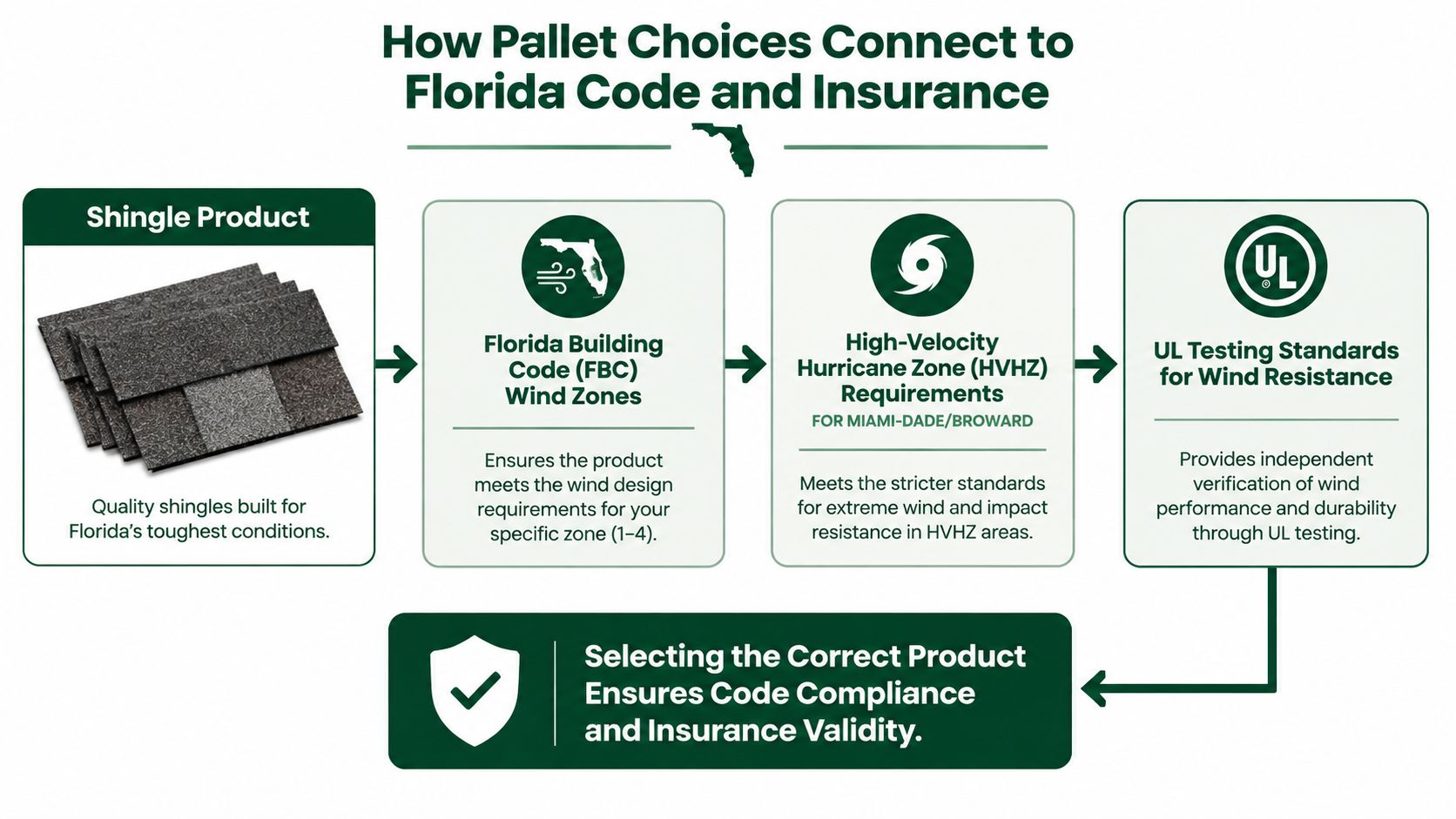
A shingle pallet is only useful if the product can be installed as part of an approved roof assembly. Florida projects may involve wind-zone requirements, local amendments, product approvals, fastening instructions, underlayment specifications, and inspection documentation. Coastal exposure and high-wind conditions can make the selection more restrictive than a simple color or style decision.
Products used in demanding Florida applications may need documented testing and approval for the intended assembly. The verified planning guidance specifically identifies ASTM D7158 Class H and ASTM D3161 Class F ratings as relevant examples for coastal homes. Those ratings don't replace a jurisdictional review, and a rating on the wrapper doesn't by itself confirm that the entire roof assembly meets every local requirement.
Quantity and documentation work together
Ordering the wrong product can create a bigger problem than ordering the wrong number of bundles. A contractor may need to verify the Florida Product Approval listing, compare the approved installation method, confirm the underlayment and nail pattern, and retain documentation for inspection.
Insurance is a separate decision. A carrier may consider roof covering, wind mitigation features, installation quality, and documentation when evaluating a policy or a potential credit. Homeowners shouldn't assume that changing from one shingle type to another guarantees a premium reduction. Coverage and insurer decisions belong to the carrier, not the roofing contractor.
A useful written scope should identify:
- Product identity: Manufacturer, line, color, and intended application.
- Approval documentation: Applicable Florida Product Approval information and local requirements.
- Accessory system: Underlayment, starter, ridge, flashing, and ventilation components.
- Fastening method: Nail type, pattern, and installation instructions.
- Inspection records: Permits, photos, and documentation needed for the jurisdiction or carrier.
Florida insurance rules and policy language can change. Homeowners reviewing a storm-related replacement or wind-mitigation question should read Florida roof insurance guidance for 2026 and confirm their specific situation with the insurer. A roofing contractor can document conditions and explain the installation scope, but can't promise coverage or an insurance outcome.
Ordering Tips and When to Get a Professional Inspection
The safest order starts with a written measurement and a product-specific material list. Don't use a neighbor's pallet count or a general online estimate as a substitute for the roof plan. The bundle count, coverage, accessories, and waste allowance all need to match the selected shingle line.
Check the order before delivery
Ask the contractor or supplier to confirm these points:
- Bundles per pallet: Verify the actual count for the selected product instead of relying on a standard assumption.
- Coverage per bundle: Compare the supplier's figure with the manufacturer's installation information.
- Accessory quantities: Confirm starter strips, ridge caps, valley materials, underlayment, flashing, and fasteners.
- Delivery location: Identify the exact staging surface and the protection planned underneath it.
- Code paperwork: Request the product approval information and installation requirements before the pallets are opened.
- Written scope: Make sure the proposal identifies pallet quantity, material type, labor, disposal, permits, and inspection coordination.
A professional inspection becomes especially useful when the existing roof has sagging decking, repeated leak areas, or signs of an earlier overlay. Those conditions can change tear-off requirements, deck preparation, staging space, and final material quantities. The visible roof area doesn't always reveal what the crew will find underneath.
Delivery safety deserves the same attention as roof safety. A brief OSHA construction safety inspection checklist offers a useful framework for checking access, hazards, equipment movement, and changing site conditions before work begins. On a residential reroof, that habit helps the crew keep pallets, debris, residents, pets, and vehicles separated.
A professional roofer should be able to explain why the order contains a particular number of pallets and how the material will move from the truck to the roof. If the answer is only “that's what we always order,” ask for the measurement and product coverage supporting it.
Planning a Florida Reroof?
JA Edwards can inspect the existing roof, measure the actual roof area, and build the material scope before delivery day. That means the pallet count, accessory quantities, staging plan, and installation scope all come from the same roof measurement.
JA Edwards of America Roofing provides roof inspections, repair and replacement planning, material scheduling, and code-focused installation for Florida homes and commercial properties. If you're planning a reroof in Orlando, Tampa, Port St. Lucie, Jacksonville, or a surrounding area, visit JA Edwards of America Roofing to request an inspection and discuss the right pallet quantity, staging plan, and roof assembly for your property.
Know the Roof Measurement Before the Truck Shows Up
JA Edwards can inspect the roof, measure the actual surface area, and build the replacement scope so materials, accessories, and delivery planning are based on the property instead of a guess.
Schedule a Free Roof InspectionIndustry & Official Sources
GAF: How Many Bundles of Shingles Are in a Square? — bundle-per-square guidance, roof measurement, and waste-factor basics.
GAF Timberline HDZ Specifications — current product specifications, bundles per square, wind standards and Florida approval references.
Florida Building Commission Product Approval Search — official database for Florida-approved construction products and assemblies.
Florida Building Commission — current Florida Building Code resources and code-update information.
OSHA Roofing Safety Guidance — material handling, roof work, access, and jobsite safety considerations.
Frequently Asked Questions
How many bundles are in a pallet of shingles?
A pallet of asphalt shingles commonly contains about 21 to 42 bundles, but there is no universal count. The manufacturer and product line determine the actual pallet configuration.
How much does a pallet of shingles weigh?
A loaded pallet may weigh roughly 2,100 to 3,360 pounds depending on the shingle type, bundle weight, and number of bundles on the pallet.
How much roof does one pallet of shingles cover?
A common planning range is about 7 to 14 roofing squares, or roughly 700 to 1,400 square feet. Actual coverage depends on the product's bundles-per-square requirement and the number of bundles on the pallet.
How many bundles of shingles cover one roofing square?
Many standard asphalt shingles use three bundles per roofing square, but specialty products can require four or more bundles. Always use the selected manufacturer's coverage information.
Can a pallet of shingles be placed on a driveway?
Often yes, but the contractor and supplier should evaluate the driveway surface, slope, pavers, access, unloading equipment, and total pallet weight before choosing the drop point.
How many pallets do I need for my roof?
Measure the actual roof surface first, convert it to roofing squares, apply the selected product's bundles-per-square requirement, add the project-specific waste and accessories, and then divide the final bundle count by the number of bundles per pallet.