
How to Choose a Restoration Company After a Florida Storm
After a Florida storm, choose a restoration company based on verified credentials, emergency response capacity, documentation quality, and clear insurance coordination. The fastest crew is not automatically the safest choice. Get the damage documented before repairs change the scene, verify who is responsible for the work, and avoid anyone who pressures you to sign before providing a written scope.
You come home after a Florida storm and find water staining the ceiling, missing shingles on the roof, and several trucks already working nearby. One crew offers to tarp the roof immediately. Another wants to open the walls. A third says it can handle the insurance claim if you sign paperwork on the spot. The pressure feels urgent because the damage is urgent, but the first decision you make can affect the quality of the entire recovery.
The U.S. damage restoration services industry is projected to generate about $7.7 billion in revenue in 2026 and include 57,615 businesses, according to industry data on water-damage restoration. That size reflects a fragmented, highly local market where homeowners need emergency response, specialized labor, accurate documentation, and insurance coordination at the same time.
The practical choice isn't just which company can arrive first. You control three decisions: who responds during the first day, how the damage is documented, and how the restoration scope connects with the insurance claim. Speed matters, but speed without evidence can leave you with incomplete work, disputed line items, or a contractor who disappears before the adjuster arrives.
What Florida Homeowners Are Really Choosing Between After a Storm
A storm-damage call usually involves more than a roof leak. Wind can remove shingles, heavy rain can enter through exposed decking, and trapped moisture can affect ceilings, insulation, drywall, flooring, and personal property. In Florida, humidity can make a small opening more difficult to manage because wet materials need prompt assessment and controlled drying.
The first trade-off is speed versus thoroughness. A crew that arrives quickly can reduce additional water intrusion, but a rushed inspection may miss damage behind walls, around roof penetrations, or in attic insulation. A slower company with better processes may produce stronger documentation, but it still needs a credible emergency plan.
The second trade-off is local presence versus surge capacity. A local office may understand nearby permitting practices, building requirements, and common roof assemblies. A larger regional network may bring additional crews and equipment during a major storm. Neither model is automatically reliable. Ask who will perform the work, where the equipment is staged, and who remains responsible after the first visit.
The three decisions within your control
-
Emergency response: The company should contain active water intrusion, protect unsafe areas, and determine what needs immediate mitigation. Tarping or board-up work should be recorded with photographs and a written description of the affected areas.
-
Documentation quality: Moisture readings, photographs, equipment logs, material damage, and daily updates create the technical record behind the restoration scope. A verbal description or a few wide-angle photos won't provide the same support.
-
Insurance coordination: The contractor can document conditions and explain the work proposed, but the insurance carrier decides coverage. A sound restoration company separates technical evidence from promises about payment.
Practical rule: Choose the company that can explain what it will do in the first visit, what it will document, and who will still be available when the adjuster reviews the loss.
The global water-damage restoration market is projected to reach $5.97 billion in 2026 and $8.97 billion by 2032, according to market research on water-damage restoration. That growth doesn't make every contractor qualified. It does make careful screening more important as homeowners encounter more companies competing for storm-related work.
The Credentials That Matter Before You Sign Anything
A business card that says “restoration” doesn't tell you whether the company can legally perform the work you need. For a roof-related loss, verify the contractor's Florida license and confirm that the license matches the proposed work. For water, fire, or mold mitigation, ask who supervises the work and what training that person has received.
The IICRC S500 standard is the principal U.S. technical reference for professional water-damage restoration and applies to residential, commercial, and institutional buildings, including their contents. A company working under that framework should be able to describe its assessment, extraction, drying, monitoring, and closeout process rather than offering only a general promise to “clean everything up.” You can review the standard through the Institute of Inspection Cleaning and Restoration Certification.
Match credentials to the loss
For storm work involving the roof and interior, look for a properly licensed Florida roofing or general contractor, current liability insurance, workers' compensation coverage, and restoration technicians with relevant IICRC training. A roofing license alone doesn't establish that a crew knows how to establish drying goals or document affected contents. Restoration certification alone doesn't authorize a company to perform every roofing or structural repair.
Ask for certificates of insurance and request that your name appear as the certificate holder for verification purposes. A certificate isn't a guarantee of workmanship, but it gives you a way to confirm that the company has arranged the coverage it represents.
| Credential | What It Covers | Why It Matters | How to Verify |
|---|---|---|---|
| Florida contractor license | Authorized construction or roofing work | Connects the proposed roof work to the contractor's legal scope | Search the license through Florida's DBPR portal |
| General liability insurance | Certain third-party property or injury risks | Shows the company has commercial coverage in place | Request a current certificate |
| Workers' compensation coverage | Employee workplace injuries | Helps distinguish an organized operation from an informal crew | Request the certificate and confirm its validity |
| IICRC certification | Restoration methods and technical standards | Supports disciplined water, fire, and contents procedures | Ask for the firm's and technicians' credentials |
| Manufacturer or system credentials | Installation of specific roofing systems | Helps with system-specific requirements and warranty conditions | Confirm the credential with the manufacturer |
Florida roof work can also involve permits, product approvals, roof plans, insurance documentation, and final inspections. Florida roof permit documentation guidance describes common items such as Florida Product Approval numbers, a roof sketch showing damaged areas, and contractor insurance documentation.
Emergency Response and Crew Capacity in Storm Season
A true emergency response operation has people, equipment, and accountability already organized. A 24-hour phone line is useful, but it doesn't prove that the company has its own crews ready to act. Ask whether the person answering the call works for the company, whether the field team is an employee or subcontractor, and who will manage the job after the initial mitigation.
During the first 0 to 72 hours, a competent response may include temporary roof protection, board-up work, a safety assessment, moisture mapping, and photographs before materials are removed. If contents need to be moved or packed out, the crew should identify what was moved, where it went, and whether disposal is being proposed. Thermal imaging can help identify areas that deserve closer inspection, but it doesn't replace direct moisture readings.
Compare the operation, not the truck
| Question | Established response operation | Storm-chasing pattern |
|---|---|---|
| Who arrives? | Identified crews with a supervisor and company contact | Rotating crews with unclear responsibility |
| Where is equipment kept? | Local or regional warehouse staging | Equipment brought in temporarily with limited visibility |
| Who owns the drying equipment? | Company can identify equipment and placement records | Contractor relies heavily on rented or borrowed equipment |
| What happens after mitigation? | Same company tracks monitoring and closeout | Initial crew may leave before the claim review |
| What do you receive? | Written scope, photographs, readings, and updates | Cash quote or brief estimate with little detail |
Before hiring, ask for the number of trained crews available in your service area, the equipment the company owns or can access, and the location of its warehouse or staging facility. A contractor serving Orlando, Tampa, Jacksonville, or Port St. Lucie should be able to explain how it handles local calls when a regional storm creates a surge.
For immediate roof exposure, ask what temporary protection is available and how the work will be documented. JA Edwards' emergency roof tarping information provides a useful example of the questions homeowners should raise before authorizing emergency roof work.
Storm damage? Document the roof first.
Before interior work changes the scene, start with a photo-documented roof inspection. We can identify visible roof conditions, document storm-related concerns, and explain the next practical step without pressuring you into a claim.
Documentation Standards That Protect Your Claim
Restoration records aren't clerical extras. They show what was damaged, what the crew did, how conditions changed, and why the proposed work is necessary. Under the ANSI/IICRC S500 framework, a technically sound workflow includes loss assessment, safety evaluation, extraction, psychrometric baseline readings, moisture mapping, material triage, daily monitoring, drying-goal verification, and final documentation. The drying target is generally to bring affected materials within about 2 to 4 percentage points of unaffected reference materials in the same building, as described in water-mitigation guidance based on IICRC S500.
Records to request before work begins
-
Pre-mitigation photographs: These should show the affected rooms, roof conditions, visible water, contents, and any pre-existing issues before demolition or drying equipment changes the scene.
-
Moisture map: The map should identify affected materials and include readings from appropriate pin-type or non-invasive meters. A guess based on a dark stain isn't equivalent to measured information.
-
Psychrometric log: Temperature and humidity readings help establish whether drying conditions are improving and whether the equipment is being used appropriately.
-
Equipment log: Ask for the type, location, and operating status of air movers, dehumidifiers, or other drying equipment.
-
Daily monitoring notes: The record should show repeated readings, changes in equipment placement, and the reason for continuing or stopping mitigation.
-
Contents inventory: If items are moved, packed out, cleaned, or discarded, the company should identify them and preserve a record of what happened.
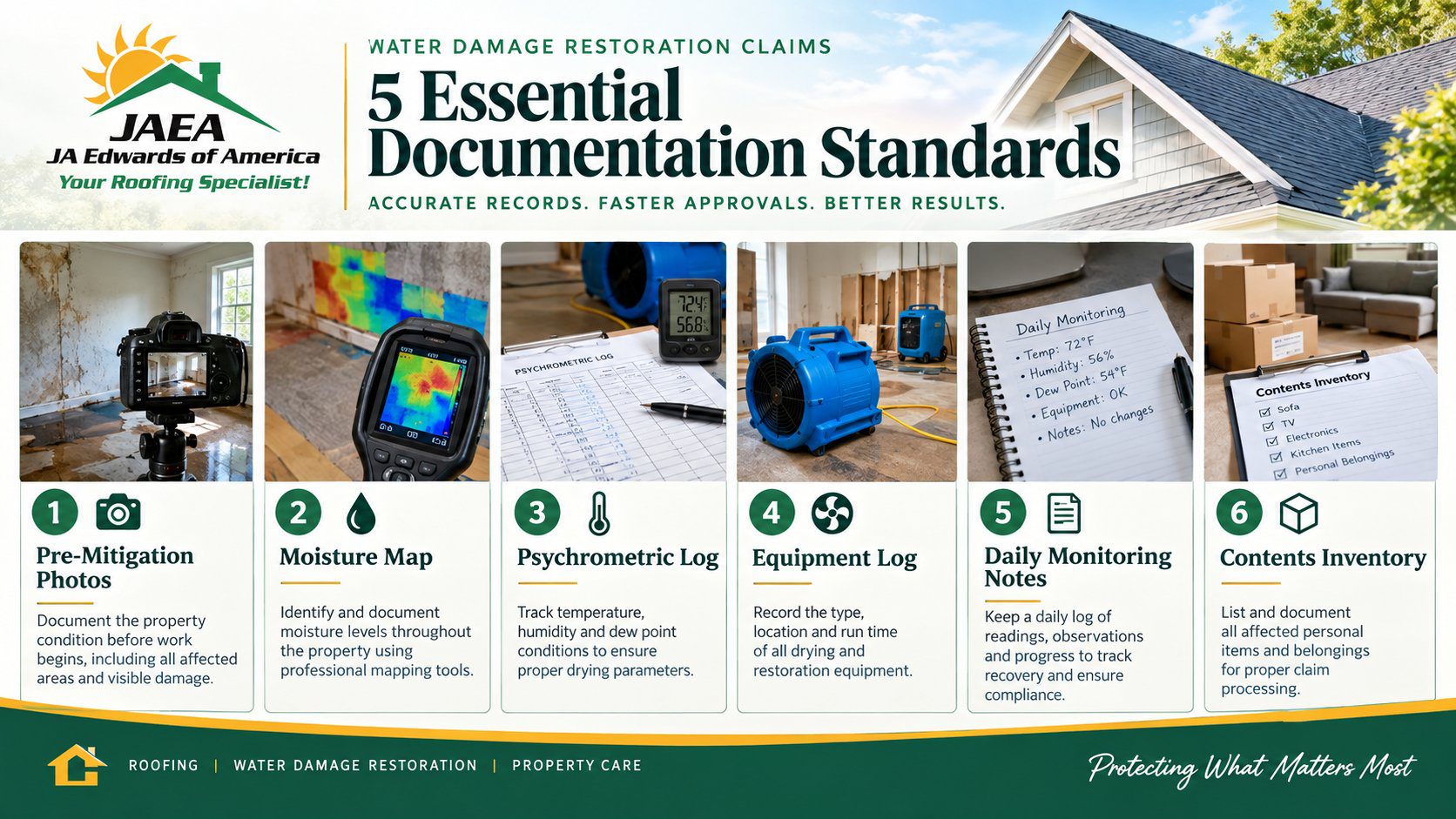
Visual dryness isn't a drying goal. A wall may feel dry while moisture remains inside a baseboard, under flooring, or behind a cabinet. The crew should verify progress with readings and keep the job file complete before demobilizing.
Homeowners handling a loss can also review this step-by-step Florida claims guide for general claim-filing context. For roof-specific evidence, use a process that includes documenting storm damage on your roof for a Florida insurance claim, with clear photographs and descriptions tied to actual conditions.
How Restoration Work Connects to Roofing and Insurance Claims
Insurance coordination is a separate hiring criterion, not a courtesy. The contractor's job is to document conditions, prepare a defensible scope, explain the proposed repairs, and communicate with the carrier as appropriate. The carrier still makes the coverage decision, and no restoration company can guarantee approval.
A roof inspection may identify wind creasing, displaced materials, damaged flashing, or openings around penetrations. Those findings can connect to interior staining, wet insulation, damaged drywall, contents handling, and code-related roofing work. If the roof evidence is vague, the adjuster may struggle to connect the exterior condition with the interior loss.
What strong claim coordination looks like
A detailed estimate identifies work by location, material, quantities, and task. Depending on the job, the contractor may use estimating platforms such as Xactimate or Symbility, but software alone doesn't make a scope accurate. The photographs, measurements, notes, and causation narrative must support the line items.
| Documentation Element | Weak Practice | Strong Practice |
|---|---|---|
| Roof condition | Wide photo of the entire roof | Close images tied to roof sections and observed damage |
| Interior loss | General statement that rooms are wet | Room-by-room scope with affected materials and readings |
| Cause of damage | “Storm damage” without explanation | Narrative connecting observed conditions to the documented event |
| Temporary protection | Invoice with no field record | Photos, date, location, and reason for tarping or board-up |
| Code-related work | Omitted or described as an assumption | Identified separately for carrier and permitting review |
| Supplemental items | Added without supporting evidence | New findings linked to photographs, measurements, and notes |
For Florida homeowners reviewing rebuilding needs, this resource on home replacement cost for hurricane codes can help explain why code-related considerations deserve a separate discussion. It doesn't determine your coverage, but it highlights why the initial scope shouldn't treat every roof as a simple material replacement.
A claim can also involve actual cash value and replacement cost provisions, depending on the policy and carrier decision. The contractor should explain what it observed and what work it recommends, while the homeowner reviews coverage questions with the insurer or an appropriately licensed professional.
For a Florida-specific example of how roof inspection, mitigation, scope development, and repair can connect, review the storm-damage roof repair process in Tampa. The central lesson is simple. A complete file gives the adjuster something concrete to evaluate, while a lump-sum estimate leaves too much room for disagreement.
Red Flags That Signal a Storm-Chasing Operation
Storm-chasing crews often reveal themselves through their process before they reveal themselves through poor workmanship. An unsolicited representative appears while the neighborhood is still without power, offers a quick verbal price, and asks for a signature before providing a license, insurance certificate, or itemized scope. That combination should slow you down, even if the roof is actively leaking.
A local address and a truck with Florida plates don't prove quality, but the absence of verifiable information is a serious warning. A legitimate company should be able to identify its legal business, provide a written assessment, explain who will do the work, and remain reachable after the initial emergency visit.
Watch for these pressure tactics
-
Door-knock urgency: You don't need to sign immediately because someone claims to have just finished work nearby.
-
Large upfront payment: Ask why the money is needed, what milestone it covers, and whether the agreement explains payment terms.
-
One-page scope: A vague description such as “repair roof and interior” doesn't identify materials, locations, protection, drying, or exclusions.
-
Unverified license: Search the contractor through Florida's DBPR records instead of relying on a logo or license number printed on a flyer.
-
No local references: Request recent Florida storm-work references and call them directly.
-
Assignment pressure: Don't sign an Assignment of Benefits or similar document within minutes because someone says it's required for service.
-
No physical office: A temporary phone number and unfamiliar address make follow-up harder if the project stalls.
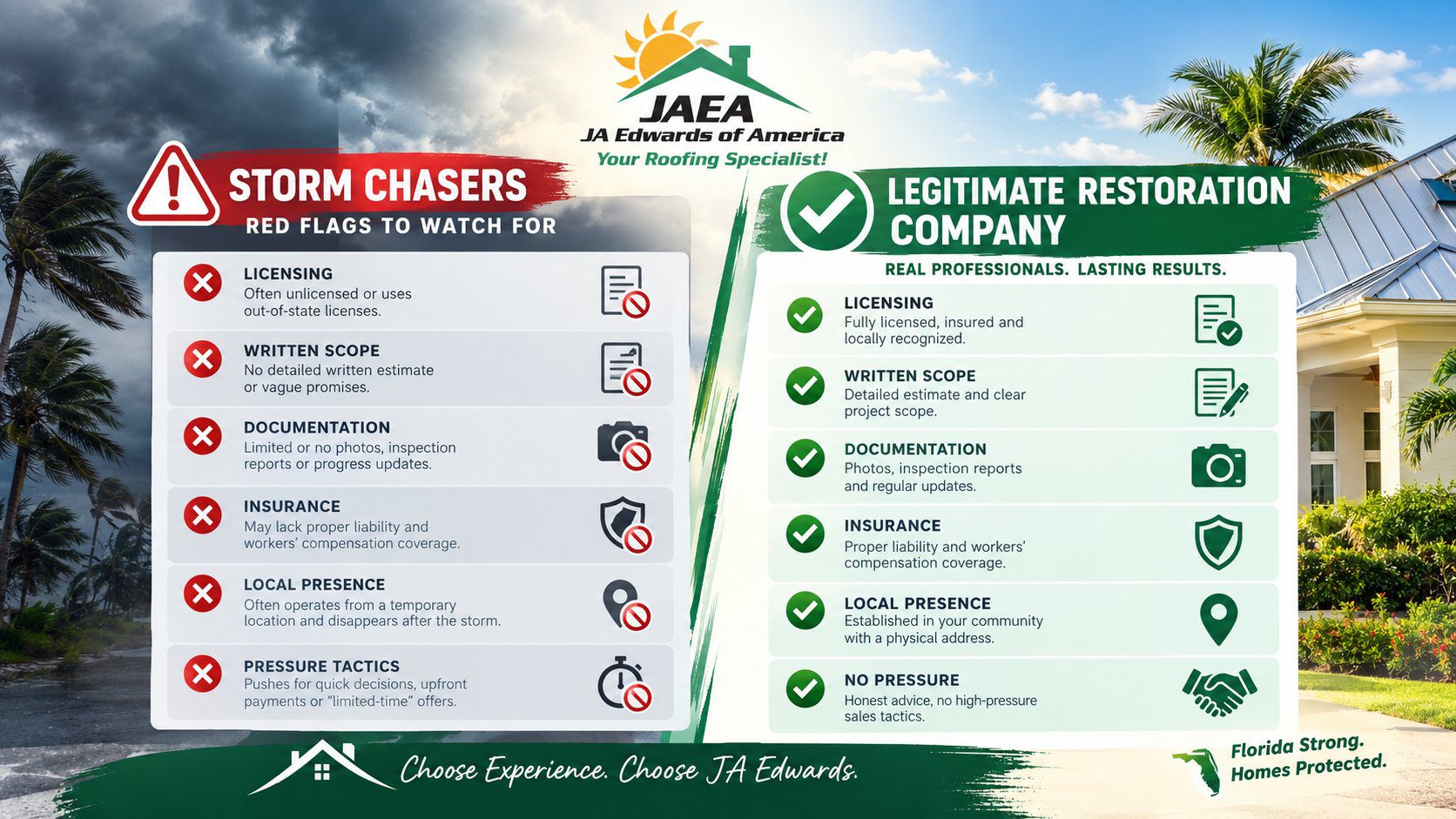
A trustworthy counter-move is verification. Ask for the Florida license, current certificate of insurance, IICRC credentials by name, written scope, and local references. JA Edwards' Florida roofing scam warning signs offers another practical reference for recognizing pressure-based roofing sales tactics.
The first truck at your door isn't necessarily the right contractor. Speed helps contain damage, but speed doesn't replace verification.
Don't sign under pressure after a storm.
A free roof inspection gives you a written starting point before you commit to repairs, restoration work, or an insurance-related scope.
Your Practical Checklist Before Hiring a Restoration Company
Use the following sequence before signing a restoration agreement. If the company refuses to provide basic information, treats questions as an inconvenience, or asks you to rely on verbal promises, keep looking.
-
Confirm the state license. Search the contractor through Florida's Department of Business and Professional Regulation records. Make sure the license belongs to the contracting business you plan to hire and relates to the work proposed.
-
Request insurance certificates. Ask for current general liability and workers' compensation documentation. Request the certificate as part of your verification, and don't assume a subcontractor has the same coverage as the company that signed your agreement.
-
Verify IICRC credentials. Ask whether the firm and the technicians assigned to your project hold relevant water, mold, or fire restoration credentials. The company should also be able to explain its equipment and monitoring procedures.
-
Review the documentation process. Before work starts, ask how the crew will produce pre-loss photographs, moisture maps, psychrometric readings, equipment records, contents inventories, and daily drying logs. If the answer is “we'll take care of the paperwork,” ask for more detail.
-
Get a written scope and estimate. The document should identify affected areas, proposed demolition, drying or cleaning work, temporary protection, materials, exclusions, timing, and the process for handling newly discovered conditions. Don't rely on a lump-sum verbal quote.
-
Check local references and reviews. Request references from Florida storm jobs completed within the past 18 months, as specified in this hiring checklist, and ask those customers whether the company remained available through inspection, documentation, and closeout. Review local feedback rather than relying only on reviews posted during a storm surge.
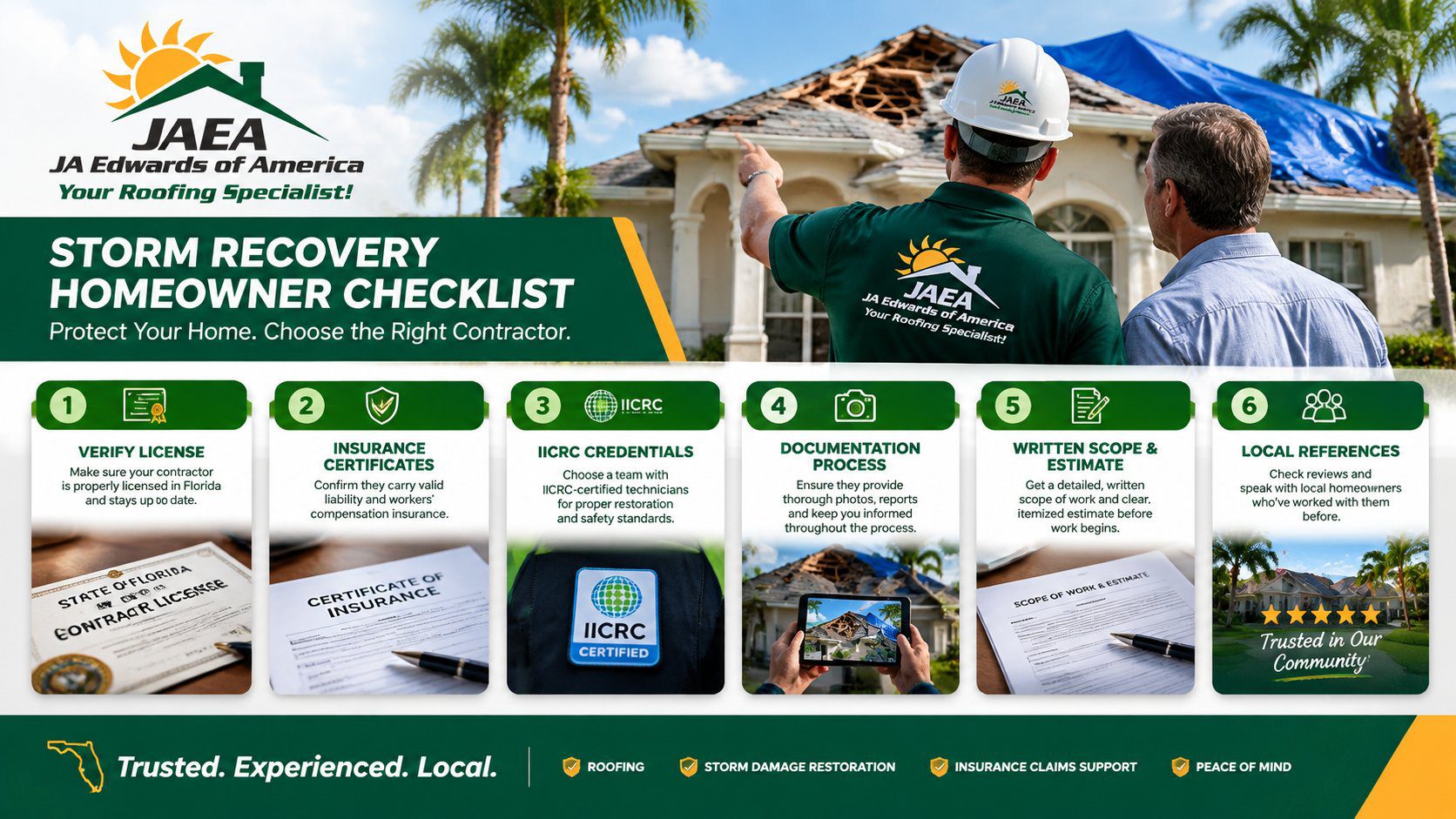
The most useful first step is a documented roof and property inspection. It establishes the condition of the roof and affected interior areas, preserves evidence before repairs alter the scene, and gives you a clearer basis for discussing mitigation and insurance. If you're in Orlando, Jacksonville, Tampa, Port St. Lucie, or a surrounding Florida community, JA Edwards of America Roofing provides photo-documented inspections, emergency tarping, roof repairs, replacements, and storm-damage support for residential and commercial properties. Visit JA Edwards of America Roofing to schedule an inspection and start with a written record instead of a rushed promise.
Start with a documented inspection
Before repairs, restoration work, or insurance conversations change the scene, get a clear photo record of the roof and visible storm damage. The inspection is free, and the report is yours to keep.