
Do You Need a Roofing Permit in Florida? 2026 Rules Homeowners Should Know
Most full reroofs still require a permit, but Florida changed its permit law in 2026. Here is what the new under-$7,500 exemption actually says, when it does not apply, how the 25% roof rule works today, and what homeowners should expect from application through final inspection.
A roofing permit is not just a fee attached to a reroof. It connects the proposed work to the applicable Florida Building Code, product approvals, wind requirements, inspections, and the local building department responsible for the property.
The confusing part is that Florida now has statewide permit exemptions, statewide roofing rules, and local administrative procedures operating at the same time. A City of Orlando permit page, a Tampa threshold, a Jacksonville reroof process, and a Port St. Lucie checklist can all look different without necessarily contradicting state law.
This guide separates those layers and uses current government sources rather than treating an old contractor blog or a pre-2026 permit page as statewide law.
Table of Contents
- The Short Answer: When Does a Florida Roof Need a Permit?
- What Changed in Florida on July 1, 2026?
- Roofing Work That Still Typically Needs a Permit
- Orlando, Tampa, Jacksonville & Port St. Lucie Examples
- The Florida 25% Roof Rule: What It Actually Says Now
- What Goes Into a Roofing Permit Package?
- What Roof Inspections Should You Expect?
- Older Homes & Hurricane-Mitigation Requirements
- How Long Can a Florida Roofing Permit Take?
- Who Pulls the Permit and Who Closes It?
The Short Answer: When Does a Florida Roof Need a Permit?
For a typical full roof replacement, the safe answer is yes, expect a permit. Florida Statute 553.79 starts from the rule that construction, alteration, modification, repair, or demolition of a building requires a permit unless another law provides an exception.
Roof replacement is also treated as permit work by the major jurisdictions JA Edwards serves. The City of Orlando has a dedicated residential roof permit process; Tampa publishes roofing permit requirements; Jacksonville lists reroofs among work requiring permits; and Port St. Lucie publishes a roof replacement permit application and checklist.
But that is not the whole answer anymore.
Important 2026 Change
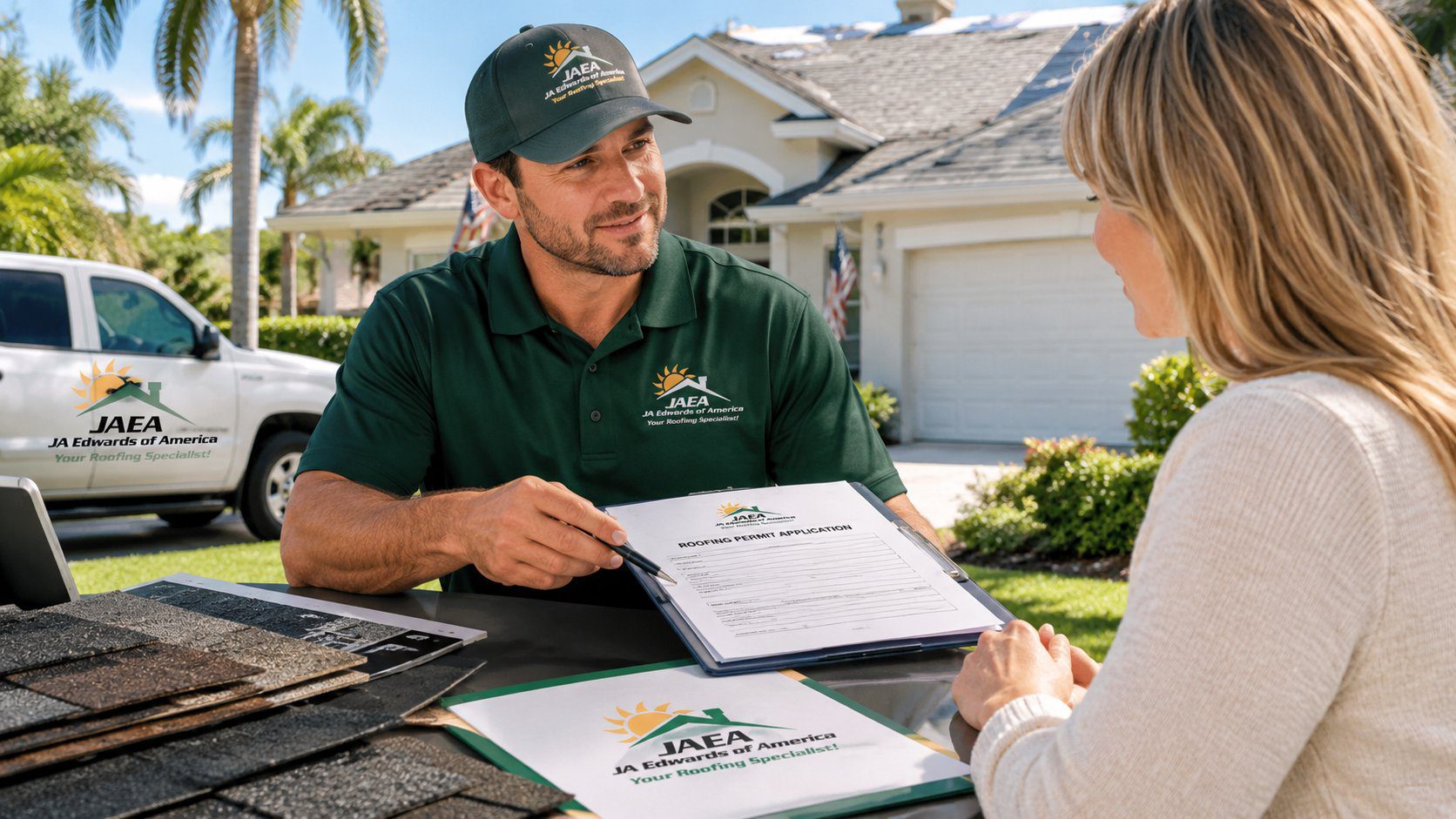
Florida's 2026 permit law created a statewide exemption for certain work valued at less than $7,500 on property containing a single-family dwelling. It is not a blanket “small roof repair = no permit” rule. Flood-hazard properties and electrical, plumbing, structural, mechanical, or gas work are excluded, and the owner or contractor must request the exemption in writing.
What Changed in Florida on July 1, 2026?
House Bill 803 changed Florida's building-permit statutes for 2026. The controlling language now appears in Florida Statute 553.79.
For a single-family dwelling, the statute says a local government must exempt the owner or the owner's contractor from obtaining a building permit for work valued at less than $7,500 when the statutory conditions are satisfied.
The exemption does not apply when:
The statute expressly excludes those properties from this exemption.
For roofing, structural deck, rafter, truss, or similar structural work can take the project outside the exemption.
The statute specifically prohibits dividing one project into multiple smaller projects to evade the rule.
The owner or contractor must submit a written request to the local enforcement agency with a contract or other documentation showing the nature and value of the work.
One important correction to a lot of summaries circulating online: the statute does not say the home has to be owner-occupied for this particular permit exemption. It refers to the owner of a single-family dwelling or the owner's contractor.
Practical rule: If a roof repair is small enough to fall under $7,500, do not assume it is automatically permit-free. First determine whether the work is structural, whether the property is in a flood hazard area, and whether the local agency has accepted the required exemption request.
Roofing Work That Still Typically Needs a Permit
The new exemption did not eliminate Florida roofing permits. In practice, these projects should still be treated as permit work unless the building department confirms otherwise:
- Full roof replacement: A complete reroof normally exceeds the exemption and involves a new permitted roofing assembly.
- Roof re-cover: Installing a new roof covering over an existing system is normally reviewed as reroof work.
- Structural roof repairs: Deck, truss, rafter, structural framing, or similar work falls outside the under-$7,500 exemption.
- Work valued at $7,500 or more: The statewide exemption is written for work valued at less than $7,500.
- Work in a flood hazard area: The 2026 exemption does not apply.
- Commercial and multifamily roof work: The new exemption is written for property containing a single-family dwelling, not as a general commercial roofing exemption.
That is why a contractor should identify the real scope before answering the permit question. A repair that looks like a membrane or shingle patch from above may expose deteriorated decking once the covering is removed.
How the Process Looks in JA Edwards Markets
State law controls statewide rules, but the local building department still manages applications, documents, inspections, and administrative procedures. That is where homeowners see the differences.
Orlando
The City of Orlando directs residential roof replacement and repair projects through its roof-permit process and requires roof-system details such as underlayment, covering, and fasteners. Orlando also requires a dry-in/in-progress inspection for reroof permits. Small work that may qualify for the new state exemption should be confirmed with the city before work begins.
Tampa
Tampa's published roofing guidance requires permits for new roofs, reroofs, re-covers, or repairs exceeding 500 square feet, while its code lists roof-covering work of 500 square feet or less among permit exemptions. The 2026 state under-$7,500 exemption can create an additional statewide question for qualifying single-family work.
Jacksonville
Jacksonville lists reroofs among alterations that require a permit and maintains a separate roofing-fee schedule. For a small repair, the 2026 state exemption still needs to be evaluated against the actual scope, value, flood status, and structural work.
Port St. Lucie
Port St. Lucie publishes a dedicated roof replacement permit application and identifies roof replacements or substantial repairs as permit work in its storm-recovery guidance. The city also publishes project-specific roofing documentation and inspection requirements.
Do not copy a permit threshold from one city and apply it to another. The statewide statute, the Florida Building Code, and the local administrative process all matter.
The Florida 25% Roof Rule: What It Actually Says Now
This is the part most likely to be repeated incorrectly.
The old shorthand is: “If you repair more than 25% of the roof in 12 months, you have to replace the whole roof.”
That is no longer an accurate blanket statement.
Florida Statute 553.844(5) says that when an existing roofing system or roof section was built, repaired, or replaced in compliance with the 2007 Florida Building Code or any later edition, repairing, replacing, or recovering 25% or more does not automatically require replacement of the entire roof or roof section. Only the portion being worked on must be constructed to the currently applicable Florida Building Code.
The 25% Rule Is Not One Sentence Anymore
Roof compliant with the 2007 FBC or later? The state-law exception can allow 25% or more of the roof or roof section to be repaired, replaced, or recovered without forcing full replacement solely because of the percentage.
Older roof or compliance cannot be established? The broader 25% code rule may still matter, and the building official should determine how it applies to that roof section and project.
So the right question is not just “what percentage are we repairing?” It is also “what code was the existing roof built or reroofed under?”
For a deeper explanation, see JA Edwards' Florida 25% roof replacement rule guide.
What Goes Into a Roofing Permit Package?
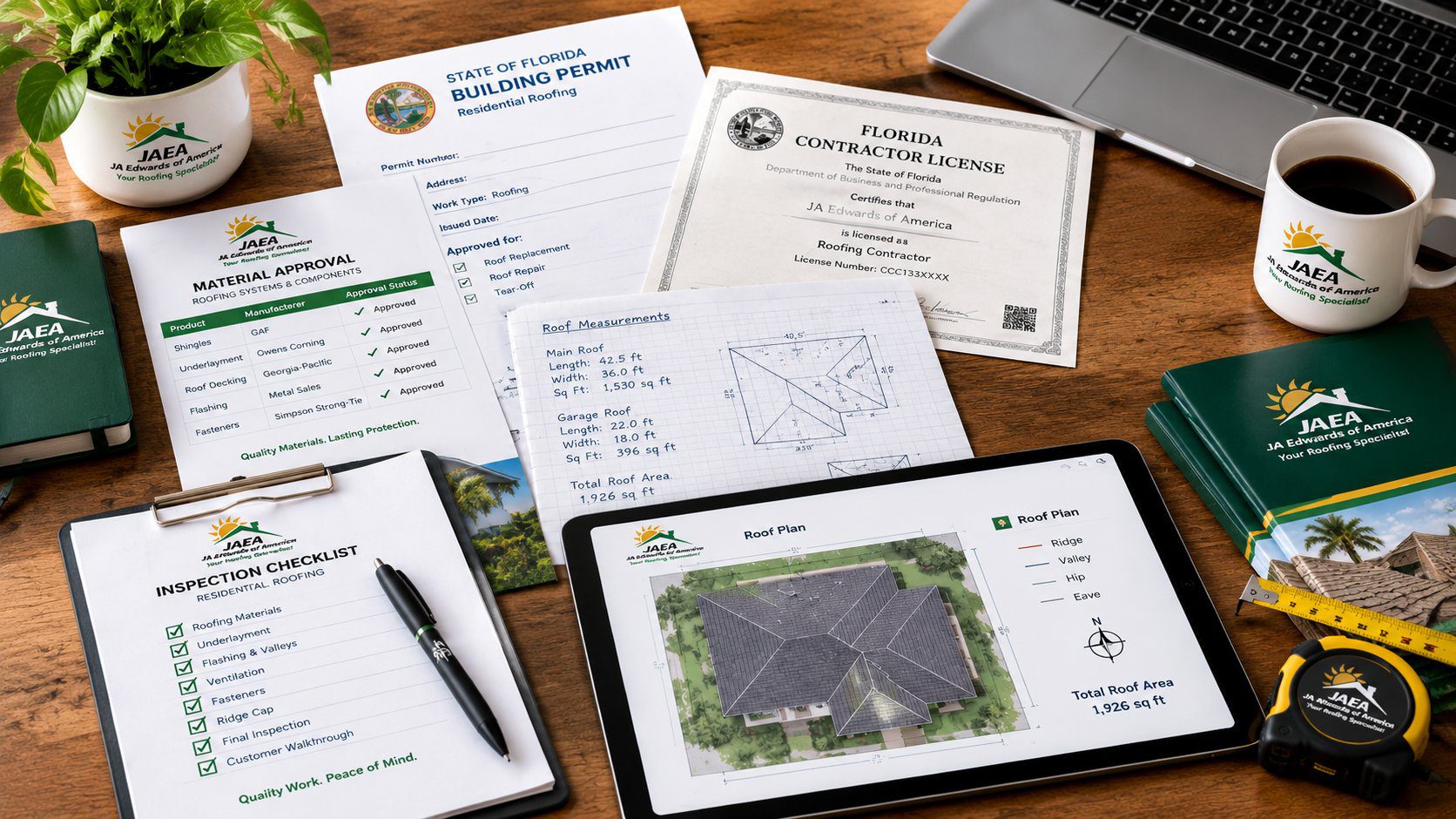
The exact checklist changes by jurisdiction and roof system, but a typical Florida reroof submittal may include:
- Property and owner information
- Licensed contractor information and license number
- Roof area, slope, and scope of work
- Existing and proposed roof covering
- Underlayment system
- Fastener type and fastening schedule
- Florida Product Approval or applicable approval documentation
- Engineering or calculations when required by the system or jurisdiction
- Notice of Commencement when required
When is a Notice of Commencement required?
Florida Statute 713.135 requires the permitting authority to obtain a copy of the recorded Notice of Commencement before the first inspection when the direct contract is greater than $5,000. The permit itself can be issued before the NOC is recorded, but inspections cannot proceed past the statutory point without the required copy.
The City of Orlando, for example, tells applicants to file a recorded NOC when project value exceeds $5,000 and provide the city with the recorded information.
Why the exact roof system matters
A permit is not issued for “some shingles” or “a metal roof” in the abstract. Reviewers may need to verify the actual product approval, underlayment, fastening, deck substrate, attachment method, and wind design that make up the proposed roof assembly.
The Florida Building Commission's Product Approval search is one of the official tools used to verify products approved for use under the current Florida Building Code.
What Roof Inspections Should You Expect?
Inspection names and timing vary, so there is no single statewide list that every building department uses identically. A reroof may involve some combination of:
- Permit/application review
- Deck or sheathing inspection
- Dry-in or in-progress inspection
- Fastening, flashing, or concealed-work verification
- Final roof inspection and permit closeout
Orlando specifically states that it requires a dry-in/in-progress inspection for residential and commercial reroof projects and warns that a roof may be rejected at final inspection if concealed work was covered before the required inspection.
Port St. Lucie and St. Lucie County also publish roofing inspection procedures that address decking/sheathing, in-progress conditions for certain systems, and final inspection.
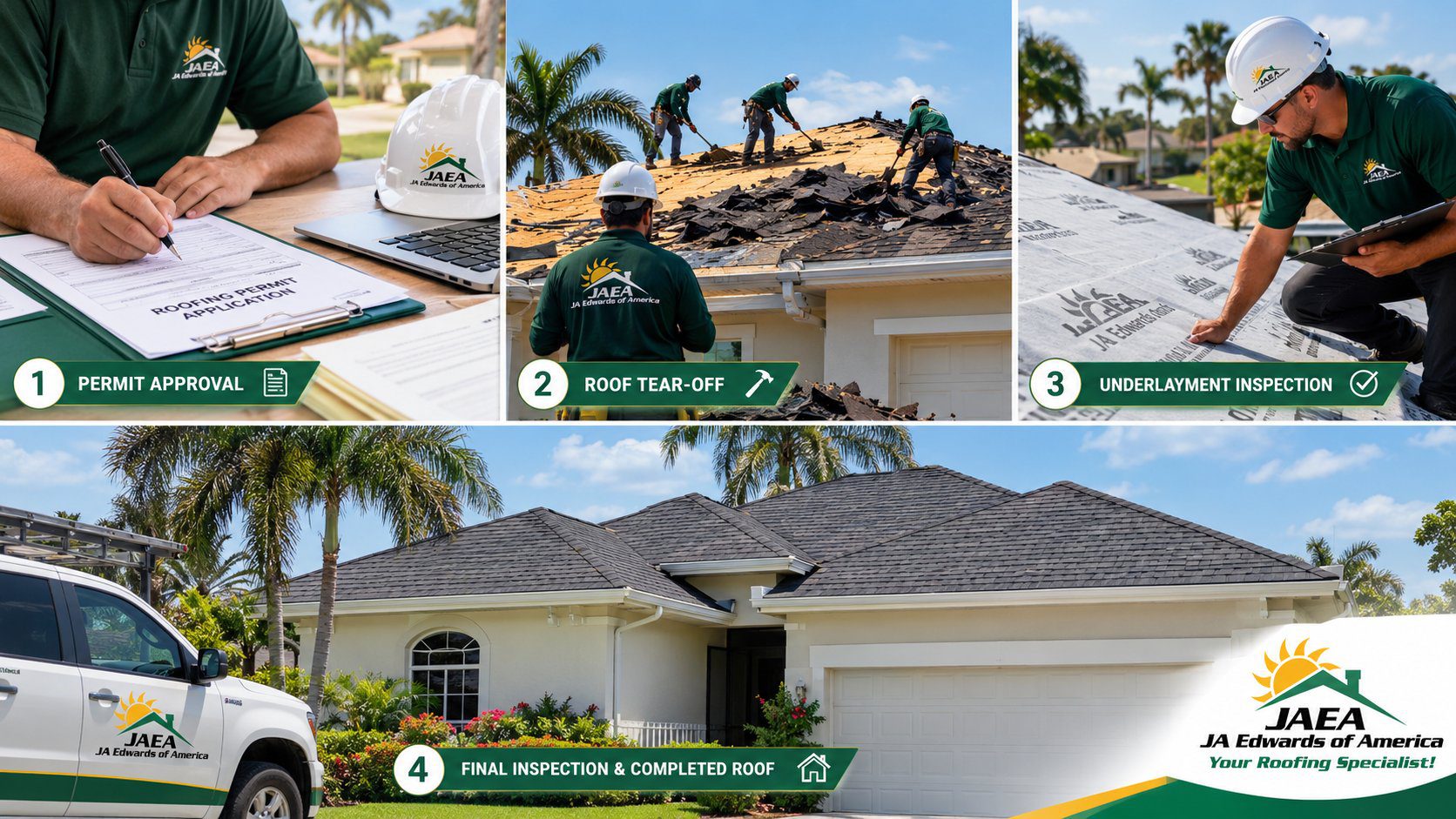
Do not cover required inspection work early. If decking, underlayment, flashing, or another concealed component is covered before the required inspection or approved documentation, finished roofing may have to be removed so the jurisdiction can verify the work.
Older Florida Homes & Hurricane-Mitigation Requirements
Reroofing an older Florida home can trigger more than a roof-covering review.
Florida Statute 553.844 directs the Florida Building Code to include windstorm-loss mitigation techniques in certain roof replacements on site-built single-family residential structures. Depending on the property, that can involve roof-deck attachment, secondary water protection, and, under defined conditions, roof-to-wall connection improvements.
Tampa's roofing guidance, for example, states that single-family residences constructed before March 1, 2002 must comply with applicable hurricane-mitigation retrofit requirements during reroofing.
This does not mean every pre-2002 home gets the same retrofit scope. Property value, wind-borne debris location, existing connections, roof configuration, and the statutory cost limits can affect what applies.
If the existing roof has leaks, sagging, prior overlays, or unknown deck conditions, a professional inspection before the permit package is finalized can reduce surprises. See what to expect during a professional roof inspection.
How Long Can a Florida Roofing Permit Take?
There is no single guaranteed statewide issuance time for every reroof because incomplete applications, revisions, engineering, product approvals, flood review, and local corrections can all affect the process.
But Florida did add a useful 2026 timing rule. Under Florida Statute 553.792, a local government generally must approve, approve with conditions, or deny a complete and sufficient permit application within 5 business days for specified permits on an existing single-family dwelling when the work is valued at less than $15,000 and the applicant is using the local government's plans reviewer, unless the applicant waives the timeframe.
That is a review deadline, not a promise that every roof permit is issued in five days. A missing product approval or an incomplete application can still stop the clock from producing the result a homeowner expected.
Who Pulls the Permit and Who Closes It?
When JA Edwards is the roofing contractor on a permitted project, the company can coordinate the roofing permit process, submit the roofing scope and required documentation, respond to permit comments, schedule required inspections, and track the permit through closeout.
The building department still makes the permitting and inspection decisions.
Before work begins, a homeowner should be able to answer four basic questions:
- Is this project permitted or legitimately exempt?
- If permitted, what is the permit number?
- Which inspections are required before the roof is covered?
- Who is confirming final approval and permit closure?
A permit that was opened but never properly closed can create unnecessary questions later. Keep the permit number, inspection results, product information, warranty documents, invoices, and final approval with the home's roof records.
Current Florida Code as of September 2026
The statewide code currently in effect is the Florida Building Code, 8th Edition (2023), which became effective December 31, 2023. The Florida Building Commission's current development schedule sets December 31, 2026 as the effective date for the 9th Edition (2026).
That upcoming transition is another reason not to rely on an old permit checklist saved from a previous reroof. The applicable requirements should be confirmed for the actual permit and jurisdiction.
Start With the Roof Scope, Not a Permit Guess
A small repair, structural repair, re-cover, and full replacement can follow very different permit paths. Have the roof inspected first so the paperwork matches the work that actually needs to be done.
Schedule a Free Roof InspectionOfficial Sources Used for This Guide
Florida Statute 553.79 — statewide permit rule and the 2026 under-$7,500 single-family exemption.
Florida Statute 553.844 — windstorm-loss mitigation and the current 25% roofing exception.
Florida Statute 553.792 — local-government permit review timeframes.
Florida Statute 713.135 — Notice of Commencement requirements.
Florida Building Commission — current Florida Building Code information and 2026 code-update materials.
City of Orlando — Residential Roof Permit.
City of Tampa — Roofing Permit Requirements.
Important: This article provides general roofing-permit information for Florida homeowners. The building official with jurisdiction over the property makes the final permit and inspection determination for a specific project.
Frequently Asked Questions
Do I need a permit to replace my roof in Florida?
For a typical full roof replacement, yes. Full reroofs generally go through the local building-permit process because the new roof assembly, materials, fastening, product approvals, and inspections must be reviewed under the applicable Florida Building Code.
Can a small roof repair in Florida be done without a permit in 2026?
Possibly. Florida Statute 553.79 now requires a permit exemption for qualifying work valued at less than $7,500 on property containing a single-family dwelling. The exemption does not apply in a flood hazard area or to structural, electrical, plumbing, mechanical, or gas work. The owner or contractor must also submit the required written exemption request and documentation to the local enforcement agency.
Does repairing more than 25% of a roof automatically require full replacement in Florida?
No. If the existing roofing system or roof section was built, repaired, or replaced in compliance with the 2007 Florida Building Code or a later edition, Florida Statute 553.844(5) says only the portion being repaired, replaced, or recovered must comply with the current code even when the work reaches 25% or more. Older roofs can require a different analysis.
When is a Notice of Commencement required for a Florida roof?
Under Florida Statute 713.135, a copy of the recorded Notice of Commencement must be provided before the first inspection when the direct contract is greater than $5,000. Local jurisdictions may have their own submission procedures.
Can roofing work start as soon as the permit application is submitted?
If the work requires a permit, filing the application is not the same as having an issued permit. Work should begin only after the required authorization has been issued and the contractor understands the inspection sequence. A statutory permit exemption is a separate process and should be documented before relying on it.
Which Florida Building Code is in effect in September 2026?
The Florida Building Code, 8th Edition (2023), is the current statewide code as of September 2026. The Florida Building Commission has scheduled the 9th Edition (2026) to take effect on December 31, 2026.