
Class 4 Shingles Cost in Florida for 2026
Class 4 shingles cost about $5–$8 per sq ft installed in Florida. Compare the upgrade, quote line items, and insurance limits for 2026.
For 2026, Class 4 shingles cost about $5 to $8 per square foot installed in Florida, or roughly $10,000 to $16,000 for a measured 2,000-square-foot roof. That's a planning range, not a bid.
The decision isn't just whether to buy a tougher shingle. It's whether the added material cost makes sense alongside the tear-off, deck repairs, underlayment, and wind-resistant installation your roof needs. Keep those costs separate, and don't subtract an insurance discount until your carrier confirms it in writing.
Class 4 Shingles Cost for a Florida Roof
Class 4 shingles run about $5.00–$8.00 per square foot installed in Florida, a planning estimate that already includes typical tear-off, underlayment, and disposal. On a measured 2,000-square-foot roof that works out to $10,000–$16,000, with the tougher shingle itself accounting for only part of the bill.
2026 planning ranges for Class 4 versus standard shingles
The table below combines that Florida benchmark with HomeMatchup's installed-cost comparison, which lists standard architectural shingles at $4.50–$6.50 per square foot and Class 4 shingles at $550–$800 per roofing square.
| Cost measure | Standard architectural | Class 4 impact-resistant |
|---|---|---|
| Installed per square foot | $4.50–$6.50 | $5.00–$8.00 in Florida |
| Installed per roofing square (100 sq ft) | $450–$650, calculated from the installed range | $550–$800 in the separate market comparison |
| Measured 2,000 sq ft roof, typical install | $9,000–$13,000, calculated from the installed range | About $10,000–$16,000 |
| Upgrade over standard shingles | Baseline | Roughly $1,000–$3,000, the gap between the measured-roof totals above |
| Material only per square | About $90–$150 | About $120–$200 |
These are planning figures, not JA Edwards estimates. The installed-per-square row comes from a different market comparison than the Florida per-square-foot row, so their lower endpoints do not match and should not be merged into a single price formula.
Read the upgrade row as a range, not a fixed number. Where it lands depends on which two products you are comparing, because a basic architectural shingle and a premium Class 4 shingle can differ in appearance and warranty terms as well as impact resistance. Part of that gap buys more than a tougher shingle.
Why bundle prices don't tell you replacement cost
Material-only pricing covers the shingles. It does not cover tear-off, deck preparation, flashing, underlayment, labor, permits, or cleanup, so a supplier's product price and a contractor's installed estimate can both be accurate while describing different purchases.
In Florida the gap widens further. Deck repairs, fastening requirements, and wind-code installation details sit in the labor and materials portion of the quote, beside the shingle line rather than inside it. Keep one more separation in mind while you budget: the Class 4 label is a UL 2218 impact rating, and any wind-mitigation credit is a separate paperwork matter, so price the job without a discount your carrier has not confirmed.
Budgeting rule: Compare the same roof scope with different shingles, not different roof scopes with different totals.
Use the roof's measured surface area, not the home's living area. Slopes, overhangs, attached garages, and covered porches can make those measurements different. Ask for the measurement report and confirm which roof sections the contractor included.
For broader budgeting context, the guide to roof replacement costs helps separate the shingle decision from the rest of the project. Unusual deck repairs, steep slopes, complicated flashing, and jurisdiction-specific requirements belong outside a basic planning allowance unless the estimate expressly includes them.
Anywhere in Florida, the useful comparison is an inspected roof with a written scope. A statewide price range can help you prepare financially, but roof shape and required code work determine what your property needs. We'd treat any quote that cannot break out the shingle upgrade from the code work as incomplete.
How Class 4 Is Tested and What the Rating Does Not Cover
Does the Class 4 label mean the roof is protected? It means the product passed a laboratory impact test, not that the finished roof is protected against every storm outcome.
GAF's explanation of impact-resistant roofing distinguishes the product's tested impact performance from wind resistance, installation quality, service life, and insurance eligibility. Ask for certification identifying the exact shingle model, not a brochure showing that the manufacturer sells impact-resistant products.
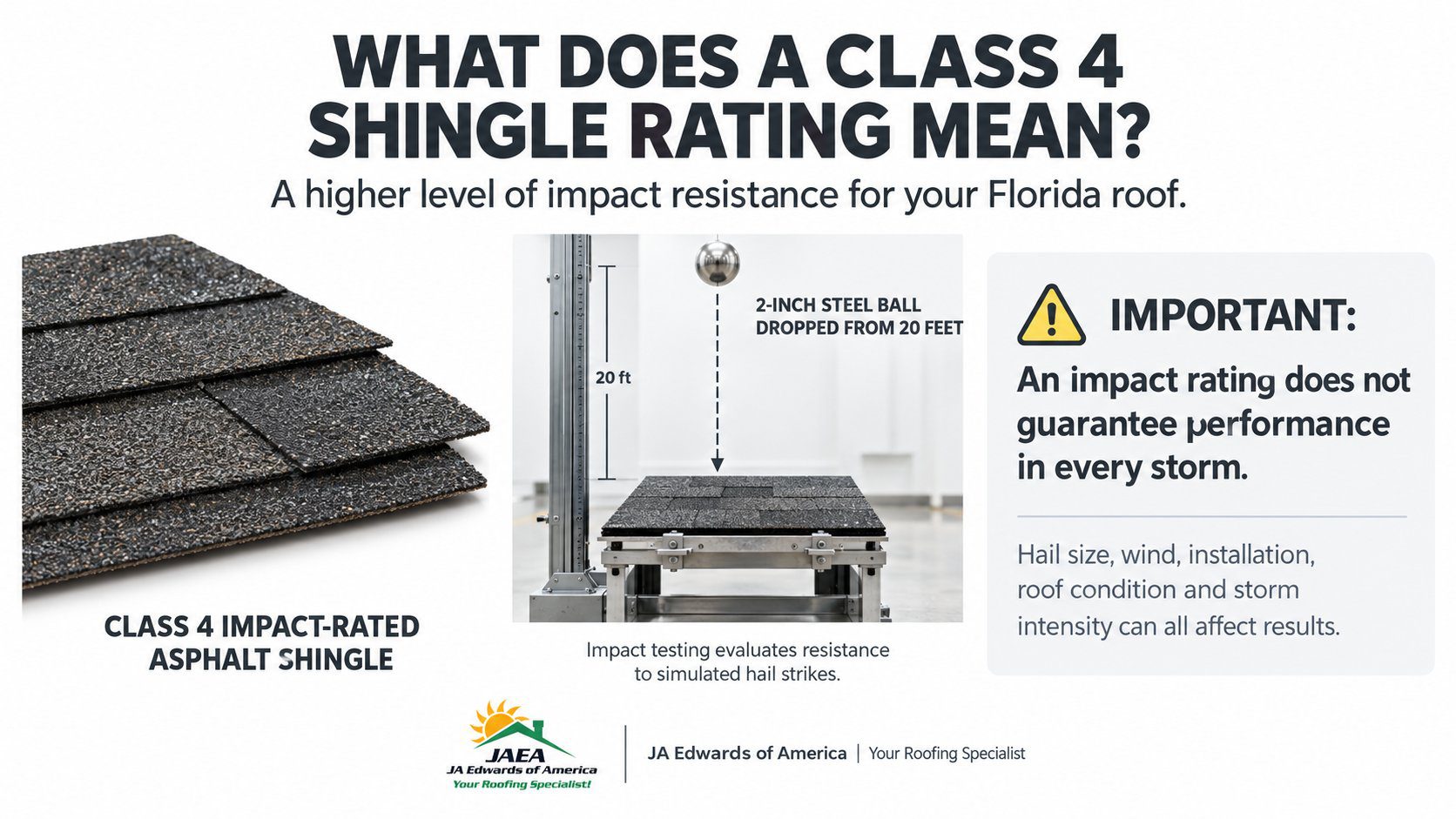
What happens in the impact test
A steel ball stands in for hail and strikes selected locations on a roofing test deck. The sample must satisfy the test's damage criteria at those locations, rather than merely look acceptable from the ground.
Asphalt magazine's examination of shingle impact ratings describes the UL 2218 scale from Class 1 through Class 4, using the ball sizes and drop heights below.
UL 2218 impact classes
| Class | Steel ball | Drop height | What it means |
|---|---|---|---|
| Class 4 | 2 inches | 20 feet | Highest impact class; must avoid rupture at test spots |
| Class 3 | 1.75 inches | 17 feet | One step below Class 4 |
| Class 2 | 1.5 inches | 15 feet | Mid-scale impact test |
| Class 1 | 1.25 inches | 12 feet | Lowest class on the four-step scale |
A controlled steel-ball test isn't a prediction of every hailstorm. Don't translate the ball diameter into a promise that the roof will survive hail of the same size without damage. Our guide on when hail damage means a new roof covers what to check after a real storm.
Buy the assembly, not just the labeled bundle
A Florida replacement also has to address wind uplift, water entry, and applicable building requirements. The contractor must select compatible underlayment, flashing, edge details, and fasteners, then install them according to the product instructions and the permitted scope.
Heat exposure, age, roof slope, fastening, and workmanship affect how roofing performs after installation. Coastal and inland properties may require different details, so ask which product approvals and installation specifications apply to your address. Don't assume a shingle upgrade resolves an existing deck or flashing problem.
JA Edwards of America is a Florida Certified Roofing Contractor (CCC1334804), a Certified General Contractor (CGC1534283) and a GAF Master Elite contractor. Those credentials are relevant to system selection and installation requirements, but they don't turn an impact rating into a storm guarantee.
For a homeowner choosing between products, the Florida shingle-selection guide provides additional context. Review the impact classification, wind-performance documentation, installation instructions, and warranty terms as separate documents. A Class 4 label answers only part of the buying decision.
Line Items Inside a Class 4 Quote
What assumptions are included in this Class 4 quote? That question is more useful than asking why a contractor's total doesn't match an online average.
Some roofing guides put 2026 planning estimates at about $5.94–$9.18 per square foot installed. Published totals can disagree because each source measures roof area differently, prices labor under different local conditions, and builds in different repair allowances. Read any per-square-foot figure as a planning number, then let a measured quote set your budget.
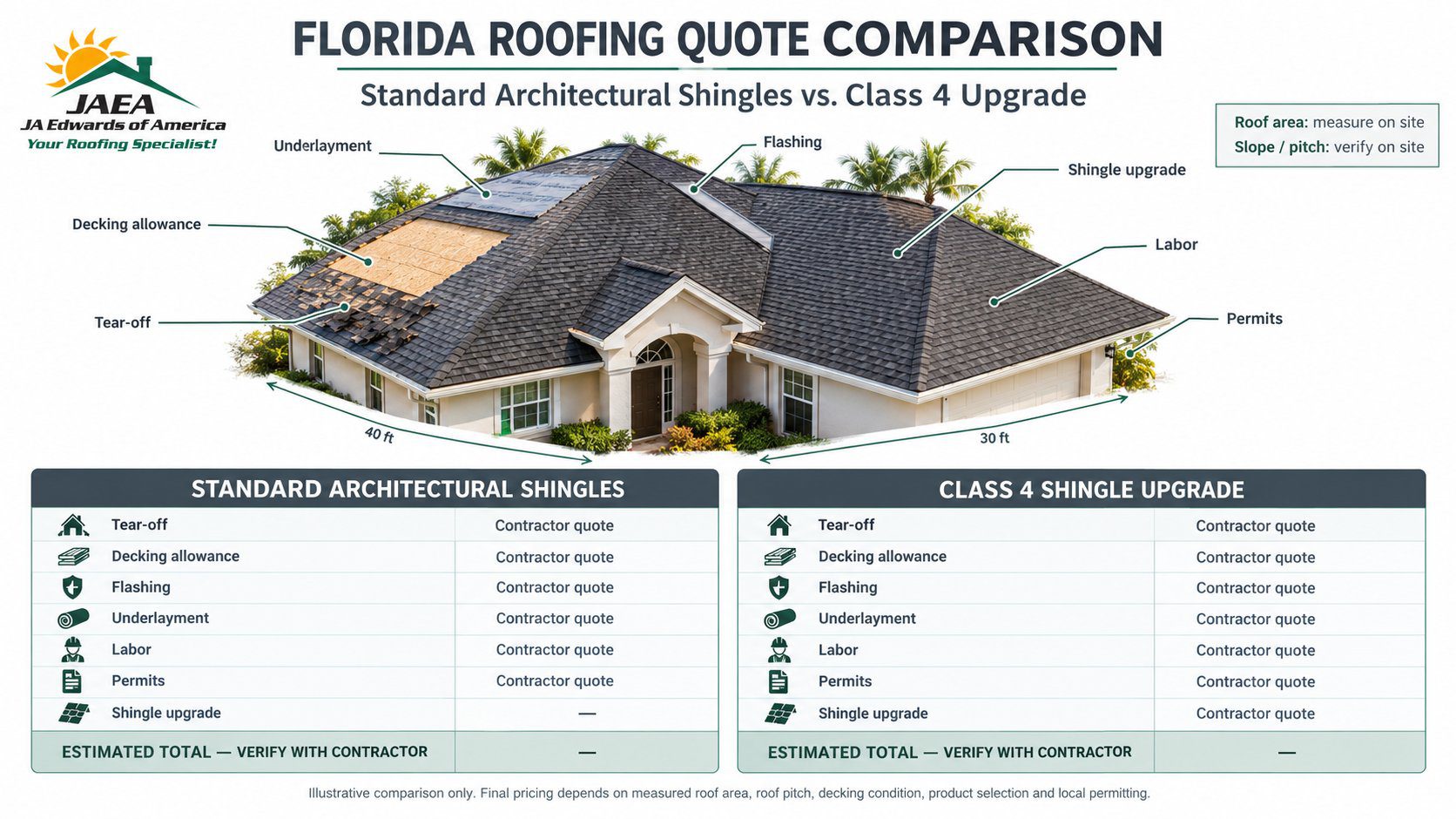
Build a base-roof versus upgrade worksheet
Start with a complete standard architectural replacement. Keep its required deck work, flashing, underlayment, ventilation, and permitting intact, then ask the bidder to identify the added charge for the specified Class 4 product.
This works because much of the replacement process remains similar whichever asphalt shingle you select. The crew still removes the old covering, prepares the deck, protects vulnerable transitions, and installs the new roof correctly. On most Florida jobs the impact-rated shingle is a modest line item sitting next to tear-off, decking, and wind-code work, so the premium only becomes clear when the base scope is held constant.
Base roof versus Class 4 bid worksheet
| Line item | What to confirm | Why it changes the total |
|---|---|---|
| Measured roofing squares | Roof area, not living area | Incorrect area changes the entire estimate |
| Material and labor | Listed separately | Shows the true Class 4 premium |
| Tear-off and disposal | Priced as its own line | Removal work is separate from the shingle upgrade |
| Decking allowance | Included quantity and price per additional sheet | Soft or rotten deck adds cost unrelated to the shingle |
| Flashing and ventilation | Scope written out | Missing scope makes bids look cheaper than they are |
| Permit fees | Included or excluded | Local jurisdiction sets applicable fees |
| Florida wind-uplift fastening and underlayment | Included or excluded, with specified assembly | Required installation details affect materials and labor |
Don't accept a vague decking allowance without a change-order process. Ask how the contractor will photograph concealed damage, obtain your approval, and price additional replacement once the old roof is removed. A deck allowance stated as sheets included plus a price per additional sheet tells you exactly what hidden damage will cost before anyone tears off a shingle.
Flashing deserves the same attention. An estimate should say what happens at walls, valleys, chimneys, plumbing penetrations, and other transitions present on your roof. A promise to replace shingles doesn't tell you whether the bidder plans to reuse worn flashing.
Resolve exclusions before signing
Ask each bidder to mark scope as included, excluded, or subject to inspection. A low price with undefined repairs isn't necessarily a better purchase than a higher price with clear allowances.
Verify the product. Record the manufacturer, exact model, and UL 2218 impact classification.
Identify installation requirements. Ask which underlayment, fastening, and edge details the proposal includes.
Read the repair terms. Confirm how hidden damage changes the contract price.
Separate warranty coverage. Distinguish manufacturer material coverage from contractor workmanship coverage.
The guide to reading a roofing estimate and spotting red flags can help you check proposals before comparing totals. Warranty language and payment terms belong in that review, too.
A cheaper proposal is only cheaper if it includes the work your roof needs.
Keep the comparison focused on written scope. Don't strip underlayment or deck repairs to make room in the budget for an upgraded shingle, and don't size the project around a premium discount you haven't confirmed in writing. Compare worksheets, not headline prices.
Insurance Credits That Need Written Proof
A Class 4 shingle does not automatically lower a Florida homeowners policy. You have to separate a product's impact certification from wind-mitigation documentation, and a carrier may offer no separate impact-resistance credit at all.
The UL 2218 rating on the bundle is a hail-impact test result. Wind-mitigation credits are a separate matter, and they usually depend on what an inspection documents about the roof system rather than on the shingle label alone. Before choosing the upgrade for financial reasons, ask your agent for a written answer tied to your property, policy, and proposed product. A general statement that impact-resistant roofs can earn discounts isn't enough to build a household budget around.
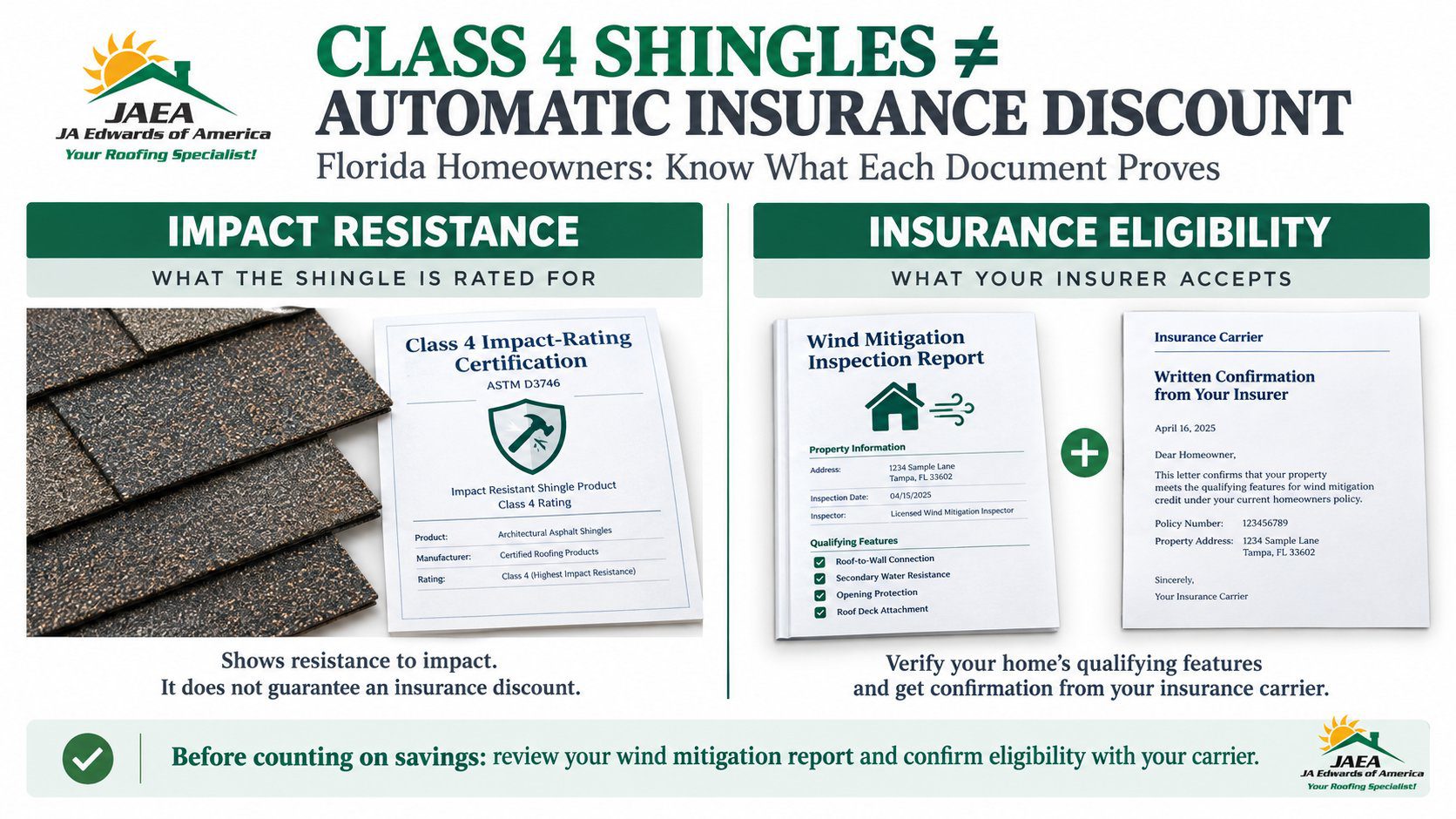
Ask the carrier before calculating savings
Send the product documentation to your agent before signing the material selection. Request answers that identify both eligibility and the actual dollar effect.
Exact product eligibility. Does this manufacturer and shingle model qualify under your policy?
Required proof. Does the carrier need a classification certificate, installation invoice, photographs, or an inspection?
Premium treatment. Does any credit apply to the entire premium or only a defined component?
Inspection requirements. Is a new wind-mitigation inspection required, and what must it document?
Timing and conditions. When would a confirmed credit begin, and what could change it?
Carrier language tends to stay cautious for a reason. State Farm's homeowners discount information, for example, says qualifying impact-resistant roofing may earn a discount, subject to verification. "May" is not a promise, and a discount program in another state is not a Florida offer.
A savings example is not your payback forecast
Run the arithmetic with your own numbers. Where the Class 4 upgrade adds $2,000–$3,000 to the contract price, a confirmed $450 annual saving would take roughly 4.4–6.7 years to recover the premium, and only if the carrier verifies that saving in writing first.
Keep the upgrade in perspective against the rest of the quote. Beside tear-off, deck repairs, and Florida wind-code work, a $2,000–$3,000 shingle premium is a modest line item. If the insurance credit never materializes, the question is whether the tested impact resistance alone justifies the charge.
That example isn't an estimate for your roof. Use the incremental upgrade charge from your proposal and the annual dollar savings your carrier confirms. If the carrier won't confirm savings, evaluate the purchase for impact resistance without assuming an insurance payback.
Roof age, policy changes, deductibles, and documentation requirements can all shift the outcome. The explanation of how a new roof can affect Florida homeowners insurance helps distinguish a new roof's broader underwriting effects from a product-specific credit.
Keep product labels, invoices, permit records, inspection reports, and installation photographs together. JA Edwards can document roof conditions and explain the roofing process, but the insurance carrier decides discounts and claim coverage.
Three Roofs and Where the Money Goes
The following are planning illustrations, not completed JA Edwards projects. Each starts with a similar replacement decision but puts the spending priority in a different place.
The simple-roof illustration uses the installed benchmark of $5.00–$8.00 per square foot, compared with $4.50–$6.50 for standard architectural shingles. The Florida planning bands below are illustrative budgeting assumptions, not site-specific quotes.
A straightforward ranch with a sound deck
Say a ranch has about 20 roofing squares, a walkable pitch, and no unusual flashing conditions. For this hypothetical roof, allow roughly $2,000–$3,000 for the Class 4 premium, with a complete installation potentially near the $10,000–$16,000 planning band if inspection confirms the assumed scope.
The useful question is what the homeowner receives for the incremental charge. Ask for the exact product specifications and warranty terms, then decide whether its tested impact resistance justifies the added expense.
Don't replace a functioning roof early solely to capture an unconfirmed insurance benefit. The upgrade is easier to evaluate when replacement is already necessary and the underlying scope is settled.
A cut-up roof with difficult access
Now use the same hypothetical measured area but add steep slopes, multiple valleys, and upper-story access. The contractor has to plan worker protection, material handling, tear-off, and detailed transitions differently.
Here, labor and roof geometry may matter more than the shingle selection. A headline price based on an uncomplicated roof won't describe that work accurately, even though the upgrade remains only part of the total.
Ask the bidder to explain the access and complexity charges. You want those costs attached to actual conditions, not hidden inside an unexplained premium for Class 4 shingles.
Where Class 4 money goes on three roofs
| Situation | Roof setup | Main cost driver | Planning read |
|---|---|---|---|
| Simple ranch | About 20 squares, sound deck, walkable pitch | Class 4 premium about $2,000–$3,000 | Full install may stay near $10,000–$16,000 |
| Cut-up steep roof | Same area, valleys, steep pitch, upper-story access | Labor, tear-off, possible deck allowance | Basic per-square-foot headline can understate the total |
| Older permitted re-roof | Soft deck or underlayment and fastening that need updating | Code and deck work may exceed the shingle upgrade | Price the assembly first, then the Class 4 add-on |
An older roof with concealed repair needs
For the older-roof scenario, inspection identifies soft decking or installation details that need updating during a permitted replacement. Some concealed conditions may only become clear after tear-off.
The spending priority is a suitable deck and a compliant roof assembly. Choosing a premium shingle doesn't make deteriorated sheathing an acceptable fastening surface, and it doesn't correct missing protection beneath the covering.
Spend in this order: Correct the substrate and required installation details before paying for an optional material upgrade.
A sound deck and confirmed insurance treatment make the impact-resistance upgrade easier to evaluate. When extensive repairs are necessary, establish that scope first so you don't mistake the cost of fixing the roof for the cost of choosing Class 4.
Decide on Class 4 After a Measured Inspection
Class 4 is worth pricing when replacement is already needed and you want better tested impact resistance. It's a weaker financial argument when the main attraction is an insurance reduction the carrier hasn't confirmed or a product price that excludes installation.
Make the decision with a measured estimate, not a living-area calculation. A professional inspection should identify visible conditions, flag potential concealed repairs, and explain which installation requirements affect the proposed assembly.
Use a clear decision order
Establish the roof scope. Confirm measured area, condition, access, and the sections being replaced.
Separate necessary work from the upgrade. Keep deck repairs and wind-related installation requirements distinct from the material selection.
Save the product documents. Retain the classification certificate, applicable product approvals, and installation instructions.
Verify insurance treatment. Let your agent identify what proof the carrier accepts before counting savings.
The roof inspection guide explains what to expect from a condition assessment. Ask for photographs that connect each proposed repair to the estimate, especially where staining, soft decking, or previous patching raises questions.
Keep communication and financing practical
Before work starts, confirm who handles scheduling, repair authorizations, and after-hours messages. For context, Mercateer's 24/7 answering for roofing contractors describes a contractor-side communication option; homeowners should still verify their roofer's actual response arrangements rather than assume an answered call means an immediate site visit.
Financing is available for qualified residential projects through JA Edwards. Review the offered terms against the complete written scope, not an assumed insurance reimbursement or future premium reduction.
The right recommendation comes from the actual roof and your priorities. Documentation can support your records and conversations with your insurer, but neither an inspection nor a material selection guarantees coverage or a discount.
JA Edwards of America Roofing offers measured roof inspections and itemized roof replacement estimates that separate the Class 4 shingle upgrade from decking, underlayment, and required installation work. To schedule an inspection anywhere in Florida, contact JA Edwards of America and ask the team to evaluate your roof before you choose the upgrade.
JA Edwards of America installs both standard architectural and Class 4 impact-resistant shingles across Florida as a Florida Certified Roofing Contractor (CCC1334804) and Certified General Contractor (CGC1534283). We'll price both options on the same measured roof so you can see the real difference. If you're paying for the roof yourself and sign during Black Friday week 2026, our Black Friday roofing deal takes $300 off for new customers. Our post on when hail damage means replacing the roof covers the other side of the impact question.
Talk to a licensed roofer about your roof
Tell us where you are and what’s going on with your roof. We’ll inspect it and give you a written scope and estimate.