
Golf Ball-Size Hail Hit Lake Park, Riviera Beach and North Palm Beach: What Homeowners Should Check Now
A severe thunderstorm dropped hail up to 1.75 inches across northeastern Palm Beach County on Friday evening, October 23. Here is what the National Weather Service recorded, where the hail fell, what hail that size does to tile, shingle and flat roofs, and how to handle the claim.
On Friday, October 23, 2026, a severe thunderstorm dropped hail up to 1.75 inches (golf ball size) on northeastern Palm Beach County, with the heaviest hail around Lake Park, Riviera Beach, North Palm Beach and Singer Island. The National Weather Service logged the 1.75-inch report near Lake Park at 6:18 p.m. Hail that size can crack roof tiles, fracture shingles and puncture flat roofs without causing a leak right away, so homes in the swath should get a documented roof inspection before the next heavy rain.
Lake Park, Fla. Hail in South Florida usually means pea-size ice that melts on the driveway in a minute. Friday evening was different. Viewers sent local TV stations videos of hailstones bouncing off driveways and splashing into pools, and the stones that fell around Lake Park were the size of ping-pong balls, with a few as large as golf balls.
Hail is easy to forget once it melts, and most of the damage it does to a roof can't be seen from the yard. A cracked tile or a bruised shingle usually doesn't leak the first night. It starts letting water in weeks later, during a heavy rain, when it's much harder to show the insurance company that Friday's storm caused it.
What happened Friday evening
The storm built over northeastern Palm Beach County late Friday afternoon and moved toward the coast. This is how the evening unfolded, based on the National Weather Service and local news reports:
- Early eveningThe National Weather Service in Miami issued a Severe Thunderstorm Warning for northeastern Palm Beach County, in effect until 6:45 p.m., with radar showing wind gusts up to 60 mph and ping-pong ball-size hail. The warning named West Palm Beach, Palm Beach Gardens, Riviera Beach, Lake Park, North Palm Beach, Juno Beach, Jupiter, Mangonia Park, Palm Beach and the Port of Palm Beach (CBS12).
- 6:18 p.m.The largest hail report of the night: 1.75 inches, about 2 miles northeast of Riviera Beach, described as ping-pong ball-size hail with a few golf ball-size stones in the Lake Park area (NWS Storm Prediction Center).
- Friday nightLocal stations received several reports of large hail from Riviera Beach, Lake Park and North Palm Beach, and the storms left about 4 inches of rain in the West Palm Beach area (WFLX Fox 29).
The 1.75-inch report is the only official hail measurement from the storm so far, and it came from a broadcast media report, which is normal for a fast-moving storm in the evening. The National Weather Service treats hail of 1 inch or larger as severe, and 1.75 inches is well past that line.
The hail map
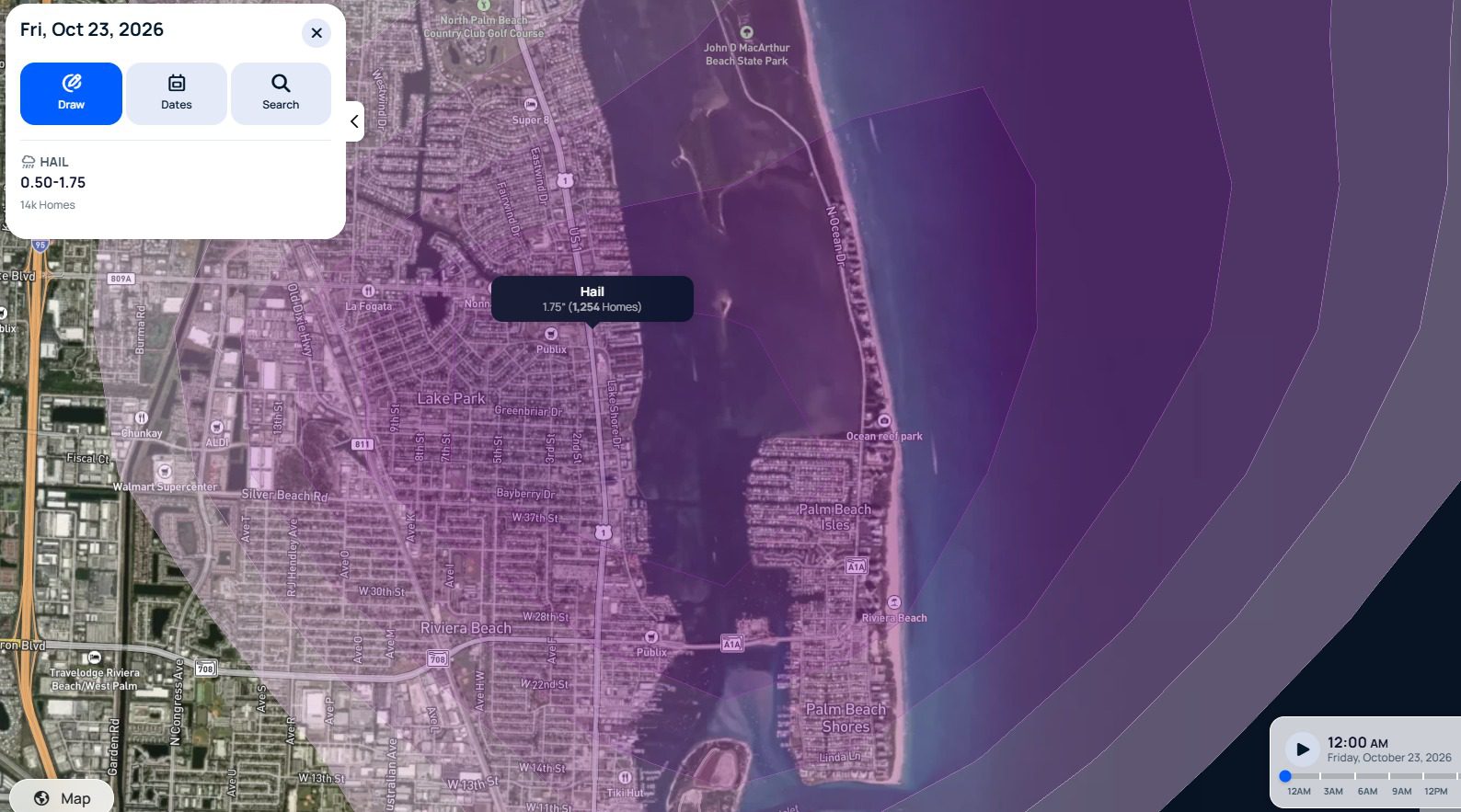
The radar-estimated hail data we pulled for our project managers puts about 14,000 homes inside the hail swath, with hail estimates from about half an inch on the edges to 1.75 inches in the core. The core, where the estimates reach 1.75 inches, covers about 1,250 homes, centered on Lake Park east of U.S. 1, the Lake Worth Lagoon and the northern end of Singer Island.
Around the core, Riviera Beach, North Palm Beach, Palm Beach Shores and the rest of Singer Island sit in the zone where estimates run from about 1 to 1.5 inches. That is still hail large enough to damage a roof, especially an older one, so being outside the darkest zone doesn't mean a home came through clean.
What 1.75-inch hail does to a roof
A hailstone the size of a golf ball falls hard enough to damage every roofing material found along this stretch of coast. The damage just looks different on each one, and most of it is easy to miss from the ground.
| Roof type | What hail this size does | Why it gets missed |
|---|---|---|
| Concrete or clay tile | Cracks and chips tiles, breaks ridge and hip caps, and can damage the underlayment under a broken tile | Hairline cracks can't be seen from the yard, and the tile stays in place until water gets under it |
| Asphalt shingles | Knocks off granules and bruises or fractures the mat underneath, which weakens the shingle | The shingle can look intact while the damage underneath shortens its life and opens a path for water |
| Flat and low-slope roofs | Punctures or splits membranes and cap sheets, dents metal edges and damages rooftop units | Condo and commercial flat roofs are rarely seen by owners, and small punctures leak slowly |
| Metal roofs | Dents panels and can damage coatings and seams | Cosmetic dents and functional damage look similar, and the difference matters for insurance |

The damage doesn't stop at the roof. Hail this size also tears pool screen enclosures, dents gutters and AC condenser fins, cracks skylights and damages cars, and those dents and tears are some of the best evidence that a property took a direct hit. For a closer look at what hail damage looks like on each roofing material, see our visual guide to hail damage on a roof.
Was your home in Friday's hail swath?
Our Port St. Lucie team covers Lake Park, Riviera Beach, North Palm Beach and Singer Island. We mark and photograph every hit and give you a written report tied to the October 23 storm. Florida licensed CCC1334804, GAF Master Elite.
What to check from the ground
Stay off the roof. Wet tile breaks under foot, and the evidence you need is mostly visible from the ground anyway. A quick walk around the house in the next few days gives the inspector and the insurance company a clear record tied to Friday's storm:
- Look at the gutters and downspouts. Soft aluminum dents easily, so round dents along the gutters are one of the clearest signs from the ground that hail hit the roof above them.
- Check the base of the downspouts. On a shingle roof, a pile of dark, gritty granules that wasn't there before Friday means hail knocked them off the shingles.
- Walk past the screen enclosure, AC unit and mailbox. Tears in the pool screen, dented condenser fins and dents on metal surfaces show which side of the house took the hail.
- Look for broken pieces on the ground. Chips of tile or pieces of ridge cap in the yard or on the driveway mean tiles were broken on the roof.
- Photograph everything with the date. Take wide shots and close-ups, and keep any photos or videos you took of the hail while it was falling. Our guide to documenting storm damage for a Florida insurance claim covers what adjusters look for.
If water is already coming through a ceiling, contain it inside and keep people away from wet light fixtures, then call for an emergency tarp instead of going up on the roof.
Condos and HOAs on Singer Island
A lot of the homes in the hail core are condominiums and townhomes, especially on Singer Island and along the Lake Worth Lagoon. In most condominium buildings the roof is a common element covered by the association's master policy, not by each owner's policy, so the association, through its board and management company, is the one that files the roof claim.
If you own a condo or townhome in the swath, ask your management company in writing whether the roof falls under the master policy or your own, and whether the association has scheduled an inspection. Flat roofs on mid-rise and high-rise buildings are exactly the kind that hide hail punctures, and the association has the same claim deadline as everyone else. JA Edwards of America holds GAF Certified Commercial Contractor status and inspects and repairs flat and low-slope roofs on condominium and commercial buildings.
Deductibles, deadlines and storm chasers
Friday's storm was a thunderstorm, not a hurricane, and that changes your deductible. In Florida the percentage hurricane deductible applies to hurricane losses, so hail from an ordinary thunderstorm usually falls under your policy's regular deductible, unless the policy has a separate wind and hail deductible or a separate roof deductible. Your declarations page shows which ones you have, and our guide to what it costs to fix hail damage walks through how the deductible and your coverage type change what you pay.
Florida law gives you one year from the date of loss to report a new property claim, so this storm's deadline is October 23, 2027 (Florida Department of Financial Services). Don't let the date make you wait, though. The longer the gap between the storm and the claim, the easier it is for an adjuster to argue the damage came from age or from a later storm.
Hailstorms bring door-to-door contractors within days. Before you sign anything, check that the company holds a Florida roofing or general contractor license at MyFloridaLicense.com, and be wary of anyone who offers to cover or waive your deductible, since Florida law prohibits contractors from offering that kind of incentive. Our list of roofing scam warning signs in Florida covers the rest.
JA Edwards of America has been a Florida roofing contractor since 2004 and serves Palm Beach County from our Port St. Lucie office. If your home or building was in Friday's hail swath, schedule a free roof inspection and we'll document every hit with dated photos, tell you whether the roof needs a repair or a replacement, and give you a written report tied to the October 23 storm.
Palm Beach County hailstorm: frequently asked questions
Where did the October 23, 2026 hail hit in Palm Beach County?
How big was the hail?
Can my roof be damaged even if it isn't leaking?
Does my hurricane deductible apply to this hail damage?
How long do I have to file a claim for the October 23 hail?
Who files the roof claim for a condo on Singer Island?
Get your roof checked after the hail
Tell us where the property is and what you've noticed since Friday. Our Port St. Lucie team calls back with a real inspection time.