
Wind Damage Roof Insurance Claim in Florida: What to Document First
Wind damage can be obvious, subtle, or mixed with normal roof aging. The useful first steps are simple: stay safe, document what you can see, prevent more damage, notify the insurer promptly, and let a professional inspection separate the roofing issues from the coverage decision.
You wake up after a rough night of wind and rain, step outside, and see shingles in the yard, a lifted ridge cap, or a fresh ceiling stain in the hallway. The first question is not whether the roof looks bad. It is whether the condition can be documented clearly enough to show what changed, when it changed, and what the roof needs now.
Wind and hail are common sources of homeowners insurance losses. Triple-I reports that wind and hail represented 40.7% of homeowners property-damage losses in 2022, and its claim-frequency data works out to roughly one wind- or hail-related property claim for every 35 insured homes. Those are national insurance statistics, not a promise that any individual roof condition will be covered.
Important Florida claim reminder
Do not wait for a “perfect” contractor packet before reporting damage. Florida DFS advises policyholders to contact the insurance company or agent as soon as possible, document the loss, and make reasonable temporary repairs to prevent further damage. You can continue adding photos, invoices, weather records, and contractor findings after the claim is opened.
Table of Contents
What Wind Damage Really Means for Your Florida Roof
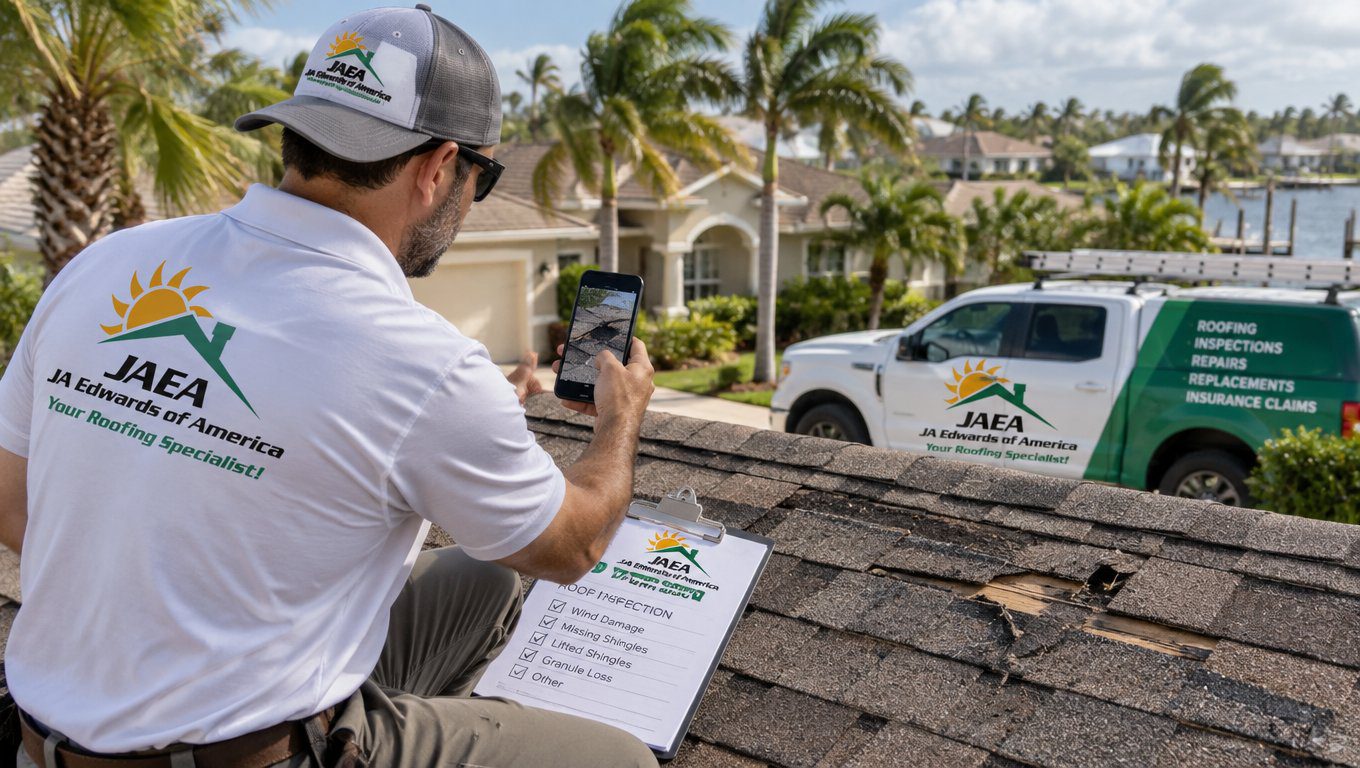
The morning after a wind event, photographing the obvious is a good first step: a missing shingle, a limb on the ground, displaced roofing material, or water inside the home. Those photos establish context, but a professional inspection looks beyond the obvious and documents the pattern of failure.
On shingle roofs, wind-related conditions can include creased tabs, broken or released seal strips, displaced shingles, or ridge pieces pulled loose. Tile and metal systems can show damage at edges, flashings, fasteners, clips, seams, and transitions where uplift forces act on the assembly. Not every loose or worn component proves a covered wind loss, which is why condition, age, maintenance history, and the storm timeline all matter.
Visible damage is not the same thing as a coverage decision
An insurer may agree that a roof has damage while still investigating why the condition exists. Roof age, previous repairs, deterioration, old leaks, installation issues, foot traffic, and long-term weathering can all become part of that review.
Florida's Office of Insurance Regulation commissioned a 2024 residential wind-loss study that analyzed claims from Hurricanes Irma, Michael, Ian, and Idalia. The single-family data set included 143,731 claims and about $5.26 billion in claims paid or reserved. That study is useful context for the scale of Florida wind losses, but it does not determine whether a particular roof condition is covered.
Read the official Florida OIR residential wind-loss study.
What a roofer can document and what the insurer decides
A roofing contractor can inspect the roof, photograph visible conditions, document emergency mitigation, identify damaged roofing components, explain whether the affected area appears repairable, and prepare a roofing scope. The contractor does not decide whether the policy covers the loss. Coverage, deductibles, exclusions, and settlement decisions belong to the carrier under the policy.
For a broader non-roofing legal overview of Florida property damage, the original draft linked this Florida property damage guide. For roofing-specific preparation before storm season, JA Edwards also has a guide to Florida wind mitigation inspections.
How to Document Wind Damage Before the Details Get Lost
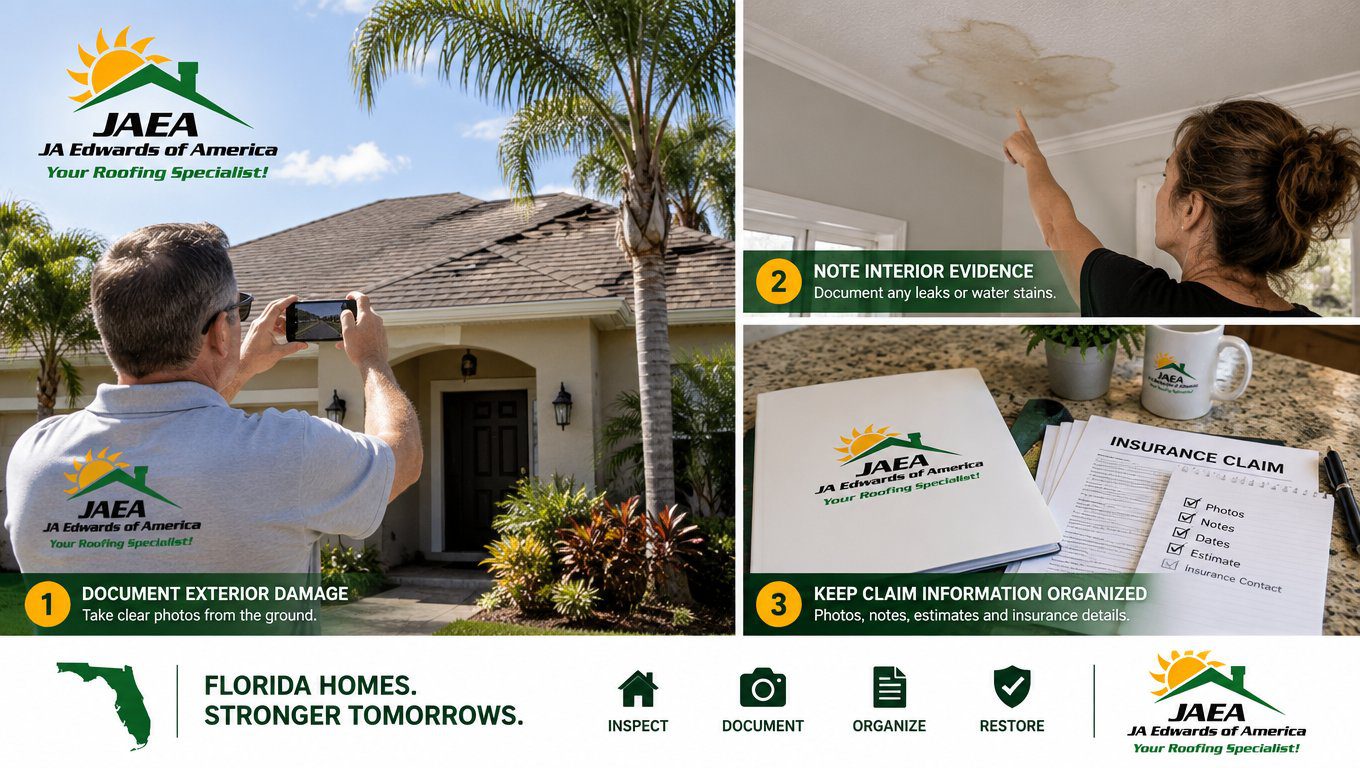
Start from a safe position and work from broad context to detail. You do not need to climb onto the roof yourself to begin documenting the loss.
Start with a safe exterior photo sequence
A simple photo sequence is easier to understand later than dozens of random close-ups. Capture:
- Street-level views showing the entire home from multiple angles.
- Each roof plane that is visible from the ground without climbing onto the structure.
- Zoomed detail of displaced roofing material, ridge damage, flashing, gutters, vents, debris impact, or fallen branches.
- Detached materials that landed in the yard, driveway, or around the structure.
- A short video walkthrough explaining what you noticed and when.
Keep the original files. Phone timestamps can help preserve sequence, and a short written note about the storm date and discovery date makes the folder easier to understand later.
Document the inside of the house and attic
Exterior wind damage does not always produce an immediate interior leak, but if water entered the building, preserve that evidence too.
- Ceilings and walls: new stains, bubbling paint, wet drywall, or trim separation.
- Attic framing and sheathing: darkened wood, wet insulation, active dripping, or daylight at damaged openings.
- Vents, chimneys, and transitions: areas where water may track through the roof system.
- Temporary protection: buckets, plastic, tarps, drying equipment, or other steps taken to reduce additional damage.
Add weather information and preserve damaged material
Roof photos show condition. Weather records help establish when a storm occurred. Keep basic notes about the event and, when useful, save official or reliable local weather information that matches the reported date of loss.
If roofing material came off and can be stored safely, photograph it before moving it and keep it until the insurer has had a reasonable opportunity to inspect the loss. Florida DFS also advises policyholders not to discard damaged property before the company inspection when feasible.
Keep one organized claim folder
Use one digital folder for photos, video, a short timeline, emergency mitigation receipts, invoices, weather information, carrier correspondence, and the contractor's inspection findings. The point is not to delay reporting the claim. It is to keep the information organized as the claim develops.
The original draft also referenced this overview of first notice of loss workflows for readers interested in how digital FNOL processes work. For a Florida roofing checklist, see our guide to documenting storm damage for a Florida roof insurance claim.
Emergency Steps to Protect Your Home After Wind Damage
Once the initial condition is documented, the next priority is preventing more damage. Florida DFS specifically advises policyholders to make reasonable emergency repairs, photograph the damage and the repairs, and keep receipts.
Protect the opening without erasing the original condition
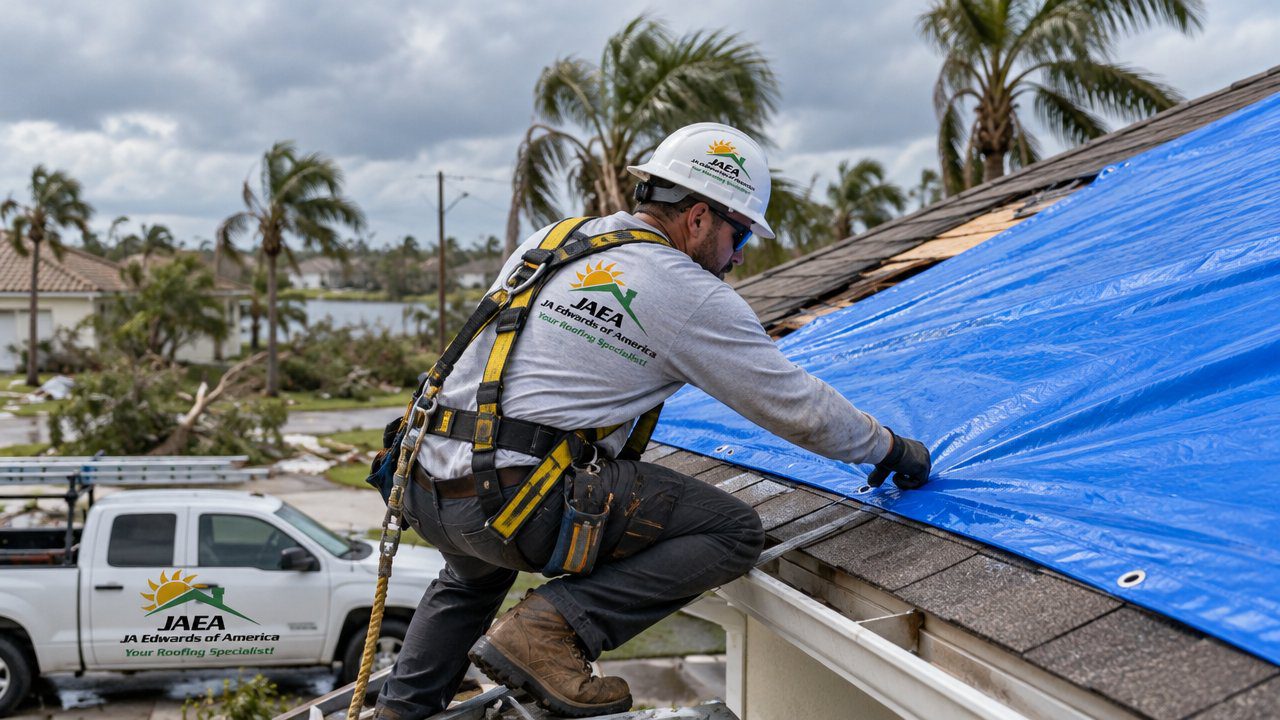
Emergency mitigation can include professional tarping, containing active leaks, moving contents away from water, and drying wet interior areas. Take photos before and after the temporary work whenever it is safe to do so.
- Tarp exposed roof areas: temporary protection can reduce additional rain intrusion.
- Contain interior water: use buckets, floor protection, and safe temporary measures.
- Dry affected areas: fans or dehumidification may help limit secondary moisture damage when conditions allow.
- Keep receipts: save invoices and receipts for emergency work and materials.
Avoid permanent repairs before the insurer can inspect when feasible
Florida DFS distinguishes emergency mitigation from permanent repair. The insurer generally has the right to inspect the original damage, so document the condition first and avoid replacing or disposing of damaged components before the carrier has had that opportunity when feasible.
For a broader storm-response sequence, see what to do after hurricane roof damage in Florida. JA Edwards can inspect the roof, provide photo documentation, and perform emergency roofing mitigation; the carrier still makes the coverage decision.
How Roof Condition Is Evaluated and Why Causation Matters
An adjuster does not only look for broken material. The inspection also considers the condition of the roof, the reported event, the distribution of damage, prior deterioration, and whether the observed pattern is consistent with the reported cause of loss.
Verisk's 2025 U.S. Roof Report shows why roof claims receive so much attention: its Xactimate-based data reported average 2025 roof estimate values of $17,631 for replacement and $4,699 for repair. Those are national claims-estimate averages within Verisk's data set, not Florida pricing quotes.
Conditions that may be consistent with wind damage
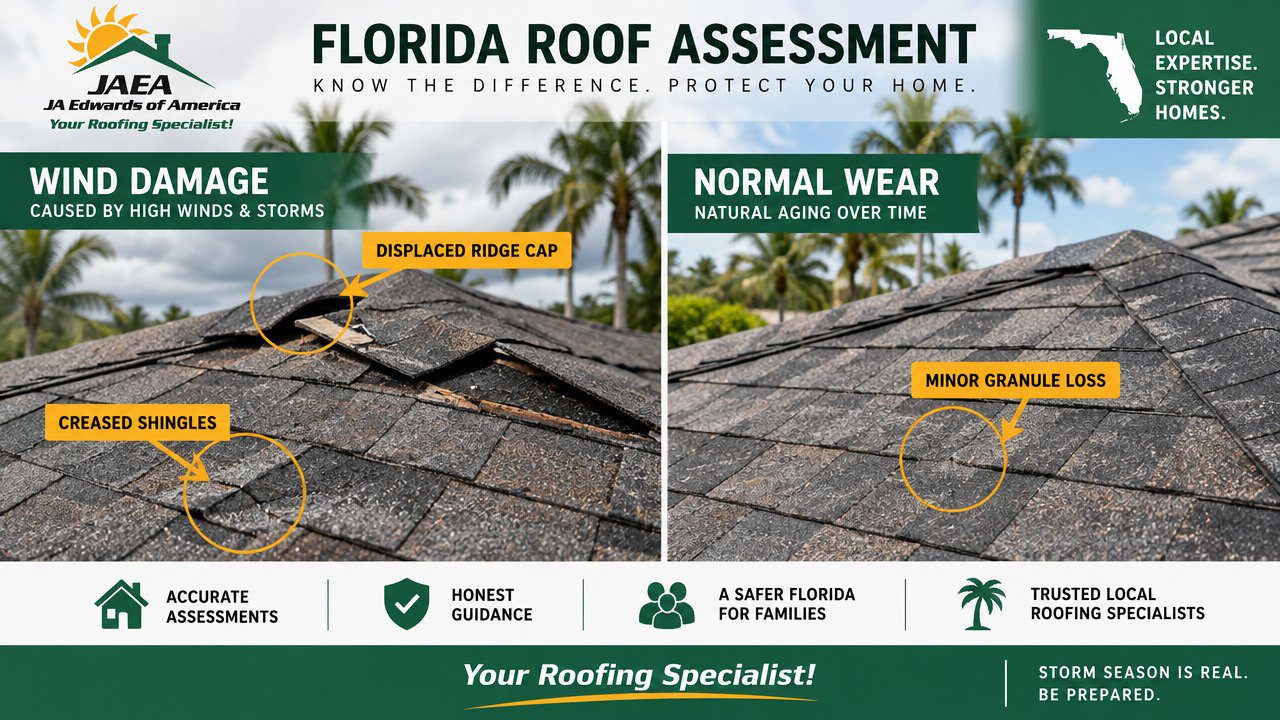
Depending on the roof system and the event, inspectors may document conditions such as:
- Creased or displaced shingle tabs
- Broken or released shingle seal strips
- Ridge cap movement or tearing
- Separated flashing at walls or penetrations
- Displaced tile or metal components
- Debris impact or storm-created openings
What can look like storm damage but may be long-term wear
Uniform granule loss, widespread age-related cracking, algae staining, long-term deterioration, older repairs, or unrelated structural movement may point to pre-existing or maintenance-related conditions. An older roof can still suffer legitimate wind damage; the point is that the pattern and timeline need to be evaluated rather than assumed.
| Condition | Can be consistent with wind | Can also have other causes |
|---|---|---|
| Creased or displaced shingles | Yes | Installation, handling, prior damage |
| Ridge cap displacement | Yes | Age, fastening, prior deterioration |
| Separated flashing | Yes | Installation, corrosion, movement |
| Uniform granule loss | Less specific | Age and weathering are common contributors |
| Algae staining or broad discoloration | Not a wind signature by itself | Environmental exposure and age |
For a closer look at the carrier visit itself, see our guide to a roof insurance adjuster inspection in Florida.
Working Through the Wind Damage Claim With Your Insurer
Once you identify storm-related concerns, notify the insurer using the reporting method in the policy or on the carrier's website. Keep the first notice factual: the date of loss, what you observed, and the fact that photos or contractor documentation are available.
Florida DFS also states that insurers generally must acknowledge a claim communication within 7 calendar days, and current Florida claim-handling rules generally require payment or denial within 60 days after notice of a property claim, subject to statutory exceptions and factors beyond the insurer's control.
The original draft linked a private legal overview of Florida roof-claim deadlines. We preserved that resource here for secondary reading: Florida roof damage insurance claims overview. For the governing notice deadline, use the Florida Statutes.
What to have ready for the adjuster
- Loss timeline: storm date, discovery date, and emergency steps taken.
- Photos and video: exterior, interior, attic, detached materials, and mitigation.
- Weather support: local storm information or official weather records when available.
- Receipts: tarping, drying, emergency materials, or other mitigation costs.
- Contractor findings: roof condition notes, photos, measurements, and roofing scope.
Hurricane deductibles are not the same as every wind or hail deductible
This is one place where the original draft needed a correction. Florida's separate hurricane deductible applies under specific statutory and policy conditions tied to hurricane coverage. Florida DFS says insurers generally must offer certain hurricane deductible options, commonly including 2%, 5%, and 10% of dwelling limits, with additional rules and exceptions. Ordinary wind, hail, or other property losses may instead involve an all-other-peril deductible, another authorized deductible, or different policy terms.
Example: a 2% hurricane deductible on $300,000 of Coverage A is $6,000. But you should not assume that same calculation applies to every non-hurricane wind or hail claim. Check the declarations page and ask the carrier or agent which deductible applies to the specific event.
Do not use the deductible alone to decide whether to report hurricane damage
Florida DFS explains that a hurricane deductible can operate on a calendar-year cumulative basis. The Department advises policyholders to report hurricane damage even when the initial repair estimate appears below the hurricane deductible, because later covered hurricane losses in the same year and hidden damage can affect how the deductible is applied.
Compare the roofing scope and the carrier estimate carefully
Differences can occur between a carrier estimate and a contractor's roofing scope. Review them item by item instead of assuming one is automatically right. Differences may involve ridge material, starter, underlayment, flashing, ventilation, accessory metals, decking observations, code-related work, quantities, or repairability.
If something appears to be missing, the useful response is documentation: photos, measurements, manufacturer requirements, permit or code information when relevant, and a clear explanation of why the roofing work is needed.
For cost context only, Verisk's 2025 U.S. Roof Report reported average roof estimate values of $17,631 for replacement and $4,699 for repair, increases of about 33% and 25% from its 2021–2024 averages. The report notes that these figures come from Xactimate estimate data and should not be treated as a universal contractor quote.
Deciding Your Next Step and Getting a Professional Inspection
After documentation and mitigation, the roofing question usually becomes simpler: is the damage localized and repairable, is the roof showing broader system failure, or is the storm damage layered on top of an already aging roof?
A useful inspection should answer practical construction questions without pretending to decide insurance coverage:
- What roof components are visibly damaged?
- Is the affected area reasonably repairable?
- Are there signs of active water intrusion or damaged underlayment/decking?
- Does the roof condition require temporary protection?
- What roofing scope is needed to restore the system correctly?
For more detail on the inspection itself, see what to expect during a professional roof inspection. JA Edwards of America can inspect and document roofs through its Florida teams in Orlando, Tampa, Port St. Lucie, and Jacksonville. For local contact information, use the JA Edwards locations page.
Wind Damage on the Roof? Start With an Inspection.
We can document the roof condition, explain whether the roofing issue appears repairable, and give you a clear scope for the next step.
Schedule a Free Roof InspectionSources & Further Reading
Triple-I — Homeowners Insurance Losses & Claim Frequency — wind/hail loss share and claim-frequency context.
Florida DFS — Homeowners Insurance Overview — notice duties, mitigation, supplemental claims, and current claim-handling timelines.
Florida DFS — Florida's Hurricane Deductible — when the hurricane deductible applies and available deductible options.
Florida Statute §627.70132 — property insurance claim notice deadlines.
Florida OIR — 2024 Residential Wind-Loss Mitigation Study — Florida hurricane claim and wind-loss data.
Verisk — 2025 U.S. Roof Report — national roof estimate severity and repair/replacement trends.
Property Insurance Coverage Law — OIR Roof Report mirror
Juan Cordero Lawyers — Florida Property Damage Laws
Matil — First Notice of Loss Workflow Overview
Frequently Asked Questions
What does wind damage look like on a roof?
Wind damage can include missing or displaced shingles, creased tabs, broken seal strips, damaged ridge caps, separated flashing, displaced tile, or damage at roof edges and penetrations. Some conditions are difficult to confirm safely from the ground.
How soon should I notify my insurance company after wind damage in Florida?
Florida DFS advises policyholders to report property damage as soon as possible and follow the policy's notice requirements. Florida Statute 627.70132 sets an outside deadline of one year for an initial or reopened property claim and 18 months for a supplemental claim, but the policy may require prompt notice.
Should I repair the roof before the insurance adjuster inspects it?
Make and document emergency or temporary repairs needed to prevent further damage. Florida DFS advises taking photos or video, keeping receipts, and generally avoiding permanent repairs before the insurer has had an opportunity to inspect the original damage when feasible.
Does every wind claim use a percentage deductible?
No. Deductibles depend on the policy and the cause of loss. Florida hurricane deductibles are separate from ordinary all-other-peril deductibles, and some policies can also include other authorized deductibles. Review the declarations page or ask the insurer or agent which deductible applies.
Can a roofing contractor determine whether insurance will cover the damage?
No. A roofing contractor can inspect the roof, document visible conditions, provide photographs, explain repairability, and prepare a roofing scope. The insurance carrier determines coverage under the policy.
What should I have ready for the adjuster inspection?
Keep a simple file with exterior and interior photos, a short timeline, weather information if available, emergency mitigation receipts, damaged materials when feasible, and the contractor's inspection findings or roofing scope.