
Roof Inspection Drones: What They Can and Can't See After a Florida Storm
A drone gives you a safe first look at a storm-damaged roof without anyone climbing a wet, unstable slope. It also misses things that only a roofer standing on the roof will find. Here is how a drone inspection works, what it's good for, and when you still need hands-on verification.
A roof inspection drone photographs the whole roof from the ground, which makes it the safest way to get a first look after a hurricane or hailstorm. It shows missing shingles, cracked tile, exposed underlayment and debris, and it gives you a dated photo record. It can't confirm what's under the surface, like wet decking, failed flashing or fastener problems, so any possible damage it finds still needs a roofer to check it up close.
A storm has just moved through your part of Florida. From the driveway you can see a few missing shingles, but you can't tell whether the damage stops at the surface or goes deeper. If a ceiling has started to stain, you want an answer fast, and climbing up there yourself is the wrong way to get it.
A drone can give a safe first look without sending anyone onto a wet or unstable roof. It has limits, though. Aerial photos document what's visible, and they don't replace a hands-on assessment. The inspections that actually answer the question combine careful drone photography with a roofer's judgment about what needs to be checked at close range.
Why homeowners turn to drone inspections after Florida storms
After a wind or hail event, most homeowners go through the same routine. They check the attic, look for ceiling stains, walk around the house and try to judge the roof from the ground. If they spot lifted shingles or broken tile, the next question is whether the roof needs a repair, a bigger restoration or just monitoring.
Going up to look isn't a safe answer, especially when the roof is wet, steep, covered in debris or structurally damaged. A trained operator can use a roof inspection drone to photograph every roof plane, ridge, valley, penetration and visible storm impact while standing on the ground. Those images tell the roofer whether a closer look is needed and where.

Timing matters after hurricanes and tropical storms. A drone lets a contractor sort out which houses need attention first without putting a technician at risk of a fall, and it produces a time-stamped photo record. That record can help organize a conversation with your insurance company, but the carrier, not the drone operator, decides what's covered.
If the images show possible damage, expect the inspection to continue. A drone might show shingles displaced around a plumbing vent, for example, and a roofer still has to check the flashing, underlayment, decking and the ceiling below. If you're putting together storm documentation, this guide on how to document storm damage on your roof for an Orlando insurance discussion walks through it step by step.
For readers interested in the aviation side of aerial work, Beyond The Bitumen from Ace Aviation Aerospace Academy offers useful context on how aviation training connects with specialized inspection work.
How a roof inspection drone workflow actually works
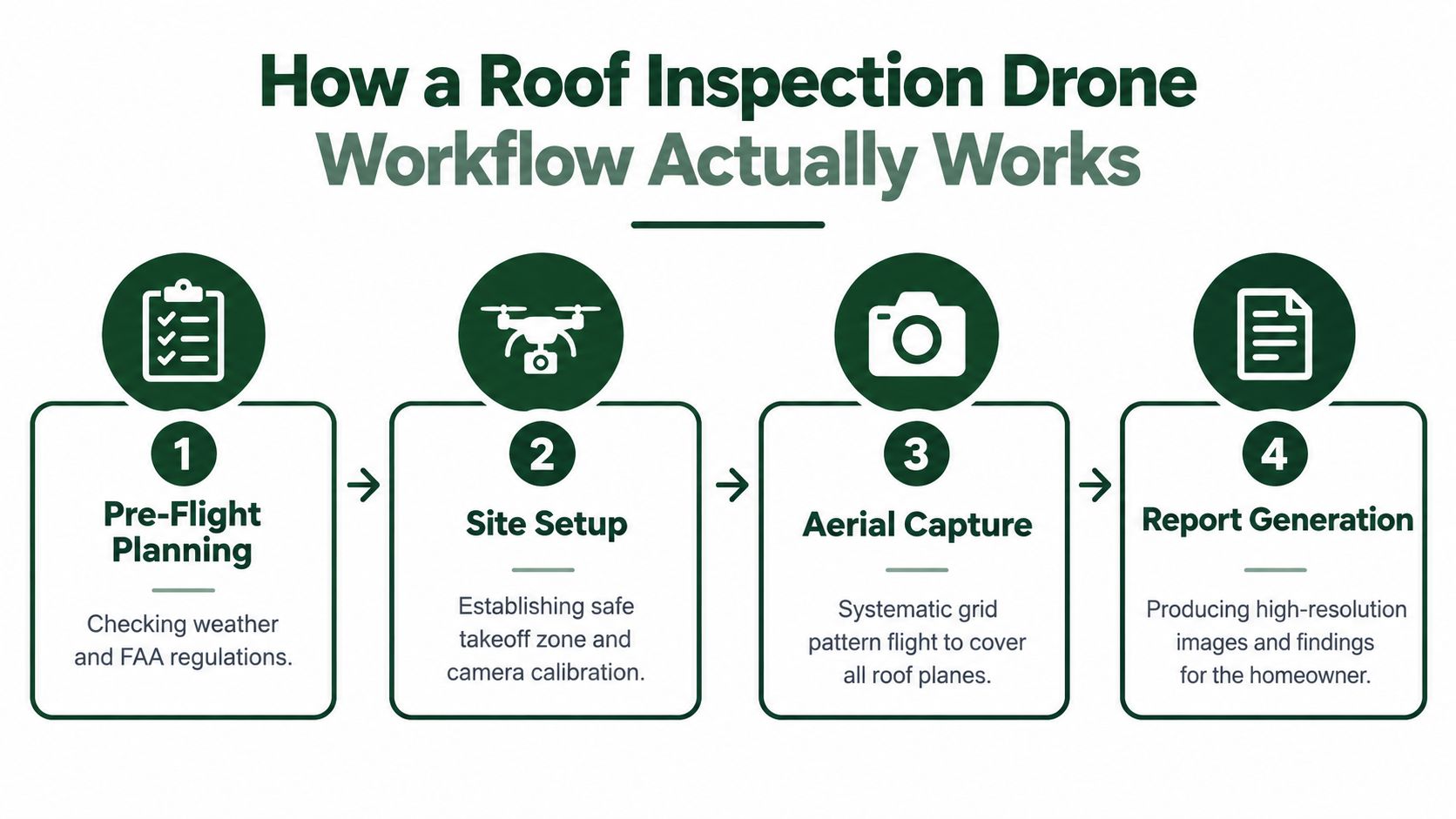
A professional flight is more than a pilot pointing a camera at the roof. The operator plans the mission, secures the site, captures overlapping images, and reviews the processed results before drawing any conclusion.
Planning comes before takeoff
The operator checks the weather, the wind, visibility, nearby obstacles, property lines and airspace restrictions. The flight plan has to account for trees, power lines, neighboring homes, antennas and the shape of the roof, and a safe spot to take off and land is set before the drone leaves the ground. Inspections built for precise measurements often add satellite positioning corrections (RTK or PPK) and fly a pre-planned grid at a fixed height above the roof.
Capture takes more than a single pass
The drone usually flies a grid or an orbit around the house, then takes angled shots of the roof edges, valleys, penetrations, vents, skylights and any visible impact points. The images need to overlap, because the software matches common features across photos to stitch them into a coherent model. Low overlap, glare, motion blur or poor light can leave gaps or make small defects hard to read.
Most inspection drones carry a high-resolution camera, and some carry a thermal sensor for a different kind of investigation. The camera should match the question. A visual survey documents missing or broken materials, while a thermal pass can point to an area that deserves a closer look for trapped moisture.
Processing turns images into an inspection record
Software can turn the photos into a stitched overhead map (an orthomosaic), a 3D model, annotated images or a written report. A trained person still has to review that output. Automated labels help sort the images, and research teams building these systems still check and correct them by hand, which is a good reason to be wary of any report that's only software output.
Measurements need controls too. In one test of 13 roofs, automated drone measurements differed from manual measurements by +1.2% to -2.7% per roof, with an average difference of 0.6%, inside the industry target of plus or minus 2% (Geo Week News roof measurement test). The article was written by the CEO of the company that makes the measuring software, so read it as a vendor's own test.
That level of accuracy depends on how the flight is set up, not on owning an expensive drone. If the operator skips positioning controls, flies at inconsistent heights or collects weak images, the measurements are less reliable. For a broader look at the stages of an inspection, see what a professional roof inspection covers.
Where drone inspections actually help Florida properties
The real reason to use a drone is that it gets eyes on the whole roof without anyone climbing it, and it leaves you with organized photos you can come back to.
On large commercial roofs the time saved is significant. A drone can cover a warehouse, a retail center or a multi-family building in a fraction of the time a two-person crew needs to walk it, which makes aerial triage useful after wind, hail or a hurricane. If you manage a building like that, our commercial roofing team handles multi-building inspections with a separate photo report for each building.
The safety benefit is direct. The first survey happens from the ground, so nobody is exposed to a fall during the assessment. That doesn't make the roof safe to walk on later, but it helps the roofer decide whether going up is justified and where.
Where the documentation helps
Drones have become a standard tool in roofing. Roofing Contractor's 2026 State of the Industry report found that 54% of U.S. roofing contractors used drones in 2025, close to the 58% that used a formal CRM system, as reported in this roofing technology adoption report.
For a homeowner, the value is a dated photo record of each roof plane and each area of concern. It can support an insurance or warranty conversation, but it doesn't guarantee coverage, and a carrier can ask for more evidence before making its own decision.
A drone also makes repeat review easy. A roofer can study a clear image of a ridge, valley or flashing detail without anyone going back up, which is especially useful when the roof is steep, fragile, multi-level or temporarily unsafe after a storm.
Popularity isn't proof that every drone inspection is thorough. The useful question is whether the operator captures enough detail, explains what's uncertain and tells you which findings need a roofer's physical follow-up. For more on getting ready before the next storm, read how hurricane season affects your Florida roof.
Not sure what the last storm did to your roof?
We'll photograph it from the air when it isn't safe to walk, check it by hand when it is, and give you a dated photo report you keep. Florida licensed, CCC1334804.
FAA rules and Florida privacy law
Commercial drone work in the United States falls under FAA Part 107. The pilot needs a Remote Pilot Certificate, the drone has to be registered with the FAA, it generally has to stay at or below 400 feet and within the pilot's visual line of sight, and night flights are allowed only with anti-collision lighting and the required training. This commercial drone license guide is a plain-language starting point on the federal rules.
Those rules cover flight safety. Privacy is a separate question, and Florida has its own law on it.
What Florida's drone law means for a roof inspection
Florida Statute 934.50 makes it illegal to use a drone to record images of privately owned property, or the people on it, for surveillance that violates a reasonable expectation of privacy, unless the owner or occupant gives written consent. The statute presumes that expectation of privacy exists wherever a person couldn't be seen from ground level. Its exceptions are aimed at law enforcement, emergency agencies, utilities, property appraisers and a few other specific uses, and none of them covers roofing contractors.
In practice that means two things for you. The roofer flying over your house should have your permission in writing, and the flight shouldn't be capturing your neighbors' backyards. Ask where the drone will fly, how the images will be stored, and whether any neighboring property will show up in the report. This is general information, not legal advice.
The same care applies after the inspection. If repairs or a replacement are recommended, ask who pulls the permits and how local requirements will be handled. This overview of Florida roofing permit requirements helps frame that conversation, though your city or county has the final say.
What drones can't see, and when you need a roofer on the roof
A sharp aerial photo shows a lot: cracked tile, missing shingles, exposed underlayment, displaced metal, staining and debris. It generally can't confirm the condition of hidden decking, where a leak is coming from underneath, how the fasteners were installed, whether the flashing has failed under the shingles, how the attic is venting, or whether the roof meets code.
That gap matters after a storm. A roof can look intact from above while water gets in through a hidden flashing failure or a damaged vent boot. The opposite happens too, and a dark mark or a shingle that looks displaced may turn out to be nothing once someone checks it in person.
Thermal images raise questions, they don't answer them
Thermal cameras can find temperature differences that deserve a closer look. They can't prove where water is getting in, because the weather, insulation, ventilation, surface conditions and time of the flight all change the reading.
In a 2023 study on drone thermography of buildings, researchers recommended a 45-degree camera angle at about 22 meters for qualitative analysis and cautioned that temperature and contrast distortions limit precise measurements (Remote Sensing, 2023). Guidance for flat commercial roofs recommends flying after sundown, with at least a 10°C (about 18°F) difference between the underside of the deck and the roof surface, and no standing water, ice or debris on the roof (Roofing Contractor thermal drone guidance).
When a roofer needs to go up
- The report shows possible structural damage. Decking, framing or areas softened by water have to be checked in person.
- There is an active leak. The ceiling stain inside and the roof photos outside have to be compared to trace where the water enters.
- Flashing or penetrations look questionable. Up close, a roofer can find lifted edges, failed sealant or installation problems that don't show from above.
- You're deciding between repair and replacement. That call depends on the material's condition, how it's attached, how many layers there are and how much life it has left.
- A thermal image shows an anomaly. It should be verified before anyone calls it a leak.

A drone is most valuable when it helps a qualified roofer choose the safest, most useful next step. If the photos show anything that needs a closer look, a free roof inspection puts someone on the roof to check it by hand. In Northeast Florida, you can also read what a roof inspection covers in Jacksonville before you schedule.
What to expect from a professional photo-documented inspection
A useful report is more than a folder of nice aerial pictures. Ask for dated photos, clear notes on where each one was taken, a summary of what's visible, and recommendations that separate what was confirmed from what still needs follow-up.
Each finding should name the roof section and say what it means in practice. "Shingles displaced near the plumbing vent on the rear slope" tells you far more than "the roof has storm damage." If the report includes measurements or a 3D model, ask what positioning and image controls were used to produce them.
Before you hire an inspector, ask:
- Who will fly the drone, and do they hold an FAA Remote Pilot Certificate?
- Will a licensed roofing contractor review the images?
- Are thermal findings presented as indicators or as confirmed leaks?
- What findings would require someone to go up on the roof?
- Will you get a written report you can use for repair planning and an insurance conversation?
Credentials matter, but they don't replace a clear process. Check the contractor's Florida license, ask about manufacturer certifications, and make sure the company actually does the roofing work the inspection may lead to. JA Edwards of America handles residential and commercial roof inspections, repairs, replacements and storm damage repair across Florida, with photo documentation on every visit. You can also read what to expect during a professional roof inspection.
When a roof is unsafe or hard to reach, our team can photograph it from the air first, then check what the images flag by hand and put it all in one dated report. Request a roof inspection for your Florida home or commercial property and we'll tell you whether a drone survey, a hands-on inspection or both make sense for your roof.
Roof inspection drones: frequently asked questions
Can a drone inspect a roof after a hurricane?
What can't a drone roof inspection see?
Is a drone inspection enough for an insurance claim?
Does a roofer need a license to fly a drone over my house?
Can thermal drones find roof leaks?
- Florida Statutes 934.50, Searches and seizure using a drone
- Geo Week News: drone photogrammetry roof measurement test
- The Roofing Brief: roofing technology adoption report (Roofing Contractor SOI 2026 data)
- Mayer et al., Investigating the Quality of UAV-Based Images for the Thermographic Analysis of Buildings, Remote Sensing (2023)
- Roofing Contractor: thermal imaging drones for commercial flat roofs
Get your roof checked
Tell us where the property is and what you're seeing. The office nearest you calls back with a real inspection time.