
Rain on a Rooftop in Florida: What Heavy Downpours Reveal About Your Roof
Heavy rain does more than make a roof wet. It increases runoff, tests gutters and drains, pushes water toward flashing and penetrations, and can expose weaknesses that never show themselves during a light shower. Here is what Florida homeowners should watch for and what the symptoms actually mean.
A Florida downpour can turn a quiet roof into a surprisingly busy water-management system. Gutters fill, valleys concentrate runoff, downspouts carry hundreds of gallons, and wind can change the direction water approaches a roof detail.
The useful way to evaluate rain on a rooftop is to look beyond the visible drip. Roof footprint, drainage, wind, flashing, underlayment, insulation and attic conditions all influence where water goes and where a weakness finally becomes visible.
Table of Contents
- How Much Water a Roof Handles During Heavy Rain
- Where Roof Drainage Starts to Fail
- How Wind Turns Rain Into a Leak
- What Florida Roofing Code Has to Do With It
- What to Inspect Safely After Heavy Rain
- Roofing Materials and Rain Noise
- Why Professional Inspections Find Hidden Moisture
- Preparing the Roof for the Next Downpour
- Frequently Asked Questions
How Much Water Can Your Roof Handle?
One reason heavy rain exposes weak details is simple volume. A rainwater-harvesting reference commonly used for rough catchment estimates lists roof and other impervious surfaces with runoff coefficients around 0.80 to 0.95, meaning much of the rainfall becomes runoff rather than soaking into the surface. That rainwater harvesting reference is useful for visualizing volume, although those coefficients are not a substitute for Florida drainage-code calculations.
A 2,000-Square-Foot Roof in One Inch of Rain
One inch of rain over a 2,000-square-foot horizontal roof footprint is about 1,247 gallons before runoff losses. At an illustrative 80% collection efficiency, roughly 998 gallons reaches the collection system.
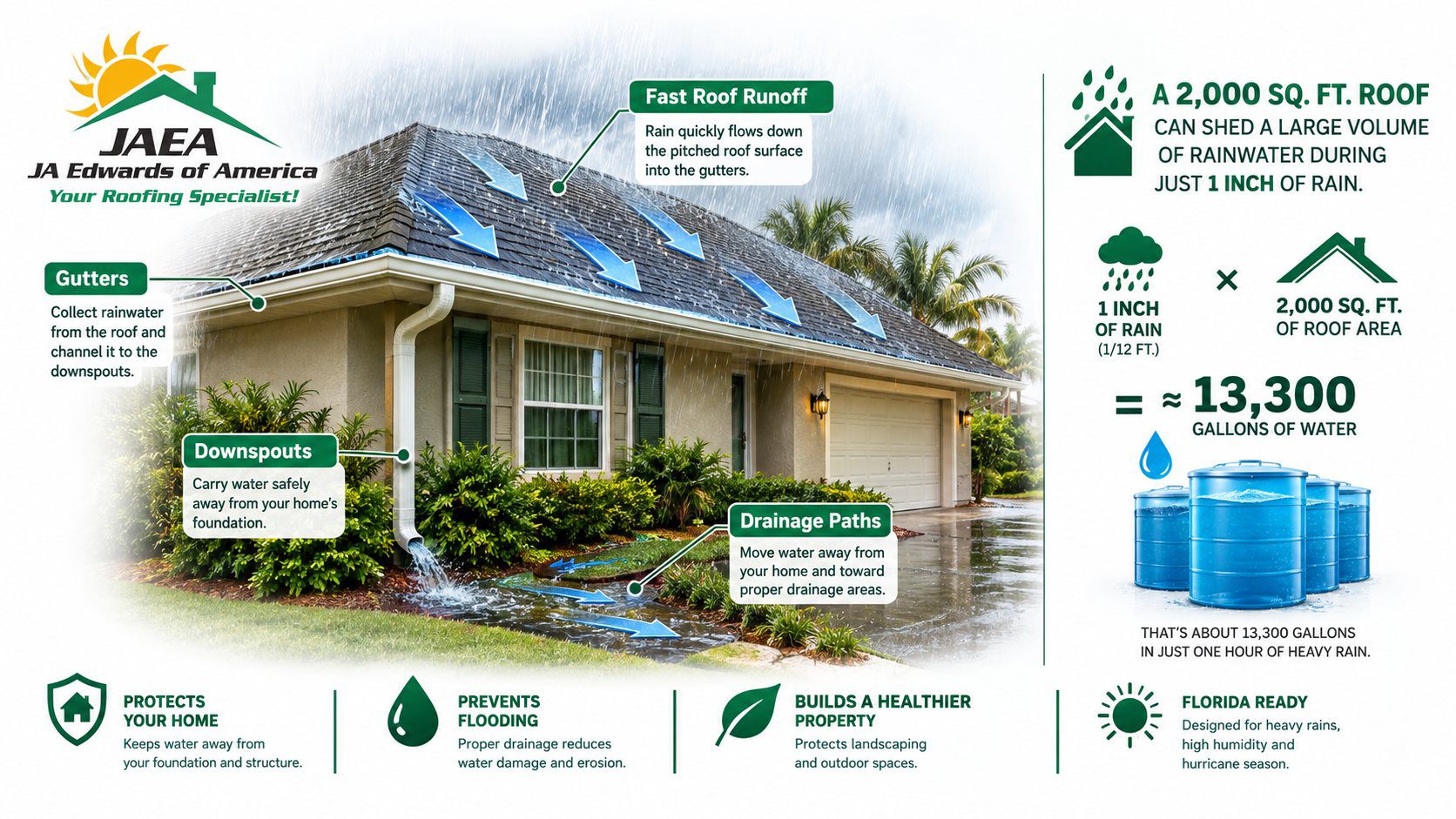
That volume does not move evenly. Valleys, roof edges, scuppers, internal drains and downspouts concentrate flow into smaller areas. A minor restriction that seems harmless when it drizzles can become obvious when the entire drainage system is working near its practical capacity.
Where Roof Drainage Starts to Fail
A leaf cluster in a valley, sagging gutter, partially blocked scupper or disconnected downspout can redirect a large amount of water toward fascia, soffits, walls or low areas. On low-slope roofs, blocked or poorly performing drainage can leave water sitting around seams and penetrations longer than intended.
A roof does not need a dramatic hole to leak. It only needs water to reach a vulnerable detail in enough quantity, or for long enough, to get through the assembly.
For more detail on drainage, see JA Edwards' Florida rain and Orlando roof drainage guide. For low-slope systems, the related Flat Roof Drainage in Florida article can be linked here after that new post is published.
How Wind and Pressure Turn Rain Into Leaks
Gravity is only part of the story. A classic National Research Council Canada building-science explanation describes leakage as requiring three things: water, an opening and a force capable of moving water through that opening. That building-science reference on roof moisture is old, but the underlying physics remains useful.
Wind supplies that force. It can drive rain laterally across the roof surface and toward laps, vents, flashing transitions, fasteners and seams that may see far less water during calm rainfall.
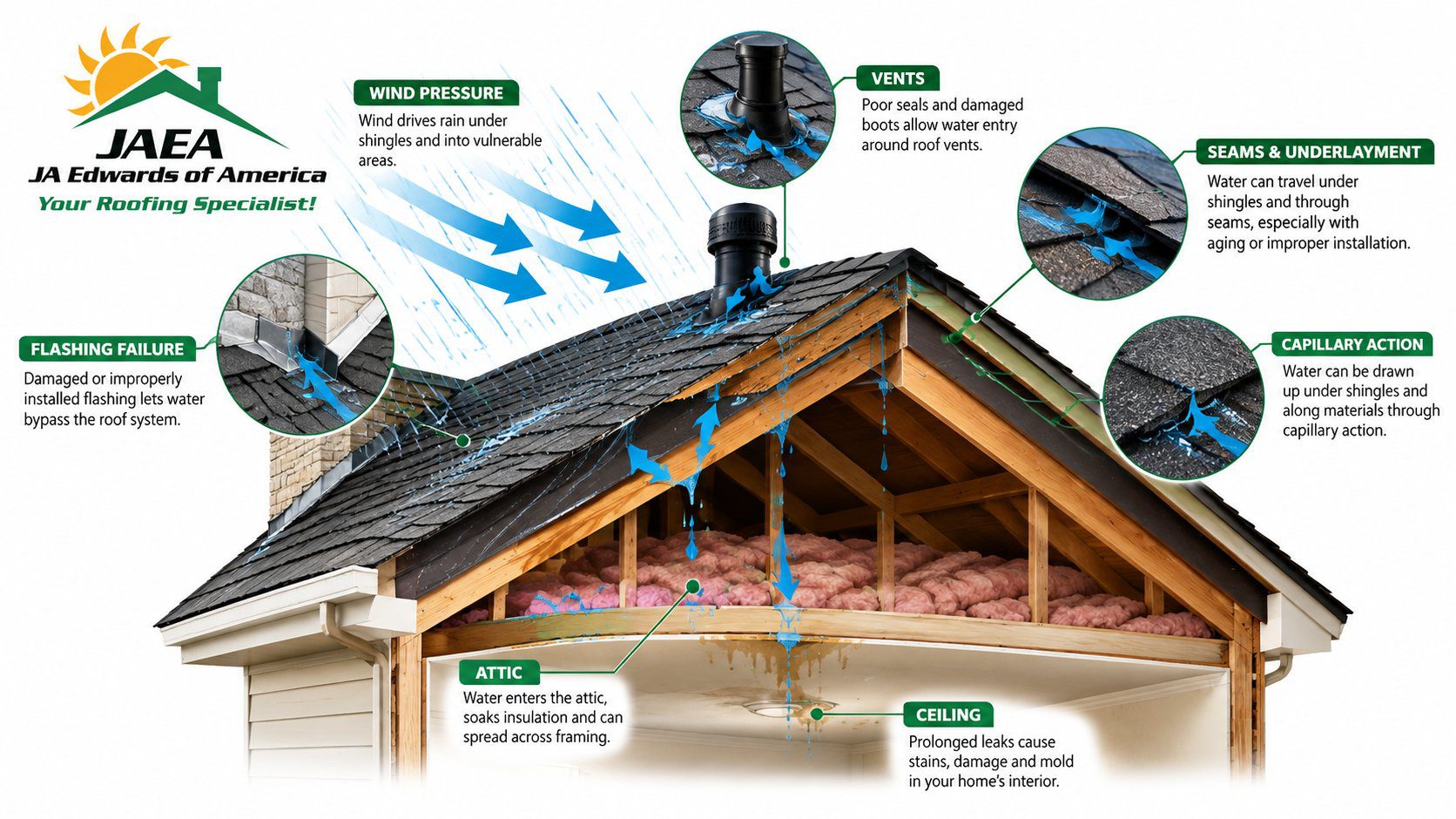
Water can then travel after it enters. Decking, framing and insulation can move the visible symptom away from the actual opening, which is why the ceiling stain is evidence, not a precise map of the leak.
If water is actively coming through a ceiling, protect people and belongings, stay clear of wet electrical fixtures and avoid standing beneath sagging drywall. The Good Boy ceiling-leak action guide remains here as a useful interior-side reference.
What Florida Roofing Code Has to Do With Heavy Rain
The current statewide code as of September 2026 is the Florida Building Code, 8th Edition (2023). Florida roofing requirements address both water management and wind resistance, but the exact test and design requirements depend on the roof covering, product approval, location and whether the project is in the High-Velocity Hurricane Zone.
Important correction from the original draft
The old article linked to the 2020 code and presented a 90 psf tested uplift value as though it applied to every Florida roofing system. It does not. The 90 psf minimum appears in a specific HVHZ TAS 114 Appendix C test protocol for certain approved roofing assemblies. It should not be used as a statewide shortcut for all roofs.
Florida's current test protocols also include wind and wind-driven-rain testing for certain roof and attic-ventilation products. For example, TAS 100(A) covers wind and wind-driven-rain resistance for qualifying ridge-area ventilation systems in the HVHZ. Product-specific approval and installation instructions still control the actual roof system.
The practical homeowner lesson is simpler than the code book: wind resistance, underlayment, flashing and proper product installation matter together. A roof covering that stays attached but allows water through a poorly integrated detail still has a problem.
For the attachment side of the equation, see JA Edwards' Florida wind mitigation inspection guide.
What to Inspect Safely After a Heavy Downpour
Do not climb onto a wet or storm-damaged roof. Shingle, tile, metal and coated surfaces can be slippery, and hidden damage can make an apparently solid area unsafe.

Do not use a garden hose to reproduce a leak when the water path is uncertain. Artificially flooding a detail can send water into electrical, insulation or interior areas and can create a different water path from the original storm.
JA Edwards' roof inspection after a storm guide goes deeper into when visible symptoms justify a professional assessment.
Roofing Materials and the Reality of Rain Noise
Rain noise is not determined by the outer roof covering alone. Decking, underlayment, insulation, attachment, ceiling construction and room acoustics all affect what occupants hear.
McElroy Metal cites research comparing about 46 dBA for rain on asphalt shingles with about 52 dBA for a metal roof over a complete assembly. Their metal roof rain-noise article is useful context, but those numbers should not be treated as a prediction for every building.
| What Changes Rain Noise? | Why It Matters |
|---|---|
| Roof deck and attachment | Mass and stiffness affect vibration and sound transmission. |
| Underlayment and insulation | Layered assemblies can dampen impact energy before it reaches the occupied space. |
| Ceiling cavity | Insulation depth, air space and ceiling construction change the interior result. |
| Rainfall intensity | Larger and faster drops can deliver more impact energy than light rain. |
| Room acoustics | Large hard-surface rooms can make the same roof sound louder than furnished, acoustically damped rooms. |
Research on roof-radiated sound has found that rainfall intensity changes noise output, including the Kobe University rainfall-acoustics study. Other work has evaluated damping coatings and layered roof assemblies, including this Australian Acoustical Society paper and this roof-construction acoustics study.
Fraunhofer also treats rain noise as a measurable performance property of roof constructions under standardized test conditions. Its rain-noise testing program is a useful technical reference.
If a homeowner is choosing materials primarily because of noise concerns, the conversation should focus on the complete assembly, not just “metal versus shingles.” JA Edwards' local pages on metal roofing in Orlando and shingle roofing in Orlando provide broader material context.
Why Professional Inspections Catch Hidden Moisture
A ground-level check can reveal a missing shingle or overflowing gutter. It usually cannot confirm wet underlayment, moisture beneath tile, deteriorated deck material or a flashing detail that only leaks under wind-driven rain.

A professional evaluation can connect roof conditions to interior symptoms. Depending on the building and issue, that may involve photographs, attic observations, moisture readings, inspection of valleys and penetrations, and examination of drainage or storm-damaged areas.
Photo documentation also establishes what was visible at the time of inspection. That can help with maintenance planning and communication after a storm. The roofing contractor can document conditions and prepare a repair or replacement scope, but the insurance carrier decides coverage.
For more detail, read Everything You Need to Know About Roof Inspections or use JA Edwards' roof inspection service.
Preparing the Roof for the Next Downpour
Florida roof maintenance works best when the entire water path is considered. Keep accessible drainage routes clear, address recurring gutter overflow, watch for flashing deterioration and have roof damage investigated before the next stretch of severe weather.
The backlink-exchange resource from Cultivate House Detailing on gutter cleaning before storm season fits naturally here.
Coastal and high-exposure Florida properties can also use JA Edwards' roof maintenance tips for coastal owners in Tampa.
Heavy Rain Does Not Create Every Problem. Sometimes It Reveals One.
A hard storm increases water volume, wind pressure and drainage demand all at once. That makes it very good at finding a weak flashing detail, blocked outlet, loose covering or hidden water path that quieter weather never exposed.
The right response is not to guess from the ceiling stain. Document what happened, keep people safe and trace the water path before deciding what to repair.
Do Not Wait for the Next Hard Rain
If a leak, overflow or attic moisture appeared during the last storm, a documented inspection can identify the likely water path before another downpour tests the same area again.
Schedule a Free Roof InspectionTechnical & External References
Rainwater Harvesting for Drylands and Beyond — illustrative roof runoff coefficients and catchment calculations.
National Research Council Canada / MIT mirror — classic roof-moisture and water-entry principles.
Florida Building Commission — Code Resources — current Florida Building Code and supplements.
2023 FBC HVHZ TAS 114 Appendix C — uplift test protocol and the context for the 90 psf test value.
McElroy Metal — Rain Noise — metal-vs-shingle rain-noise discussion.
Frequently Asked Questions
Why does my roof only leak during heavy rain?
Heavy rain increases the amount of water moving across the roof, while wind can drive water toward vulnerable laps, flashing, vents, valleys and fasteners. A detail that stays dry during light rain can begin leaking when the drainage volume or wind pressure becomes high enough.
How much water can one inch of rain put on a 2,000-square-foot roof?
One inch of rain over a 2,000-square-foot horizontal roof footprint is about 1,247 gallons before losses. Using an illustrative 80 percent collection efficiency produces about 998 gallons of runoff. Actual drainage behavior depends on roof geometry, rainfall intensity, gutters, drains and losses.
Should I climb onto my roof after a Florida storm?
No. Wet roofing can be slippery, and hidden storm damage can make footing unsafe. Start with ground-level photos, windows, safe attic access if appropriate, and a professional inspection when damage or leakage is suspected.
Are metal roofs always much louder than shingles in the rain?
No. The complete roof assembly matters. Decking, underlayment, insulation, ceiling construction and interior acoustics can strongly affect what occupants hear. Published comparisons often show relatively modest differences for complete residential assemblies.
Does a ceiling stain show exactly where the roof is leaking?
Not necessarily. Water can travel along decking, framing, insulation and other materials before appearing indoors. The stain identifies an affected area, but the exterior entry point can be several feet away.
Does storm damage automatically mean insurance will replace my roof?
No. A roofing contractor can document visible conditions and prepare a repair or replacement scope, but the insurance carrier determines coverage under the policy.