
How to Patch a Shingle Roof After a Florida Storm, and When Not To
A ceiling stain after a storm sends most people looking for a missing shingle right above it, and that's often the wrong spot. Here is how to find where the water is really getting in, when a patch is the right call, how a proper shingle repair is done, and when the job belongs to a licensed roofer.
You can patch a shingle roof when the damage is limited to one or a few shingles, the shingles around it are still flexible and attached, and the decking underneath is dry and solid. The repair means lifting the course above, removing the damaged shingle and its nails, sliding in a matching shingle, nailing it to the manufacturer's pattern and sealing the tabs. If the leak path is unclear, the decking is soft, shingles are missing in several places or the roof is wet or steep, stop and call a licensed roofer.
A ceiling stain shows up after a Florida storm, and the first instinct is to look straight above it for a missing shingle. That often sends homeowners to the wrong spot. Wind-driven rain can get in at a roof edge, a valley, a flashing joint, a vent or a nail hole, then run along the underside of the roof deck before it ever reaches the ceiling.
Before you patch anything, stop the water from spreading inside, move furniture and electronics out of the way, and photograph what you can see. A small repair may be the right answer, but only once you know whether the damage is isolated or part of a bigger failure in the shingles, underlayment, flashing or decking.
Find where the leak really starts
After a heavy storm, start inside. Put a container under any active drip, move valuables away from the wet area, and check the attic for wet insulation, darkened roof sheathing, stained rafters or moisture trails. Don't climb onto a wet roof to chase the leak, because wet asphalt shingles are slippery and walking on them can cause more damage.
Water rarely falls in a straight line. It can enter several feet from the ceiling stain, run along the underside of the deck and collect at a rafter before it drips into the room. This Ventura County roof leak guide explains the general problem, and Florida storms make it more urgent because the wind drives rain under lifted tabs and into roof transitions.
A safer storm leak triage
Work through these steps before you think about a permanent patch:
- Control the damage inside. Use buckets, towels and plastic sheeting. Keep water away from electrical fixtures, and only shut off power to the area if you can reach the panel safely.
- Record what you see. Photograph the ceiling, the attic stains, any exterior damage visible from the ground, fallen debris and displaced materials. Note the date and which rooms are affected.
- Get temporary protection if water is coming in. A professional emergency tarp can stop more water from getting in until the roof is repaired. Don't try to rig a cover yourself in rain or high wind.
- Compare inside and outside clues. A stain near a vent, chimney, valley, eave or roof-to-wall joint deserves attention even if the shingles above it look fine.
For more warning signs, see our guide to the top signs of a roof leak in Jacksonville. A missing shingle may be the part you can see, while the actual leak is at a nearby flashing detail or a loosened nail.
After Hurricane Milton, early Florida Office of Insurance Regulation data from the four-county landfall corridor showed that roof-only claims made up more than 60% of dwelling-property losses, according to this 2026 roof damage report. When the roof takes that much of the damage, a post-storm inspection needs to cover the whole roof, not only the spot that looks worst from the yard.
Patch or replace? How to decide
A localized repair makes sense when the rest of the roof is sound. The shingles around the damage should still be flexible and fastened, the decking should be dry and firm, and the problem should sit in one place, like a single damaged shingle, a flashing joint or a vent.
The roof's age changes the math. Asphalt shingles are commonly expected to last about 20 years, though product quality, ventilation, installation, Florida heat and storm exposure all shorten or stretch that. Verisk has reported that about 29% of U.S. homes with asphalt shingle roofs have less than four years of useful roof life left (The State of America's Roofs). On a roof that close to the end, paying for patches can cost more over a couple of years than a roof replacement.
Florida's 25% rule, and the exception that matters
The Florida Building Code has long limited repairs to 25% of a roof or roof section in any 12-month period. Past that point, the whole roof or section had to be brought up to current code, which usually meant a full replacement. In 2022 the Legislature changed that for newer roofs. Under section 553.844 of the Florida Statutes, if the existing roof was built, repaired or replaced to the 2007 Florida Building Code or later, only the part being repaired has to meet current code, even when the work goes past 25%.
Which side of that line your roof falls on depends on when it was installed and permitted, so a contractor should measure the damaged area, look up earlier work and permits, and confirm the local requirements before planning a big patch.
Repair or replacement: what each condition usually points to
| What you see | Likely solution | What it means |
|---|---|---|
| One missing or damaged shingle, with flexible shingles around it | Targeted repair | The damage is probably limited to a replaceable surface piece. |
| Repeated leaks in different parts of the roof | Replacement evaluation | Several entry points usually mean the underlayment, flashing or shingles are failing more broadly. |
| Brittle shingles, exposed underlayment or heavy granule loss | Replacement evaluation | A patch won't give back the life the roof has already lost. |
| Wet, rotten or soft decking | Open it up and replace the damaged wood | New shingles can't fix a base that's wet or structurally damaged. |
| Storm damage near or over 25% of the roof or section | Code review before any work | Depending on the roof's age, the 25% rule can turn a patch into a reroof. |
| An old roof with isolated storm damage | Compare repair cost with replacement | Paying for repeated repairs rarely makes sense when the roof has little life left. |
A repair renews part of an existing roof. A replacement removes the old covering, fixes any damaged decking and installs a new one, and Florida doesn't allow a new covering over an old one that's water-soaked or too deteriorated to hold it. Our guide to roof repair or replacement goes deeper on that choice.
Gathering tools and inspecting the damage safely
The damaged shingle isn't the first thing to come off. First make sure the roof is dry, the weather is stable and you can work without standing on an unsafe slope. A roof with possible structural damage, electrical hazards nearby or widespread storm damage should be left to a licensed contractor.
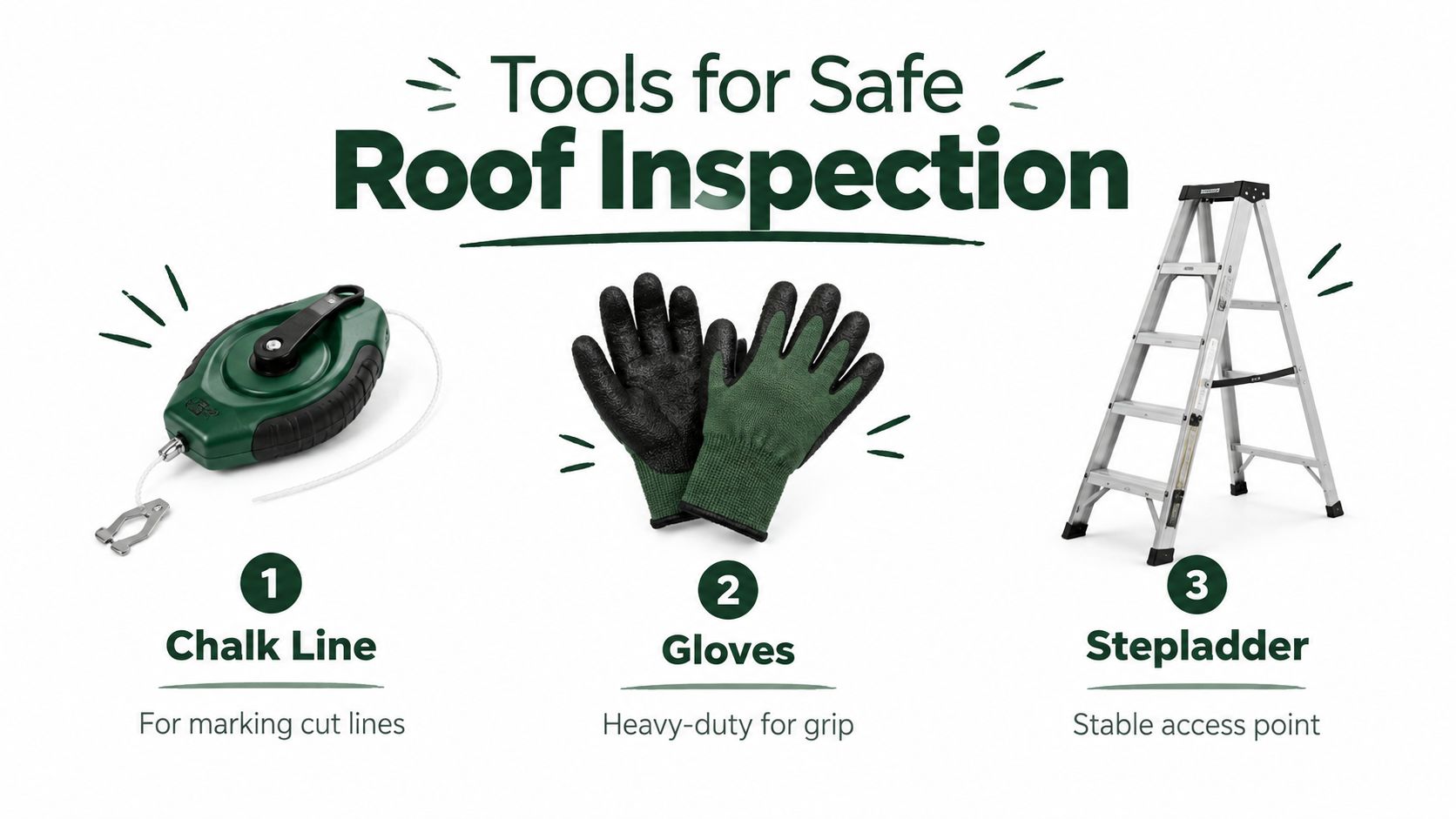
For a small repair you can reach safely, gather materials that match what's already on the roof: a replacement shingle of the same type and size, a flat pry bar, a utility knife, a hammer, a chalk line, gloves, asphalt roofing cement approved for the shingle, and roofing nails that meet the manufacturer's specs. If the underlayment needs repair, use an ASTM-labeled underlayment. Near the coast, corrosion-resistant nails matter even more because salt air eats ordinary fasteners.
Inspect before you pull a single nail
- Start in the attic. Follow moisture marks on the sheathing and rafters. Look for wet insulation, discoloration, mold and a trail that leads toward a valley, vent, edge or nail.
- Check the roof from a safe spot. Look for lifted tabs, missing or creased shingles, exposed underlayment, loose flashing, damaged vent boots and granules in the gutters.
- Look past the obvious damage. Check the neighboring rows, the seal strips, the nail heads, the underlayment laps, the flashing edges and the decking near the suspected entry point.
- Photograph the hidden layers. Before covering anything back up, photograph the decking, underlayment, flashing and nail placement. Those photos help with a warranty review or an insurance claim, though the carrier decides coverage.
- Stop if the roof underneath is compromised. Wet or rotten decking, widespread lifting, several damaged sections or a leak path you still can't find all call for a professional.
Wind is the main threat to Florida shingle roofs, and the state has some of the strictest wind rules in the country. After Hurricane Andrew, South Florida added a tougher shingle test that runs a conditioned shingle assembly at 110 mph, as described in this IIBEC article on shingle damage. Replacing one shingle without checking how the shingles around it are fastened can leave that whole area open to the next strong wind.
A flat bar works well for careful removal, but forcing it can tear the tabs next to it. If you're thinking about removing more than a few shingles, read our guide to taking shingles off a roof first. Don't use a ladder as a work platform, and don't carry bundles onto a roof you can't get onto safely.
How to replace and seal a damaged shingle
Once the inspection confirms the damage is isolated and you have a matching shingle, remove only as much as you need to reach sound rows. Lift the tabs on the row above the damaged shingle, break the adhesive bond with the flat bar, and pull the exposed nails without tearing the shingles that are staying.

Slide out the damaged shingle and clear away old cement, bent nails and debris. Check the decking and underlayment before you install anything. If the wood feels soft or looks deteriorated, stop the shingle repair, because the damaged decking has to be replaced first as part of a properly scoped roof repair.
Fastening and sealing the new shingle
Line up the new shingle with the exposure and the rows on either side. Alignment isn't only about looks, because the new shingle has to sit under the row above and over the row below so water keeps shedding down the roof.
Follow the shingle manufacturer's nailing pattern. Drive each nail through the marked nailing zone, set the head flush without cutting into the shingle, and use the fastener type the manufacturer specifies. Reusing bent nails, or nailing too high or too low, cuts holding power and can damage the shingles around it.
Hand-seal the tabs with compatible asphalt roofing cement when the factory seal strip has been disturbed or won't bond soon. Construction specifications such as these asphalt shingle specifications call for spot-sealing with roofing cement when the temperature is below 50°F, instead of relying on the factory strip alone. Use only the amount and product the shingle maker approves, because extra cement can run across the face and get in the way of drainage.
A shingle that looks the same isn't necessarily compatible. Before you install it, confirm the product, size, wind rating and nailing requirements match what's on the roof.
For contractors choosing pneumatic equipment, Value Tools Co is one source for roofing nailers. The tool doesn't replace the manufacturer's fastening instructions, though. A nailer set too high overdrives the nails, and one set too low leaves them sticking up so the shingle can't lie flat.
Minor scuffs and small tears should only be fixed with methods the manufacturer approves, and badly damaged shingles should be replaced, not covered. For more on installation, see our explanation of how to shingle a roof.
Would you rather not go up there?
We'll find where the water is actually getting in, show you photos, and tell you whether a repair will hold or the roof needs more. Florida licensed CCC1334804, GAF Master Elite.
When a DIY patch becomes a hazard
Spotting a missing shingle from the ground doesn't mean the roof is safe to climb or the repair is simple. Florida roofs get dangerous after rain, and heat, humidity, steep slopes and sudden weather changes add to the risk. A roof that looks dry from the driveway can still have slick algae, loose granules or unstable shingles underfoot.
Stop and call a professional if any of these apply:
- The roof is steep, wet or hard to reach. A fall can cause serious injury, and a ladder on unstable ground is its own hazard.
- There's electrical equipment nearby. Service masts and power lines need distance. Never deal with a possible electrical hazard from the roof.
- The decking feels soft. Patching over wet or rotten wood hides the problem and leaves the new shingle with nothing solid to hold.
- Several shingles are lifted or missing. Wind can loosen the shingles around them without causing a leak right away.
- Granule loss is widespread. Losing that much of the protective surface means the roof needs more than one new shingle.
- You still don't know where the leak is. A patch in the wrong spot won't stop water coming in at a valley, vent, flashing edge or nail.
- You can't confirm the replacement shingle matches. Matching color doesn't confirm the wind rating, size or compatibility.
Poor installation and broken seals are common causes of wind damage. FEMA's guidance for sloped roofs recommends ASTM-rated shingles that meet local wind requirements, ASTM-labeled underlayment rated for the area, drip edge at the eaves above the underlayment, and nails driven in the manufacturer's nailing zone, with ring-shank nails for wood (FEMA P-2181 sloped roof fact sheet).
A patch becomes unsafe when it hides a bigger failure, even if the new shingle itself was installed correctly. Document the storm damage before cleanup removes the evidence, but keep people safe first. If water is near electrical fixtures, the attic has structural damage, or the roof was hit in several places, keep everyone off the roof and get a professional inspection.
Checking the repair and keeping records
A finished patch needs more than a new shingle that looks straight from the yard. Check that the tabs are seated, the sealant is compatible and in the right place, the nails are flush without cutting the shingle, and the rows around it are still secure. Running a hose over the area can help confirm a leak has stopped, but never spray water near an electrical hazard or use it as a substitute for a safe inspection.
What your repair records should include
- Dated photos of the original damage, the opened layers, the decking, underlayment and flashing, and the finished repair.
- Material details for the replacement shingle, underlayment, nails and sealant.
- Area measurements compared with any earlier repairs on the same roof section.
- Storm notes with the date, visible wind or debris damage, affected rooms and any temporary protection used.
- The contractor's paperwork, including the scope of work and any permit or final inspection documents.
A licensed roofing contractor can define the repair scope, document storm damage and share that information with your insurance company. That help doesn't guarantee coverage, and a roofer isn't a public adjuster. For background on how roofing contractors themselves are insured, see this guide to insurance for roofing contractors.
A photo-documented professional roof inspection is especially useful when the shingle damage you can see doesn't explain the leak inside. It should answer one question clearly: can the roof be repaired safely and within code limits, or does the storm damage call for a bigger replacement plan?
JA Edwards of America handles roof inspections, shingle repairs, storm damage documentation, emergency leak protection and full replacements for homes and commercial buildings across Florida. If wind-driven rain left you with a leak, schedule a free roof inspection and we'll give you a clear answer on repair versus replacement, with photos of everything we find.
Patching a shingle roof: frequently asked questions
Can I patch a shingle roof myself?
Why is my ceiling leaking when no shingles are missing above it?
What is Florida's 25% roof rule?
How long does a shingle patch last?
Should I patch or replace an old shingle roof after a storm?
Find the real leak
Tell us where the property is and what you're seeing. The office nearest you calls back with a real inspection time.